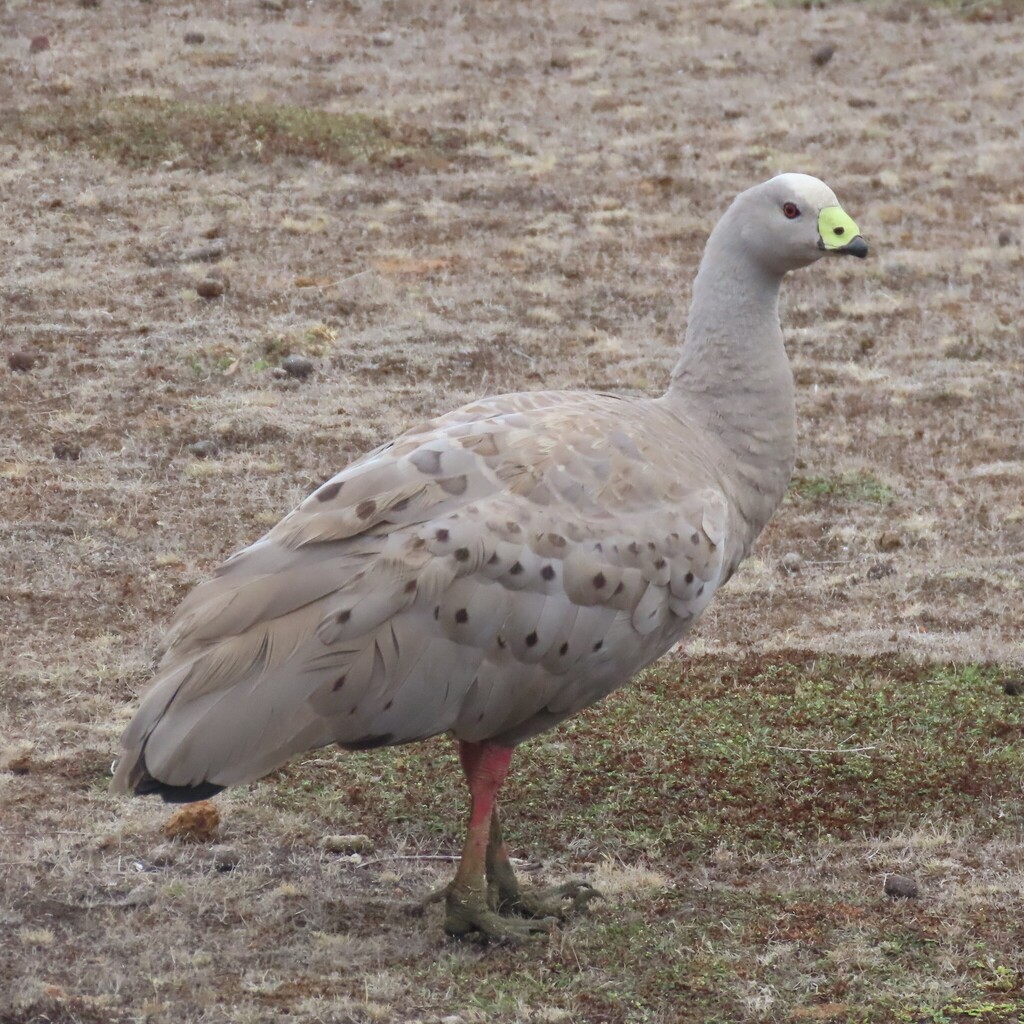
Cape Barren Goose
Photo © pimelea
Photo © pimelea — CC BY 4.0 — Source: iNaturalist #281474482Identification
The Cape Barren goose is a large, distinctive waterfowl measuring 75–100 cm in length and weighing 3.7–5.2 kg, with males generally larger than females. Its plumage is predominantly pale grey with a slight brown tint, and the relatively small head features a pale whitish patch on the forehead and crown. The most distinctive feature is its short, triangular black bill adorned with a prominent pale yellow-green cere covering more than half its length. The upperwing coverts and scapular feathers display brownish-grey spots, while flight feathers are grey with black tips that create a dark trailing edge visible in flight. The tail feathers are black, and the legs are characteristically pink with black feet.
Goslings are recognizable by their white down marked with broad dark stripes and a dark cere. Older juveniles appear paler grey with heavier spotting on wings and scapular feathers than adults. The cere gradually transitions to light yellow-green at around 70 days old, and young birds molt into full adult plumage at approximately six months of age.
Range & Habitat
The Cape Barren goose is endemic to southern Australia, with two recognized subspecies occupying distinct regions. The nominate subspecies inhabits south-eastern Australia, including southern Victoria, eastern South Australia, Tasmania, and Bass Strait islands, while the subspecies grisea is found in south-western Australia around the Recherche Archipelago and adjacent mainland coast of Western Australia. The species favours grassy islands off the Australian coast, where it nests on the ground in breeding areas.
A notable population decline in the 19th century has been reversed, particularly in eastern populations that have adapted to feeding on agricultural land. The species' ability to drink salt and brackish water allows it to remain on offshore islands year-round. Attempts to introduce Cape Barren geese to New Zealand between 1869 and 1874 were largely unsuccessful, though a small breeding population persisted at Lake Hāwea and Lake Wānaka from 1914–15 until 1946, and a few birds near Christchurch continue to survive.
Behaviour & Diet
Despite belonging to the waterfowl family, Cape Barren geese are predominantly terrestrial, only occasionally swimming. They graze extensively on grasses, sedges, legumes, herbs, and succulents, including species such as Poa poiformis, Disphyma australe, and various Trifolium species. Males produce distinctive rapid, high-pitched honking calls, particularly during takeoff or in flight, while both sexes emit low, pig-like grunting sounds and hisses when alarmed—a characteristic that inspired their alternative name "pig goose." Goslings produce whistling distress calls.
Cape Barren geese are monogamous and typically mate for life. Following mating, pairs perform a striking "triumph ceremony" in which they raise and lower their heads while facing each other and calling loudly. Pairs establish territories in autumn with breeding occurring in winter. Nesting may occur singly or in loose colonies, with males constructing shallow hollows lined with vegetation and down among tussock grass, rocks, or bushes, which females further line with down. Females typically lay four to five creamy white eggs incubated over 34–37 days, during which females may lose up to 20% of their body weight. Both parents care for young after hatching.
Best Time & Places to See It
Winter is the prime season to observe Cape Barren geese, as this is their breeding period when pairs establish territories and are most vocal and visible. The species is best found on grassy islands off the Australian coast, particularly in the Bass Strait region and around offshore islands in south-eastern and south-western Australia. Birdwatchers should focus on areas where the geese have adapted to agricultural land, particularly in eastern populations, as these birds are now more accessible than in previous centuries.
Photography Tips
The Cape Barren goose's pale grey plumage and distinctive yellow-green cere make it highly photogenic. To capture the characteristic dark trailing edge of the wings, photograph birds in flight during takeoff or landing. The striking "triumph ceremony" provides excellent opportunities for behavioral photography—look for pairs raising and lowering their heads in synchronized displays. The bird's terrestrial nature means ground-level shooting angles often work well. Early morning light highlights the subtle brown tinting and feather margins of the plumage, while the contrast between the pale body and black tail feathers is most striking in clear conditions. Patience near nesting colonies in winter will reward photographers with images of family groups and parental care behavior.
Cleland National Park
Australia
+127 birds+14 mammals
Eucalypt woodlands rise and fall across Adelaide's nearby hills, where Cleland National Park sprawls across some twenty square kilometres of native South Australian bushland. The terrain…
VIEW NATIONAL PARKLincoln National Park
Australia
+149 birds+5 mammals
Across the mid-north of South Australia, where the landscape transitions from coastal lowlands toward semi-arid interior plains, sprawls a wilderness of 2,671 square kilometres where red-earth…
VIEW NATIONAL PARKCoffin Bay National Park
Australia
+143 birds+5 mammals
Across South Australia's Eyre Peninsula, where limestone headlands rise above turquoise shallows and eucalypt woodland gives way to coastal heath, lies a 1,319-square-kilometre sanctuary shaped by…
VIEW NATIONAL PARKInnes National Park
Barcelona, Australia
+141 birds+10 mammals
Granite ridges and weathered stone outcrops rise across South Australia's Fleurieu Peninsula, defining a landscape where ancient rock formations meet open eucalypt woodland and heathland scrub.…
VIEW NATIONAL PARKFlinders Chase National Park
Australia
+142 birds+14 mammals
Granite ridges and windswept mallee scrubland define this 1,630-square-kilometre expanse on Kangaroo Island, where ancient rock formations rise abruptly from coastal heathland and woodland mosaics. The…
VIEW NATIONAL PARKWilsons Promontory National Park
Australia
+210 birds+21 mammals
Where granite headlands plunge toward Bass Strait, Wilson's Promontory National Park sprawls across nearly 1,300 square kilometers of southeastern Victoria's most rugged coastal wilderness. The park's…
VIEW NATIONAL PARKGreat Otway National Park
Australia
+255 birds+42 mammals
Temperate rainforest and wet eucalyptus woodland cloak the ridges and gullies of Victoria's Great Otway National Park, where persistent moisture and mild year-round temperatures sustain a…
VIEW NATIONAL PARKCoorong National Park
Australia
+217 birds+15 mammals
Where the Murray River meets the Southern Ocean, a chain of shallow lagoons stretches across the South Australian coast, separated from the sea by a ribbon…
VIEW NATIONAL PARKFreycinet National Park
Coles Bay, Australia
+115 birds+9 mammals
Granite peaks rise abruptly from the Tasmanian coast where Coles Bay opens into the Freycinet Peninsula, sculpting one of southeastern Australia's most dramatically vertical national parks.…
VIEW NATIONAL PARKNo community photos yet. Log in to add the first one.
No community observations of this species yet.