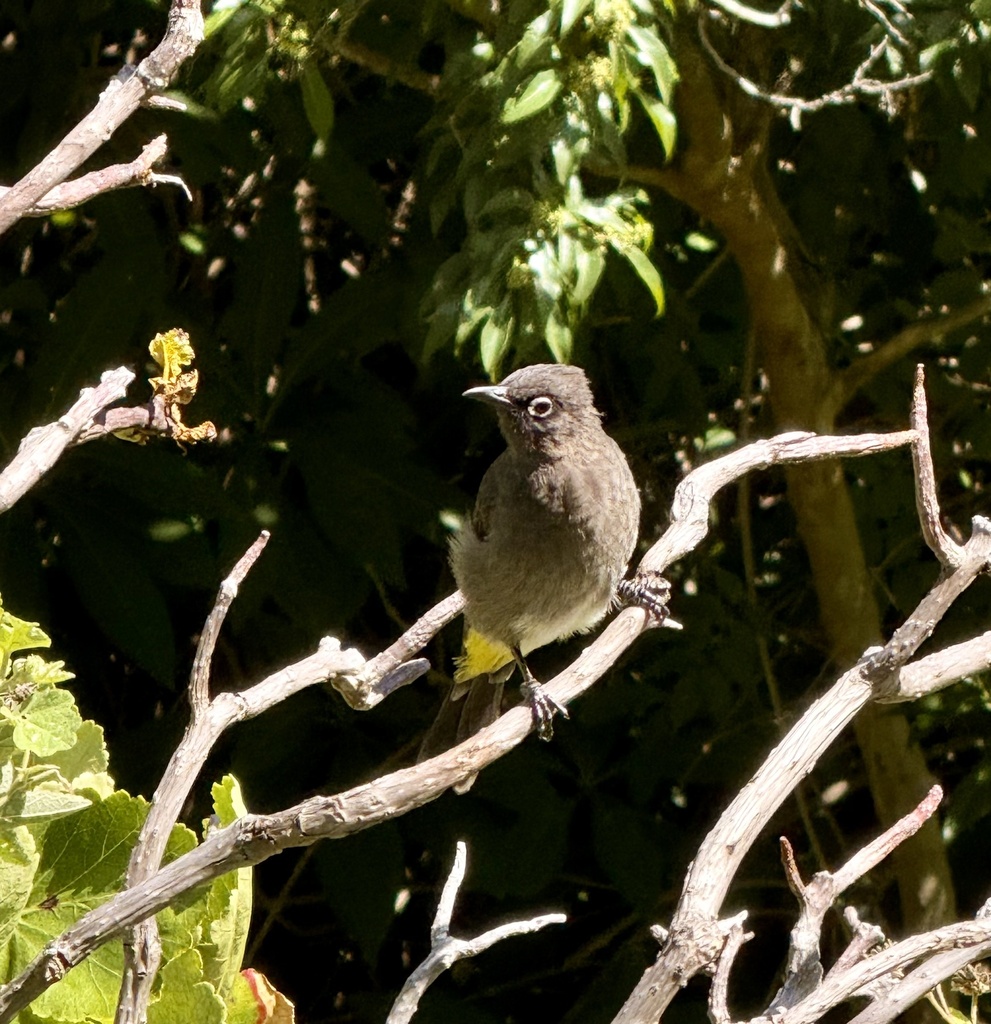
Cape Bulbul
Photo © AllyP
Photo © AllyP — CC0 1.0 — Source: iNaturalist #336467731Identification
The Cape bulbul is a medium-sized passerine measuring 19–21 cm in length. It is instantly recognizable by its dull blackish-brown plumage combined with a distinctive white eye-ring and bright yellow undertail coverts. The head bears a small crest, and the bird has a short, straight black bill with black legs and feet. The iris is dark brown. Males and females are similar in appearance, though juveniles lack the prominent eye-ring and display a darker brown belly, which aids field identification. This species is noticeably darker than other South African bulbuls, setting it apart from congeners that typically show paler underparts.
Range & Habitat
The Cape bulbul is endemic to South Africa, occurring as a resident breeder in coastal regions and the interior of western and southern areas. It favours coastal bush, open forest, fynbos vegetation, and gardens, adapting readily to human-modified landscapes. The species is well-established throughout its range and remains common across suitable habitat.
Behaviour & Diet
Active and conspicuous, the Cape bulbul is typically seen in pairs or small groups and frequently perches prominently atop bushes, making it highly visible to observers. It is a noisy bird with a characteristic liquid whistle comprising two or more varied notes, often described as pit-peet-pitmajol or piet-piet-patata. The species forages for fruit, nectar, and insects, moving energetically through vegetation. Breeding occurs during the southern spring, from September to November, with pairs constructing thick-walled cup nests concealed within the foliage of small trees or shrubs. In parts of its range, the Cape bulbul falls victim to parasitism by the Jacobin cuckoo.
Best Time & Places to See It
The breeding season from September to November offers excellent opportunities to observe this species, as pairs are particularly active and vocal during nest construction and rearing. Year-round residents mean the Cape bulbul can be encountered throughout the year in suitable habitat. Gardens and coastal bush areas are especially reliable locations for sightings, and the bird's habit of perching openly on bushes makes it comparatively easy to locate and observe.
Photography Tips
The Cape bulbul's preference for exposed perches at the tops of bushes makes photography relatively straightforward. The diagnostic white eye-ring and yellow undertail coverts are key fieldmarks to capture, along with the small crest. Early morning light enhances the contrast between the dark plumage and pale eye-ring. The bird's active, noisy behaviour means patient observers positioned near suitable habitat will be rewarded with multiple photo opportunities as birds move through vegetation and call from exposed vantage points.
Garden Route National Park
George, South Africa
+353 birds+54 mammals
Sweeping across the Western Cape's coastal and mountainous terrain, this sprawling national park encompasses over five thousand square kilometers of extraordinarily diverse landscape—from coastal limestone cliffs…
VIEW NATIONAL PARKCederberg Wilderness Area
Cederberg Local Municipality, South Africa
+136 birds+12 mammals
Where ancient sandstone ridges rise dramatically from the semi-arid lowlands of Western Cape, the Cederberg Wilderness Area spreads across nearly 1,700 square kilometres of some of…
VIEW NATIONAL PARKAgulhas National Park
Cape Agulhas Local Municipality, South Africa
+224 birds+13 mammals
Where the Atlantic and Indian Oceans meet at Africa's southernmost tip, Agulhas National Park stretches across 892 square kilometres of windswept coastal landscape and rugged limestone…
VIEW NATIONAL PARKTankwa-Karoo National Park
Hantam Local Municipality, South Africa
+201 birds+20 mammals
Across the semi-arid heartland of the Northern Cape, where winter rains carve ephemeral watercourses through endless ochre plains, Tankwa-Karoo National Park sprawls across more than 3,100…
VIEW NATIONAL PARKMountain Zebra National Park
Inxuba Yethemba Local Municipality, South Africa
+265 birds+35 mammals
Across the windswept plateaus and deeply incised valleys of the Eastern Cape's interior, Mountain Zebra National Park unfolds as a landscape of geological drama and ecological…
VIEW NATIONAL PARKBontebok National Park
Swellendam Local Municipality, South Africa
+204 birds+11 mammals
Where the Cape Fold Mountains give way to coastal lowlands, a landscape of rolling sandstone hills and fynbos heathland creates one of South Africa's most compact…
VIEW NATIONAL PARKAugrabies Falls National Park
Kai !Garib Local Municipality, South Africa
+176 birds+20 mammals
Where the Orange River cuts a dramatic scar through the Northern Cape's arid interior, Augrabies Falls National Park sprawls across nearly 1,200 square kilometers of raw,…
VIEW NATIONAL PARKAddo Elephant National Park
Sundays River Valley Local Municipality, South Africa
+388 birds+55 mammals
Where the Eastern Cape's semi-arid scrublands meet transitional woodland, Addo sprawls across 13,478 square kilometres of one of southern Africa's most biodiverse landscapes. The terrain rises…
VIEW NATIONAL PARKCamdeboo National Park
Camdeboo Local Municipality, South Africa
+272 birds+24 mammals
Granite ridges and weathered sandstone cliffs rise across a semi-arid landscape where the Karoo transitions into the eastern escarpment of South Africa, creating Camdeboo National Park's…
VIEW NATIONAL PARKNo community photos yet. Log in to add the first one.
No community observations of this species yet.