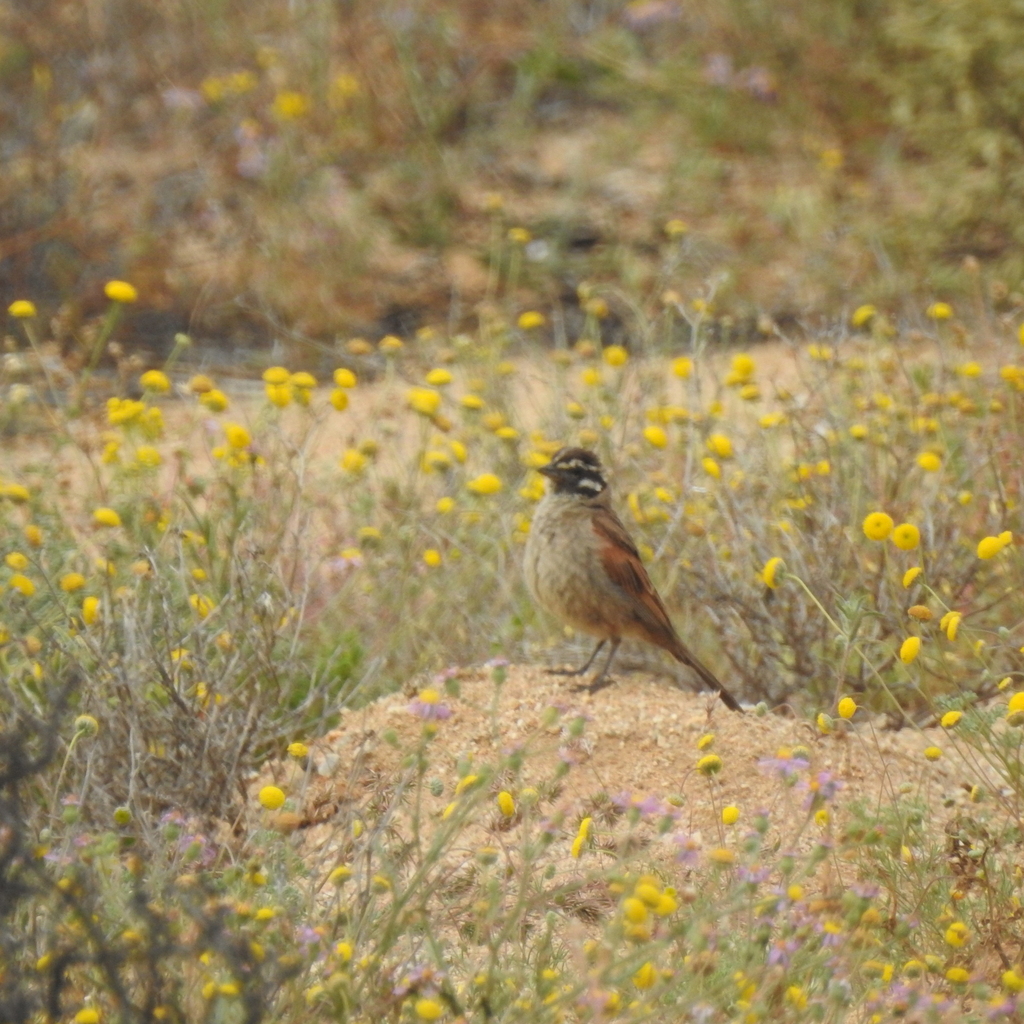
Cape Bunting
Photo © Noeleen du Toit
Photo © Noeleen du Toit — CC BY-SA 4.0 — Source: iNaturalist #187997074Identification
The Cape bunting is a small passerine measuring 16 cm in length, easily recognized by its distinctive head pattern. Adults display a black crown contrasting sharply with a white supercilium and black-bordered white ear coverts. The upperparts are grey-brown with dark streaks, while the wing coverts are a striking chestnut colour. The tail is darker chestnut, and the underparts are grey with a pale throat. The sexes are very similar, though females may show a buff tone to the white head markings, making them slightly less contrasted than males.
Young birds are duller overall, with less vibrant chestnut wings, a less distinct head pattern, and heavier streaking that extends across the breast and flanks. The species gives an ascending call of zzoo-zeh-zee-zee, while its loud, distinctive song is a rapid chirping pattern: chup chup chup chup chee chhep chu. The subspecies E. c. vincenti has a simpler song rendered as tre-re-ret tre-re-ret.
Range & Habitat
The Cape bunting is endemic to southern Africa, occurring from south-western Angola, eastern Zambia, Zimbabwe and southern Tanzania southward to the Cape. Eleven recognized subspecies display subtle plumage variations across this range, all sharing the distinctive head pattern and rufous wing coloration. The north-eastern race, E. c. vincenti, is notably darker above and slaty below, and has sometimes been considered a separate species.
This species favours rocky slopes and dry weedy scrub, with mountain habitats particularly important in the northern parts of its range. Historically, it also utilized stony arid areas with short grass, though much of this habitat has been lost to agricultural ploughing.
Behaviour & Diet
The Cape bunting is not gregarious and is typically observed alone, in pairs, or in small family groups. It is primarily terrestrial, foraging on the ground for seeds, insects and spiders. The species constructs a lined cup nest positioned low in a shrub or tussock, a typical bunting nesting strategy that provides shelter while remaining accessible for ground-feeding parents.
The breeding output consists of two to four eggs, which are cream-coloured and marked with red-brown and lilac spots. This modest clutch size is consistent with other bunting species in the region.
Best Time & Places to See It
The Cape bunting is most readily observed in rocky, mountainous terrain throughout southern Africa, particularly in the drier interior regions. The species' preference for rocky slopes and scrubland makes it a characteristic bird of the region's upland habitats. Given its non-gregarious nature, patience and careful observation are rewarded with sightings of individual birds or small family parties.
Photography Tips
Photographers should focus on capturing the bird's striking head pattern, which is the key identifying feature. The contrast between the black crown, white supercilium and ear coverts, and the chestnut wing coverts makes for compelling compositional opportunities. Ground-level or low-angle shots will be most effective, as this species forages and nests low to the ground. Early morning light will enhance the subtle grey-brown tones of the upperparts and the warm chestnut of the wings and tail.
Mapungubwe National Park
Musina Local Municipality, South Africa
+358 birds+29 mammals
Where the Limpopo River cuts through sandstone ridges at the convergence of South Africa, Botswana, and Zimbabwe, Mapungubwe National Park preserves a landscape of profound ecological…
VIEW NATIONAL PARKGarden Route National Park
George, South Africa
+353 birds+54 mammals
Sweeping across the Western Cape's coastal and mountainous terrain, this sprawling national park encompasses over five thousand square kilometers of extraordinarily diverse landscape—from coastal limestone cliffs…
VIEW NATIONAL PARKPilanesberg National Park
Moses Kotane Local Municipality, South Africa
+364 birds+49 mammals
Granite peaks and volcanic ridges rise unexpectedly from the savanna floor across this 734-square-kilometre expanse in the North West province, creating a landscape of profound ecological…
VIEW NATIONAL PARKMokala National Park
Siyancuma Local Municipality, South Africa
+246 birds+35 mammals
Across the semi-arid savanna of the Northern Cape, where red earth meets sparse acacia woodland and open grassland punctuated by rocky outcrops, lies a landscape shaped…
VIEW NATIONAL PARKCederberg Wilderness Area
Cederberg Local Municipality, South Africa
+136 birds+12 mammals
Where ancient sandstone ridges rise dramatically from the semi-arid lowlands of Western Cape, the Cederberg Wilderness Area spreads across nearly 1,700 square kilometres of some of…
VIEW NATIONAL PARKKruger National Park
Ba-Phalaborwa Local Municipality, South Africa
+540 birds+91 mammals
Across the low-lying savanna of northeastern South Africa unfolds one of Africa's largest and most ecologically intact protected areas, where acacia woodlands merge into mopane scrub…
VIEW NATIONAL PARKAgulhas National Park
Cape Agulhas Local Municipality, South Africa
+224 birds+13 mammals
Where the Atlantic and Indian Oceans meet at Africa's southernmost tip, Agulhas National Park stretches across 892 square kilometres of windswept coastal landscape and rugged limestone…
VIEW NATIONAL PARKSehlabathebe National Park
South Africa
+60 birds+1 mammals
Where the Drakensberg escarpment rises to meet the sky, Sehlabathebe National Park unfolds across a landscape of dramatic basalt cliffs, rolling alpine grassland, and crystal-clear mountain…
VIEW NATIONAL PARKTankwa-Karoo National Park
Hantam Local Municipality, South Africa
+201 birds+20 mammals
Across the semi-arid heartland of the Northern Cape, where winter rains carve ephemeral watercourses through endless ochre plains, Tankwa-Karoo National Park sprawls across more than 3,100…
VIEW NATIONAL PARKBontebok National Park
Swellendam Local Municipality, South Africa
+204 birds+11 mammals
Where the Cape Fold Mountains give way to coastal lowlands, a landscape of rolling sandstone hills and fynbos heathland creates one of South Africa's most compact…
VIEW NATIONAL PARKAugrabies Falls National Park
Kai !Garib Local Municipality, South Africa
+176 birds+20 mammals
Where the Orange River cuts a dramatic scar through the Northern Cape's arid interior, Augrabies Falls National Park sprawls across nearly 1,200 square kilometers of raw,…
VIEW NATIONAL PARKIthala Game Reserve
uPhongolo Local Municipality, South Africa
+328 birds+26 mammals
Rolling thornbush savanna and acacia woodland dominate the landscape of this 494-square-kilometre national park in KwaZulu-Natal's uPhongolo Local Municipality, where granite outcrops punctuate grassland plateaus and…
VIEW NATIONAL PARKMarakele National Park
Modimolle Local Municipality, South Africa
+341 birds+36 mammals
Granite ridges and sprawling grasslands dominate this 1,176-square-kilometre reserve in Limpopo's heartland, where bushveld transitions between rocky outcrops and open savanna. The park's rugged topography creates…
VIEW NATIONAL PARKCamdeboo National Park
Camdeboo Local Municipality, South Africa
+272 birds+24 mammals
Granite ridges and weathered sandstone cliffs rise across a semi-arid landscape where the Karoo transitions into the eastern escarpment of South Africa, creating Camdeboo National Park's…
VIEW NATIONAL PARKSperrgebiet National Park
Barcelona, Namibia
+181 birds+18 mammals
Where the Namib's ancient gravel plains meet the Atlantic coast, one of Africa's most remote and geologically austere landscapes unfolds across more than 56,000 square kilometres.…
VIEW NATIONAL PARKDorob National Park
Henties Bay, Namibia
+230 birds+13 mammals
Where the Skeleton Coast meets the Namib Desert's inland reaches, Dorob National Park sprawls across 34,021 square kilometres of one of southern Africa's most austere and…
VIEW NATIONAL PARKSkeleton Coast Park
Barcelona, Namibia
+143 birds+7 mammals
Where the Atlantic's cold Benguela Current collides with one of Africa's most hostile coastlines, the Skeleton Coast Park sprawls across more than 104,000 square kilometres of…
VIEW OBSERVATION POINTNamib-Naukluft National Park
Namibia
+217 birds+33 mammals
Across nearly 94,000 square kilometers of southwestern Namibia, a landscape of extremes unfolds where towering sand dunes meet rugged mountain ranges, and ancient riverbeds carve through…
VIEW NATIONAL PARKEtosha National Park
Namibia
+356 birds+58 mammals
Across northern Namibia's stark semi-arid plateau, a vast shallow depression transforms seasonally into one of Africa's most dramatic wildlife theaters. Etosha National Park, encompassing more than…
VIEW NATIONAL PARKWaterberg Plateau National Park
Okambukonde, Namibia
+198 birds+27 mammals
Where ancient sandstone cliffs rise 200 metres above the surrounding bushveld, a fortress of geology creates one of southern Africa's most compelling ecosystems. The plateau's steep…
VIEW NATIONAL PARKNo community photos yet. Log in to add the first one.
No community observations of this species yet.