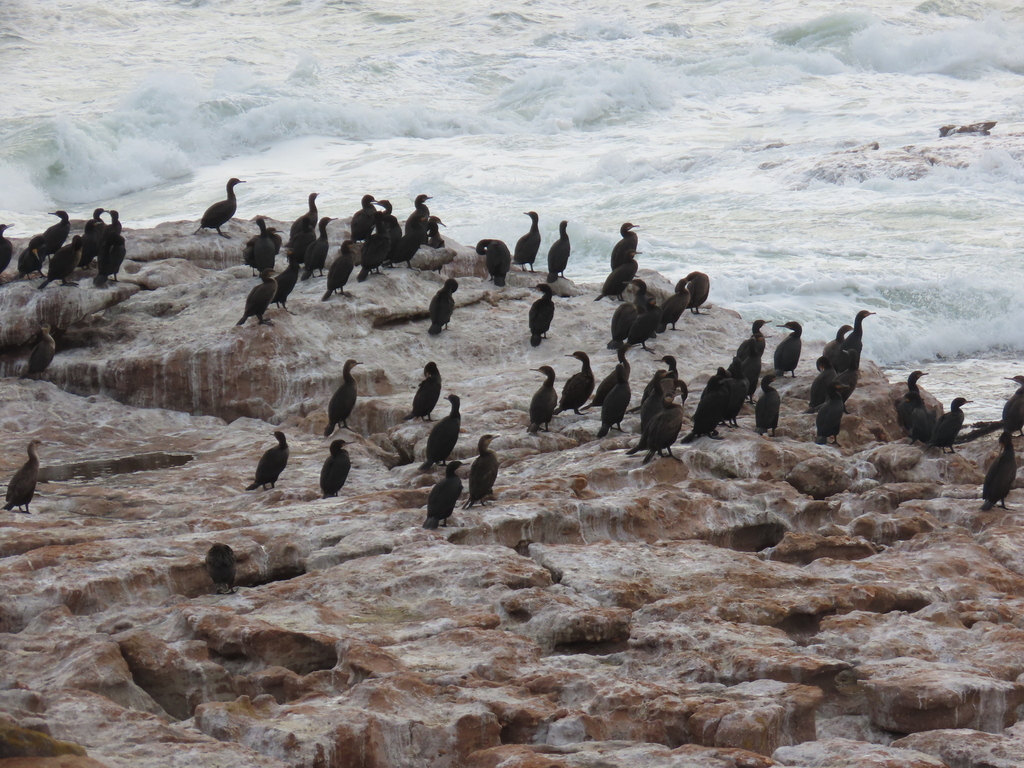
Cape Cormorant
Photo © Adele SL
Photo © Adele SL — CC BY 4.0 — Source: iNaturalist #240113405Identification
The Cape cormorant is a striking blue-black bird with a glossy sheen covering its entire body. Adults measure 61–64 cm in length and weigh 1.1–1.3 kg, with males and females showing little to no sexual dimorphism. The most distinctive features are the deep yellow-orange gular pouch beneath the beak and the turquoise eyes encircled by a greenish eye-ring. Breeding adults display particularly vibrant plumage, with wings showing a distinctive bottle-green coloration. The beak is dark grey-black.
Non-breeding and immature birds appear duller than breeding adults. Immature cormorants have a brown throat, while juveniles are overall browner with grey eyes and a black, white, or speckled gular pouch. With a wingspan around 260 mm, the Cape cormorant is a relatively compact cormorant, distinguishable from larger relatives by its size and brilliant eye color.
Range & Habitat
The Cape cormorant is endemic to the southwestern coast of Africa and classified as "Endangered" by the IUCN. Its non-breeding range extends from Lobito, Angola, to Maputo Bay, Mozambique, while the smaller breeding range spans from Southern Angola to the Eastern Cape province of South Africa. The species stays close to the Benguela Upwelling System, an area of exceptional food availability. Namibia alone supports around 57,000 breeding pairs, though overfishing has recently caused shifts in prey distribution southward and eastward, contributing to population decline.
Cape cormorants nest in colonies in remote, predator-safe areas including coastal islands, rocks, cliffs, and ledges. They benefit from man-made guano platforms off the Namibian coast, which serve as permanent roosting and nesting sites. Large beaches also provide important roosting habitat, reducing predation risk. The species inhabits coastal marine waters, lagoons, and other marine environments within their range.
Behaviour & Diet
Cape cormorants are highly social birds that commonly forage in flocks, diving to depths between 5 and 150 meters in search of food. They are foot-propelled divers with daily foraging sessions lasting approximately 5.5 hours, with individual dives typically lasting 10 to 70 seconds. Their diet consists primarily of pelagic schooling fish, particularly anchovies, pilchards, and mackerel. They are one of the main pelagic fish predators in South African waters, alongside Cape gannets and African penguins.
Breeding occurs in dense colonies from August to May, peaking between October and February. Cape cormorants are monogamous, with clutches averaging three eggs. Males initiate courtship through repeated, low-pitched clucks, to which females respond with "gra-gra-gra" vocalizations. Both parents care for eggs, maintaining a "pecking distance" between nests. Vocalization is primarily used during breeding season and varies with context—flight, courtship, maintenance, feeding, and threat detection—with chicks producing distinct calls for hatching, food requests, and threats.
Best Time & Places to See It
The breeding season, particularly October to February, offers the best viewing opportunities as birds congregate in large, active colonies. Namibia, with its 57,000 breeding pairs, provides excellent chances for observation. The species' dependence on the Benguela Upwelling System means coastal areas from Southern Angola through to the Eastern Cape province of South Africa are prime locations. Man-made guano platforms off the Namibian coast attract large numbers of roosting birds and offer accessible viewing points.
Look for Cape cormorants in coastal marine waters, particularly where they forage within 20 kilometers of their breeding colonies. Large beach areas where they roost communally are also reliable locations. Early morning hours when foraging activity peaks would maximize your chances of encountering these active predators.
Photography Tips
The Cape cormorant's brilliant turquoise eyes and deep yellow-orange gular pouch are signature features that reward close-up photography. The blue-black glossy plumage creates striking contrasts in different light conditions; photograph breeding adults during peak season when their bottle-green wing coloration is most vibrant. Colonial breeding sites offer opportunities for wide-angle shots capturing the density and activity of these gathered birds.
Early morning light at roosting beaches and on offshore guano platforms will best capture the sheen of their distinctive plumage. Patience at breeding colonies during October to February will yield images of courtship behaviors, territorial disputes over nesting sites, and parental care. Photographing diving sequences requires anticipation, as these skilled hunters can remain submerged for up to 70 seconds; focus on the water's edge where birds emerge after dives.
Garden Route National Park
George, South Africa
+353 birds+54 mammals
Sweeping across the Western Cape's coastal and mountainous terrain, this sprawling national park encompasses over five thousand square kilometers of extraordinarily diverse landscape—from coastal limestone cliffs…
VIEW NATIONAL PARKAgulhas National Park
Cape Agulhas Local Municipality, South Africa
+224 birds+13 mammals
Where the Atlantic and Indian Oceans meet at Africa's southernmost tip, Agulhas National Park stretches across 892 square kilometres of windswept coastal landscape and rugged limestone…
VIEW NATIONAL PARKAddo Elephant National Park
Sundays River Valley Local Municipality, South Africa
+388 birds+55 mammals
Where the Eastern Cape's semi-arid scrublands meet transitional woodland, Addo sprawls across 13,478 square kilometres of one of southern Africa's most biodiverse landscapes. The terrain rises…
VIEW NATIONAL PARKSperrgebiet National Park
Barcelona, Namibia
+181 birds+18 mammals
Where the Namib's ancient gravel plains meet the Atlantic coast, one of Africa's most remote and geologically austere landscapes unfolds across more than 56,000 square kilometres.…
VIEW NATIONAL PARKDorob National Park
Henties Bay, Namibia
+230 birds+13 mammals
Where the Skeleton Coast meets the Namib Desert's inland reaches, Dorob National Park sprawls across 34,021 square kilometres of one of southern Africa's most austere and…
VIEW NATIONAL PARKSkeleton Coast Park
Barcelona, Namibia
+143 birds+7 mammals
Where the Atlantic's cold Benguela Current collides with one of Africa's most hostile coastlines, the Skeleton Coast Park sprawls across more than 104,000 square kilometres of…
VIEW OBSERVATION POINTNamib-Naukluft National Park
Namibia
+217 birds+33 mammals
Across nearly 94,000 square kilometers of southwestern Namibia, a landscape of extremes unfolds where towering sand dunes meet rugged mountain ranges, and ancient riverbeds carve through…
VIEW NATIONAL PARKNo community photos yet. Log in to add the first one.
No community observations of this species yet.