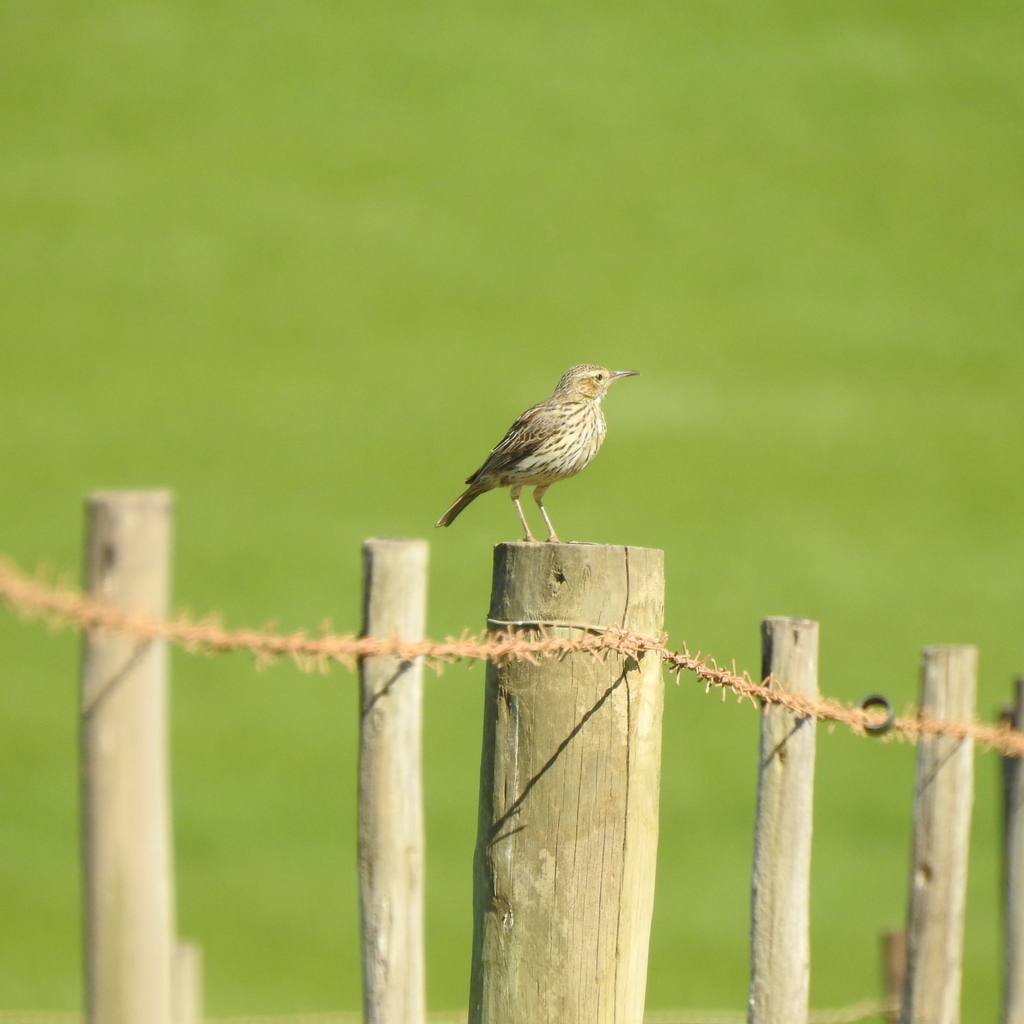
Cape Long-billed Lark
Photo © Noeleen du Toit
Photo © Noeleen du Toit — CC BY-SA 4.0 — Source: iNaturalist #178813086The Cape long-billed lark (Certhilauda curvirostris), also known as the Cape lark, Cape longbill or long-billed lark is a species of lark in the family Alaudidae. It is found in south-western Africa. Its natural habitats are semi-arid Karoo shrub and subtropical dry shrubland and subtropical or dry lowland and highveld grassland. This lark is also found in croplands, farmlands and coastal fynbos. == Taxonomy == The Cape long-billed lark was formally described in 1783 by the French naturalist Johann Hermann under the binomial name Alauda curvirostris. The specific epithet combines the Latin curvus meaning "curved" or "bent" with -rostris meaning "-billed", from rostrum meaning "beak". Hermann based his account of "Le Sirli" from the Cape of Good Hope area of South Africa that had been described in 1778 by the French polymath, the Comte de Buffon in his book Histoire Naturelle des Oiseaux. An engraving by François-Nicolas Martinet was published to accompany Buffon's account. The Cape long-billed lark is now one of five larks placed in the genus Certhilauda that was introduced in 1827 by the English zoologist William Swainson. Three subspecies are recognised: C. c. falcirostris Reichenow, 1916 – southwest Namibia to west South Africa C. c. curvirostris (Hermann…
Agulhas National Park
Cape Agulhas Local Municipality, South Africa
+224 birds+13 mammals
Where the Atlantic and Indian Oceans meet at Africa's southernmost tip, Agulhas National Park stretches across 892 square kilometres of windswept coastal landscape and rugged limestone…
VIEW NATIONAL PARKBontebok National Park
Swellendam Local Municipality, South Africa
+204 birds+11 mammals
Where the Cape Fold Mountains give way to coastal lowlands, a landscape of rolling sandstone hills and fynbos heathland creates one of South Africa's most compact…
VIEW NATIONAL PARKNo community photos yet. Log in to add the first one.
No community observations of this species yet.