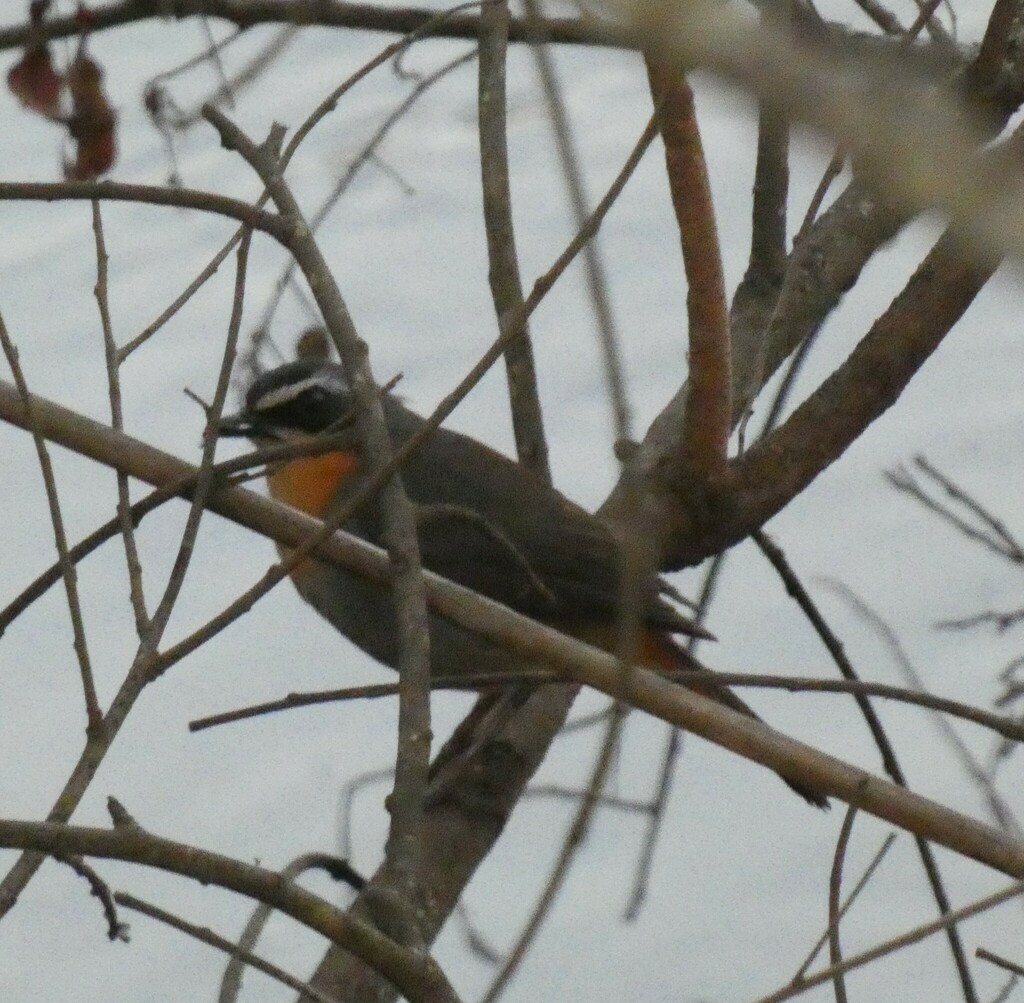
Cape Robin-Chat
Photo © agujaceratops
Photo © agujaceratops — CC BY 4.0 — Source: iNaturalist #134950899Identification
The Cape robin-chat is a small passerine measuring 16–17 cm long and weighing 28 g. Adults of both sexes are similar in appearance, featuring grey upper parts with a brownish-olive tinge on the mantle and secondary feathers. The most distinctive feature is a prominent white supercilium (eyebrow stripe) that separates the blackish lores and ear coverts from the crown. The chin, throat, central breast, rump, and outer tail feathers are bright orange, which deepens to a richer hue during the non-breeding season. The belly is pale grey to white with buffy undertail coverts. The bird sports a fairly straight, short black bill with a slightly downward curve, black legs and feet, and brown eyes. Juveniles lack the white supercilium and are dark brown above and buff below, with distinctive yellow soles on their feet—unique among robin-chats. Immatures resemble adults but retain some buff-tipped greater wing coverts.
Range & Habitat
This species has a disjunct range spanning from South Sudan southwards through Uganda, the Democratic Republic of Congo, Kenya, Tanzania, Zambia, Malawi, Zimbabwe, Namibia, South Africa, Eswatini, and Lesotho. The Cape robin-chat is a mainly resident breeder in eastern and southern Africa, though some populations migrate more than 100 km to lower, warmer regions during winter, while others remain year-round residents even at high altitudes. It has successfully colonized man-altered habitats including city suburbs and farmstead woodlots. The bird frequents bracken-briar fringes of Afromontane forest and prefers drier settings or higher altitudes rather than entering deep forest. Its altitudinal range varies by region: in Zimbabwe it occurs between 1,400 m and 2,200 m, while south of the Limpopo it utilizes habitats from sea level to 3,000 m.
Behaviour & Diet
The Cape robin-chat is an accomplished songster with a clear, ringing song delivered in short phrases, sometimes by competing males simultaneously. The song consists of passages of 4 to 10 whistled syllables beginning with a low, slurred whistle followed by improvised notes, rendered as "cherooo-weet-weet-weeeet" followed by a pause. Singing peaks at dawn and dusk, typically from within but near the top of trees or bushes, and may continue uninterrupted for an hour or more, sometimes extending into darkness. Males cease singing during post-breeding moult, and females sing equally well in the absence of their mates. The species has a distinctive harsh, low, trisyllabic alarm call rendered as "WA-dur-dra" or "TURR-da-da," which has given rise to local names such as "Jan frederik." The bird forages in proximity to cover in open or fairly well-lit environments. Like other robin-chats, it may mimic other bird species; one individual was recorded mimicking a total of 36 bird species. Anxious birds utter a plaintive, descending peeeeeuu note when threatened.
Best Time & Places to See It
The Cape robin-chat is a locally familiar and confiding species that benefits from its association with man-altered habitats, making it accessible to travellers in suburban and farmstead settings across its range. The bird is particularly common in montane regions; in Malawi it is common above 1,500 m, and similar elevations favour sightings elsewhere. Being a mainly resident breeder, the species is present year-round throughout much of its range, though winter visitors from higher altitudes may appear in lower, warmer regions. Early morning and dusk are the best times to encounter singing birds, as singing peaks during these periods. A five-year tenure of breeding territories by the same pair is commonplace, suggesting that productive locations can be revisited reliably across multiple seasons.
Photography Tips
The Cape robin-chat's confiding nature and preference for fairly well-lit, open environments near cover make it a rewarding subject for photographers. Position yourself near bracken-briar fringes or farmstead woodlots where the bird forages, and look for individuals perching in trees or bushes during singing periods at dawn and dusk. The white supercilium and orange underparts provide strong contrast against the grey upper parts, making the bird visually distinctive in photographs. Since the bird sings from within but near the top of trees and bushes, photography from a low angle looking upward can be effective. The species' relatively small size (16–17 cm) means that a telephoto lens will be advantageous for obtaining detailed shots while maintaining a respectful distance.
Serengeti National Park
Tanzania
+558 birds+57 mammals
Across Tanzania's northern plateau, where volcanic soils meet acacia woodland and open grassland, unfolds one of Earth's most dynamic ecosystems. The Serengeti National Park sprawls across…
VIEW NATIONAL PARKVirunga National Park
Uganda
+418 birds+13 mammals
Where the Western Rift Valley fractures the landscape of North Kivu, Virunga National Park sprawls across terrain as geologically dramatic as it is ecologically vital. Volcanic…
VIEW NATIONAL PARKBwindi Impenetrable National Park
Kanyashogi, Uganda
+603 birds+26 mammals
Steep ridges cloaked in montane forest rise from Uganda's southwestern borderlands, where the landscape grows so dense and tangled that early explorers named it impenetrable. At…
VIEW NATIONAL PARKVolcanoes National Park
Musanze District, Uganda
+152 birds+6 mammals
Where volcanic cones rise sharply above the montane forests of northern Uganda, Volcanoes National Park protects one of East Africa's most dramatic high-altitude ecosystems. The park's…
VIEW NATIONAL PARKKidepo Valley National Park
Uganda
+478 birds+24 mammals
Where the Narus and Kidepo rivers carve through northeastern Uganda's semi-arid lowlands, a landscape of sparse acacia woodland, grassland, and riverine thickets creates one of East…
VIEW NATIONAL PARKMgahinga Gorilla National Park
Cyanika, Uganda
+429 birds+6 mammals
Where the Virunga Mountains rise steeply from the Uganda–Rwanda–Democratic Republic of Congo frontier, montane forest cloaks the volcanic slopes in a dense, moisture-laden embrace. Mgahinga Gorilla…
VIEW NATIONAL PARKLake Mburo National Park
Uganda
+505 birds+24 mammals
Rolling acacia woodland and scattered lakes define this intimate savanna preserve in southwestern Uganda, where the rift valley's geological drama shapes every water source and grassland.…
VIEW NATIONAL PARKMount Elgon National Park
Matumbei ward, Kenya
+164 birds+7 mammals
Where the volcanic slopes of Mount Elgon rise above the Trans-Nzoia landscape, a montane wilderness unfolds across multiple ecological zones, each harbouring distinct communities adapted to…
VIEW NATIONAL PARKAmboseli National Park
Etonet/Lenkism ward, Kenya
+501 birds+43 mammals
Where the Amboseli basin opens toward the Tanzanian frontier, a shallow alkaline lake mirrors vast skies across one of East Africa's most iconic savanna landscapes. The…
VIEW NATIONAL PARKKilimanjaro National Park
Kenya
+207 birds+16 mammals
Africa's highest mountain rises not in isolation but as the centerpiece of a vast national park that sweeps across the borderlands of northern Tanzania, where savanna…
VIEW NATIONAL PARKMount-Kenya National Park
Abothuguchi west ward, Kenya
+334 birds+11 mammals
Where the slopes of Kenya's second-highest mountain rise steeply from the Meru County foothills, a landscape of profound ecological richness unfolds across Mount Kenya National Park.…
VIEW NATIONAL PARKTarangire National Park
Tanzania
+527 birds+50 mammals
Acacia woodland and grassland sweep across the Manyara Region where the Tarangire River carves through low hills and volcanic soils, creating one of East Africa's most…
VIEW NATIONAL PARKKitulo National Park
Tanzania
+59 birds+1 mammals
Where the southern highlands of Tanzania rise above two thousand metres, rolling grasslands and montane meadows create a landscape rarely encountered in East Africa—a sweeping plateau…
VIEW NATIONAL PARKNgorongoro Conservation Area
Tanzania
+626 birds+55 mammals
Volcanic calderas and open grassland dominate this high plateau in northern Tanzania, where the landscape rises above 2,000 metres and ancient geological forces have shaped both…
VIEW WILDLIFE MANAGEMENT AREAQueen Elizabeth National Park
Uganda
+672 birds+30 mammals
Across the southwestern escarpment of Uganda, where the Western Rift Valley descends through ancient volcanic terrain, Queen Elizabeth National Park sprawls across more than 8,300 square…
VIEW NATIONAL PARKGarden Route National Park
George, South Africa
+353 birds+54 mammals
Sweeping across the Western Cape's coastal and mountainous terrain, this sprawling national park encompasses over five thousand square kilometers of extraordinarily diverse landscape—from coastal limestone cliffs…
VIEW NATIONAL PARKPilanesberg National Park
Moses Kotane Local Municipality, South Africa
+364 birds+49 mammals
Granite peaks and volcanic ridges rise unexpectedly from the savanna floor across this 734-square-kilometre expanse in the North West province, creating a landscape of profound ecological…
VIEW NATIONAL PARKCederberg Wilderness Area
Cederberg Local Municipality, South Africa
+136 birds+12 mammals
Where ancient sandstone ridges rise dramatically from the semi-arid lowlands of Western Cape, the Cederberg Wilderness Area spreads across nearly 1,700 square kilometres of some of…
VIEW NATIONAL PARKKruger National Park
Ba-Phalaborwa Local Municipality, South Africa
+540 birds+91 mammals
Across the low-lying savanna of northeastern South Africa unfolds one of Africa's largest and most ecologically intact protected areas, where acacia woodlands merge into mopane scrub…
VIEW NATIONAL PARKAgulhas National Park
Cape Agulhas Local Municipality, South Africa
+224 birds+13 mammals
Where the Atlantic and Indian Oceans meet at Africa's southernmost tip, Agulhas National Park stretches across 892 square kilometres of windswept coastal landscape and rugged limestone…
VIEW NATIONAL PARKTankwa-Karoo National Park
Hantam Local Municipality, South Africa
+201 birds+20 mammals
Across the semi-arid heartland of the Northern Cape, where winter rains carve ephemeral watercourses through endless ochre plains, Tankwa-Karoo National Park sprawls across more than 3,100…
VIEW NATIONAL PARKMountain Zebra National Park
Inxuba Yethemba Local Municipality, South Africa
+265 birds+35 mammals
Across the windswept plateaus and deeply incised valleys of the Eastern Cape's interior, Mountain Zebra National Park unfolds as a landscape of geological drama and ecological…
VIEW NATIONAL PARKBontebok National Park
Swellendam Local Municipality, South Africa
+204 birds+11 mammals
Where the Cape Fold Mountains give way to coastal lowlands, a landscape of rolling sandstone hills and fynbos heathland creates one of South Africa's most compact…
VIEW NATIONAL PARKAugrabies Falls National Park
Kai !Garib Local Municipality, South Africa
+176 birds+20 mammals
Where the Orange River cuts a dramatic scar through the Northern Cape's arid interior, Augrabies Falls National Park sprawls across nearly 1,200 square kilometers of raw,…
VIEW NATIONAL PARKAddo Elephant National Park
Sundays River Valley Local Municipality, South Africa
+388 birds+55 mammals
Where the Eastern Cape's semi-arid scrublands meet transitional woodland, Addo sprawls across 13,478 square kilometres of one of southern Africa's most biodiverse landscapes. The terrain rises…
VIEW NATIONAL PARKIthala Game Reserve
uPhongolo Local Municipality, South Africa
+328 birds+26 mammals
Rolling thornbush savanna and acacia woodland dominate the landscape of this 494-square-kilometre national park in KwaZulu-Natal's uPhongolo Local Municipality, where granite outcrops punctuate grassland plateaus and…
VIEW NATIONAL PARKMarakele National Park
Modimolle Local Municipality, South Africa
+341 birds+36 mammals
Granite ridges and sprawling grasslands dominate this 1,176-square-kilometre reserve in Limpopo's heartland, where bushveld transitions between rocky outcrops and open savanna. The park's rugged topography creates…
VIEW NATIONAL PARKCamdeboo National Park
Camdeboo Local Municipality, South Africa
+272 birds+24 mammals
Granite ridges and weathered sandstone cliffs rise across a semi-arid landscape where the Karoo transitions into the eastern escarpment of South Africa, creating Camdeboo National Park's…
VIEW NATIONAL PARKNairobi National Park
Nairobi, Kenya
+515 birds+35 mammals
Just minutes from Kenya's capital, where the Nairobi River winds through acacia woodland and open grassland, lies one of Africa's most paradoxical wildlife sanctuaries. The park's…
VIEW NATIONAL PARKLake Nakuru National Park
Nakuru West, Kenya
+494 birds+32 mammals
Alkaline waters ringed by acacia woodland and grassland create one of East Africa's most distinctive wetland ecosystems, where the interplay of geology and climate sustains a…
VIEW NATIONAL PARKAberdare National Park
Mweiga ward, Kenya
+394 birds+30 mammals
Where the central highlands of Kenya rise to their elemental grandeur, the Aberdare range unfolds across Nyeri County as a montane stronghold of cool, misty forest…
VIEW NATIONAL PARKHell’s Gate National Park
Olkaria ward, Kenya
+388 birds+18 mammals
Volcanic scarps and geothermal vents dominate the floor of Hell's Gate, where the East African Rift has carved a dramatic gorge through crystalline rock formations. The…
VIEW NATIONAL PARKSaiwa Swamp National Park
Sinyerere ward, Kenya
+255 birds+4 mammals
Where papyrus and sedge marshes stretch across a highland plateau in western Kenya, Saiwa Swamp National Park shelters one of East Africa's most productive freshwater wetland…
VIEW NATIONAL PARKOl Donyo Sabuk National Park
Matungulu North ward, Kenya
+200 birds
Granite peaks rise abruptly from the highland plateau of Matungulu North, their weathered slopes clothed in scattered woodland and montane grassland that shifts between verdant and…
VIEW NATIONAL PARKNo community photos yet. Log in to add the first one.
No community observations of this species yet.