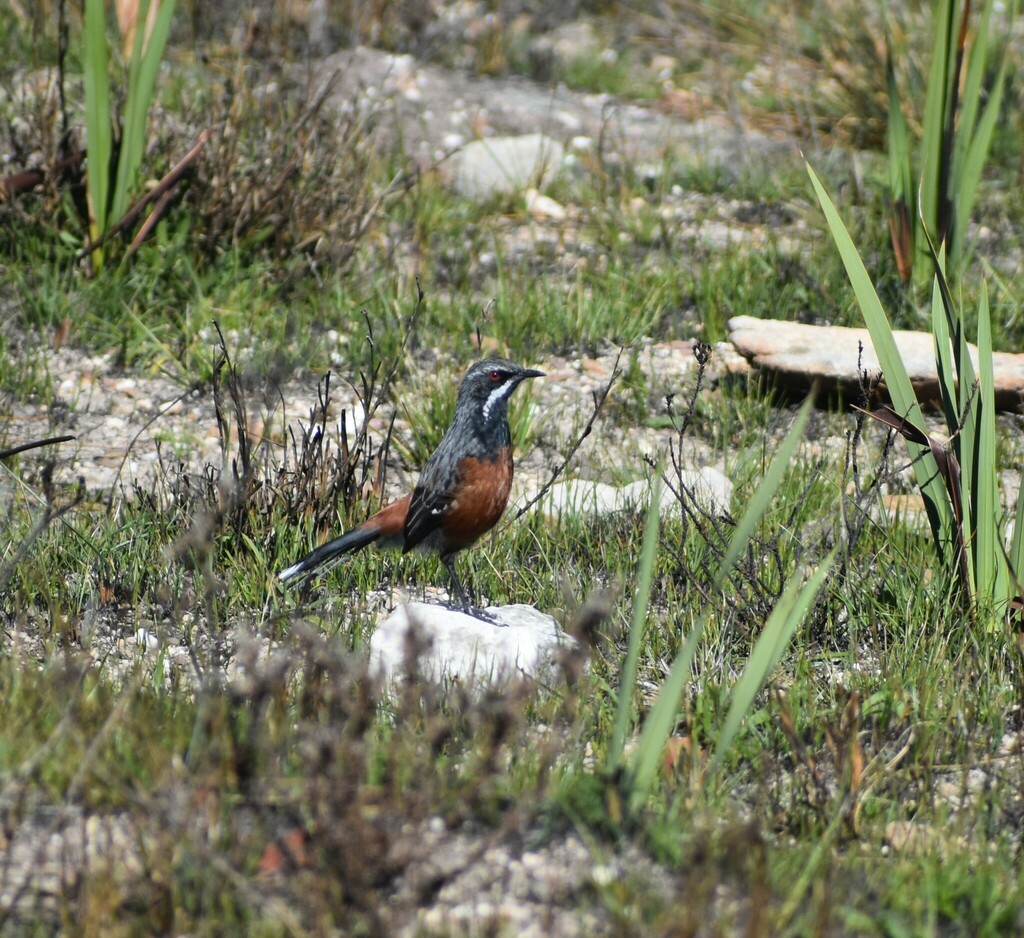
Cape Rockjumper
Photo © Justin Ponder
Photo © Justin Ponder — CC BY 4.0 — Source: iNaturalist #165158380The Cape rockjumper or rufous rockjumper (Chaetops frenatus) is a medium-sized insectivorous passerine bird endemic to the mountain Fynbos of southernmost South Africa. == Taxonomy == The Cape and Drakensberg rockjumpers were split into separate species in the 1980s. The Latin epithet frenatus refers to the "bridled" or black-and-white head pattern. When the Drakensberg rockjumper was split it was given the Latin aurantius meaning 'orange'. Initial taxonomy placed rockjumpers in the thrush family Turdidae in 1867. They were then moved to the babblers Timaliidae in the 1980s, before genetic work in the 1990s placed them in their own family Chaetopidae. See the main page on the rockjumper for more details. Some authorities (notably Dickinson and Christidis) treat the two rockjumpers as a single species, Chaetops frenatus, with two subspecies. However, for most field guides and birders, and according to the International Ornithologists' Union and The Clements Checklist of Birds of the World, they are two species. == Climate sensitivity == Cape rockjumpers exist only in Alpine Fynbos, a specialized habitat of 90,000 ha from Cape Town to Port Elizabeth in South Africa. These birds are alpine habitat specialists, and so used to a very specific range of temperatures. Cape rockjumper…
Garden Route National Park
George, South Africa
+353 birds+54 mammals
Sweeping across the Western Cape's coastal and mountainous terrain, this sprawling national park encompasses over five thousand square kilometers of extraordinarily diverse landscape—from coastal limestone cliffs…
VIEW NATIONAL PARKCederberg Wilderness Area
Cederberg Local Municipality, South Africa
+136 birds+12 mammals
Where ancient sandstone ridges rise dramatically from the semi-arid lowlands of Western Cape, the Cederberg Wilderness Area spreads across nearly 1,700 square kilometres of some of…
VIEW NATIONAL PARKNo community photos yet. Log in to add the first one.
No community observations of this species yet.