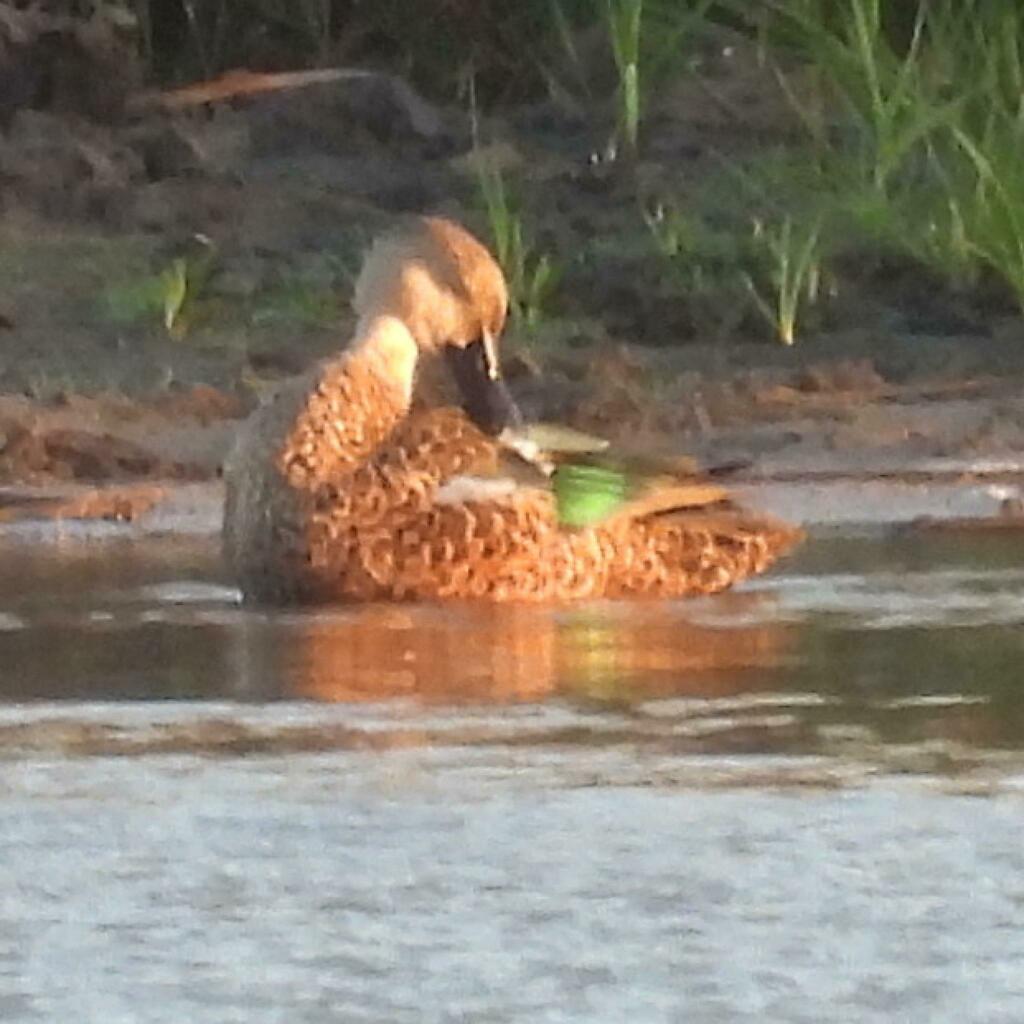
Cape Shoveler
Photo © Henry de Lange
Photo © Henry de Lange — CC BY 4.0 — Source: iNaturalist #258456010Identification
The Cape Shoveler is a medium-sized dabbling duck measuring 51–53 cm in length, immediately recognizable by its distinctive large spatulate (spoon-shaped) bill. Both sexes display speckled grey-brown plumage and dull orange legs, though males and females differ in subtle but useful ways for field identification. Males feature a noticeably paler head than females, pale blue forewings separated from the green speculum by a white border, and striking yellow eyes. Females have grey forewings instead. Cape Shovelers can only be confused with vagrant female Northern Shovelers, but are considerably darker and stockier than that species, making positive identification straightforward in their southern African range.
Range & Habitat
This species is resident in South Africa, with populations becoming increasingly uncommon further north in Namibia, Botswana, Zimbabwe, southern Angola, Lesotho, Mozambique, and Zambia. The Cape Shoveler is non-migratory but undertakes local seasonal movements in response to water availability and breeding opportunities. It inhabits open wetlands such as wet grasslands and marshes that feature some emergent vegetation, preferring habitats that provide both feeding and nesting opportunities.
Behaviour & Diet
Cape Shovelers are gregarious birds outside the breeding season, often forming large flocks at suitable wetlands. They feed primarily by dabbling, using their specialized bill to strain plant material from the water—a technique they perform by characteristically swinging their bill from side to side through shallow water. During the nesting season, their diet expands to include molluscs and insects, supplementing their usual plant-based diet. Nesting birds construct shallow depressions on the ground, typically located close to water, and line these nests with plant material and down.
Best Time & Places to See It
The Cape Shoveler is resident year-round throughout its range, though local seasonal movements may affect concentrations at particular wetlands. Being gregarious outside breeding season, they are often most conspicuous when gathered in flocks at larger wetland systems. South Africa represents the most reliable location for sightings, with populations becoming progressively less common northward through the species' range. Visiting during the non-breeding season may offer the best opportunities to observe larger flocks.
Photography Tips
The species' preference for open wetlands and gregarious nature outside breeding season make it relatively accessible for photography. The males' distinctive pale heads, yellow eyes, and blue and green wing markings provide excellent visual subjects, particularly in good light. Capture the characteristic feeding behaviour by positioning yourself to photograph the birds' distinctive side-to-side bill-swinging motion as they dabble in shallow water. Early morning light often enhances the subtle plumage details and the striking eye color of males.
Chobe National Park
Botswana
+446 birds+45 mammals
Where the Chobe River cuts a sinuous path through northern Botswana, the landscape transforms into one of Africa's most dynamic wetland-savanna mosaics. This national park encompasses…
VIEW NATIONAL PARKGarden Route National Park
George, South Africa
+353 birds+54 mammals
Sweeping across the Western Cape's coastal and mountainous terrain, this sprawling national park encompasses over five thousand square kilometers of extraordinarily diverse landscape—from coastal limestone cliffs…
VIEW NATIONAL PARKPilanesberg National Park
Moses Kotane Local Municipality, South Africa
+364 birds+49 mammals
Granite peaks and volcanic ridges rise unexpectedly from the savanna floor across this 734-square-kilometre expanse in the North West province, creating a landscape of profound ecological…
VIEW NATIONAL PARKCederberg Wilderness Area
Cederberg Local Municipality, South Africa
+136 birds+12 mammals
Where ancient sandstone ridges rise dramatically from the semi-arid lowlands of Western Cape, the Cederberg Wilderness Area spreads across nearly 1,700 square kilometres of some of…
VIEW NATIONAL PARKKruger National Park
Ba-Phalaborwa Local Municipality, South Africa
+540 birds+91 mammals
Across the low-lying savanna of northeastern South Africa unfolds one of Africa's largest and most ecologically intact protected areas, where acacia woodlands merge into mopane scrub…
VIEW NATIONAL PARKAgulhas National Park
Cape Agulhas Local Municipality, South Africa
+224 birds+13 mammals
Where the Atlantic and Indian Oceans meet at Africa's southernmost tip, Agulhas National Park stretches across 892 square kilometres of windswept coastal landscape and rugged limestone…
VIEW NATIONAL PARKTankwa-Karoo National Park
Hantam Local Municipality, South Africa
+201 birds+20 mammals
Across the semi-arid heartland of the Northern Cape, where winter rains carve ephemeral watercourses through endless ochre plains, Tankwa-Karoo National Park sprawls across more than 3,100…
VIEW NATIONAL PARKBontebok National Park
Swellendam Local Municipality, South Africa
+204 birds+11 mammals
Where the Cape Fold Mountains give way to coastal lowlands, a landscape of rolling sandstone hills and fynbos heathland creates one of South Africa's most compact…
VIEW NATIONAL PARKAddo Elephant National Park
Sundays River Valley Local Municipality, South Africa
+388 birds+55 mammals
Where the Eastern Cape's semi-arid scrublands meet transitional woodland, Addo sprawls across 13,478 square kilometres of one of southern Africa's most biodiverse landscapes. The terrain rises…
VIEW NATIONAL PARKMarakele National Park
Modimolle Local Municipality, South Africa
+341 birds+36 mammals
Granite ridges and sprawling grasslands dominate this 1,176-square-kilometre reserve in Limpopo's heartland, where bushveld transitions between rocky outcrops and open savanna. The park's rugged topography creates…
VIEW NATIONAL PARKCamdeboo National Park
Camdeboo Local Municipality, South Africa
+272 birds+24 mammals
Granite ridges and weathered sandstone cliffs rise across a semi-arid landscape where the Karoo transitions into the eastern escarpment of South Africa, creating Camdeboo National Park's…
VIEW NATIONAL PARKDorob National Park
Henties Bay, Namibia
+230 birds+13 mammals
Where the Skeleton Coast meets the Namib Desert's inland reaches, Dorob National Park sprawls across 34,021 square kilometres of one of southern Africa's most austere and…
VIEW NATIONAL PARKSkeleton Coast Park
Barcelona, Namibia
+143 birds+7 mammals
Where the Atlantic's cold Benguela Current collides with one of Africa's most hostile coastlines, the Skeleton Coast Park sprawls across more than 104,000 square kilometres of…
VIEW OBSERVATION POINTNamib-Naukluft National Park
Namibia
+217 birds+33 mammals
Across nearly 94,000 square kilometers of southwestern Namibia, a landscape of extremes unfolds where towering sand dunes meet rugged mountain ranges, and ancient riverbeds carve through…
VIEW NATIONAL PARKEtosha National Park
Namibia
+356 birds+58 mammals
Across northern Namibia's stark semi-arid plateau, a vast shallow depression transforms seasonally into one of Africa's most dramatic wildlife theaters. Etosha National Park, encompassing more than…
VIEW NATIONAL PARKNo community photos yet. Log in to add the first one.
No community observations of this species yet.