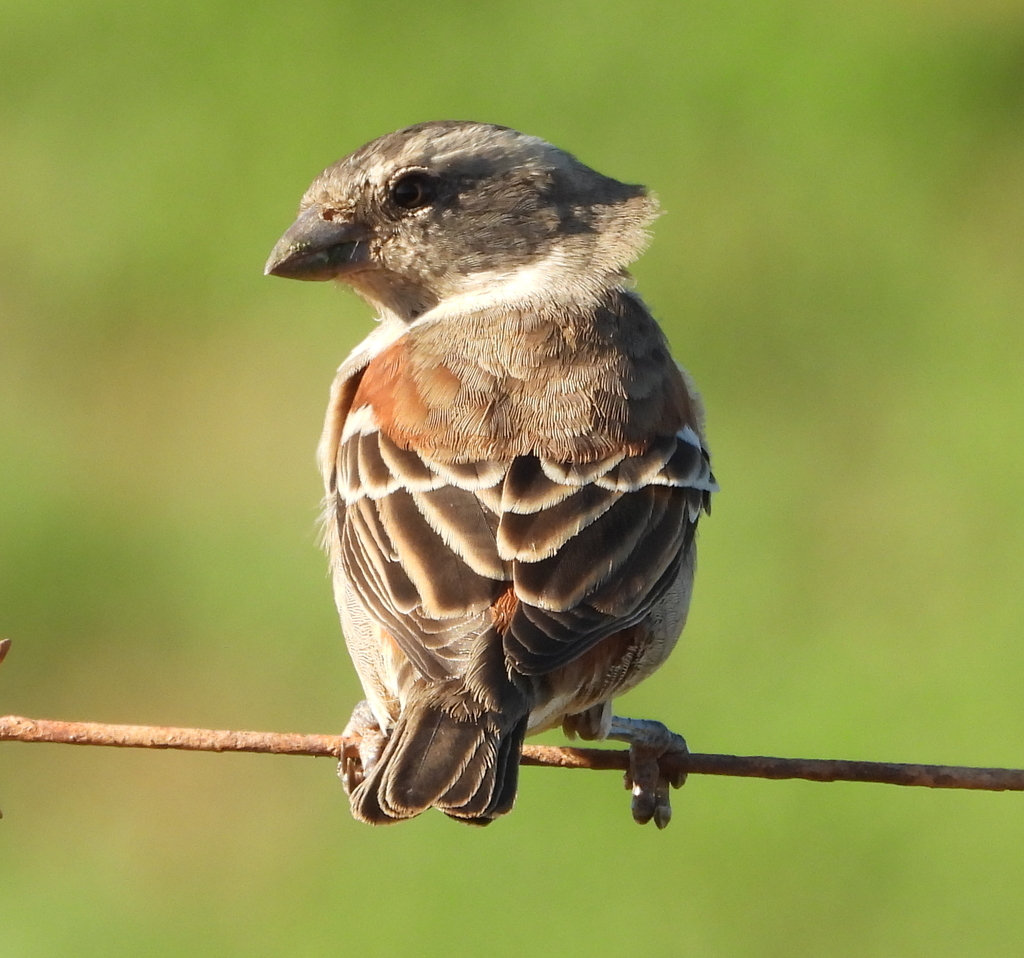
Cape Sparrow
Photo © Timothy Whitehead
Photo © Timothy Whitehead — CC BY 4.0 — Source: iNaturalist #153296654Identification
The Cape sparrow is a medium-sized sparrow, measuring 14–16 cm in length, with strikingly distinctive plumage that sets it apart from many of its relatives. Both sexes display prominent pale head stripes, though the pattern differs between them. Males are particularly bold, with a mostly black head marked by a broad white stripe curving from behind the eye to the throat, connected by a narrow black band to the black breast bib. The back and shoulders are bright chestnut, contrasting with greyish underparts and a dark grey nape. Females are duller overall, with a grey head and more subtle markings, though young males show black head markings from an early age. The wings display white and black bars, with flight feathers and tail streaked in grey and black.
In the field, listen for the Cape sparrow's musical calls, which are more melodious and mellow than those of the house sparrow. The basic call—transcribed as chissip, chirrup, or chirrichup—is used in flight and while perching socially. Males produce a distinctive loud call, tweeng or twileeng, used to advertise nest ownership, which can extend into a jerky, repetitive song.
Range & Habitat
The Cape sparrow is found throughout southern Africa, ranging from the central coast of Angola (with the northernmost point at Benguela) southward through Namibia, Botswana, and South Africa, and eastward to Eswatini. The species occurs across most of South Africa except the far east, with scattered records in southeastern Zimbabwe. Three subspecies are recognized across different regions of this range.
Originally inhabiting semi-arid savanna, thornveld, and light woodland, the Cape sparrow has readily adapted to agricultural lands and urban environments over the past thousand years. The species prefers areas with annual rainfall below 75 centimetres, though in desert regions it remains near watercourses and watering holes. In towns, it favours parks, gardens, and open spaces rather than heavily built-up areas, where reproductive success is lower. It coexists successfully with both the native southern grey-headed sparrow and the introduced house sparrow.
Behaviour & Diet
Cape sparrows are primarily seed-eaters, supplementing their diet with soft plant parts and insects. They are highly social birds, typically breeding in colonies where both parents participate fully in all breeding activities, from nest construction to feeding young. Nests are adaptable in placement, constructed in trees, bushes, cavities, or even in the abandoned nests of other species. A typical clutch contains three or four eggs.
Outside the breeding season, Cape sparrows gather in large nomadic flocks that move in search of food. This gregarious behaviour, combined with their adaptability to human-modified landscapes, has made them one of the most successful sparrow species across their range. The species is assessed as Least Concern by the IUCN, with no significant population declines recorded.
Best Time & Places to See It
The Cape sparrow is common throughout most of its range, making it relatively easy to locate. In southern Africa, the best locations are semi-arid regions with scattered trees and open ground, particularly in Namibia, Botswana, and South Africa's interior plateaus. Urban and suburban parks and gardens across major towns and cities offer reliable sightings, especially where the species has established breeding colonies.
The species is present year-round, though breeding birds are most active and vocal during the breeding season when males advertise territories with their distinctive calls. Visiting during this period increases chances of observing courtship behaviour and colony activity. Large nomadic flocks are most easily found in non-breeding seasons when birds congregate around food sources.
Photography Tips
The Cape sparrow's striking plumage and sexual dimorphism offer excellent photographic opportunities. Males, with their bold black and white head markings and chestnut backs, are particularly photogenic and stand out clearly against typical savanna backgrounds. Photograph males in good light to capture the contrast between their black and white head patterns and the bright chestnut of the back and shoulders.
Position yourself near known breeding colonies or watering holes to capture birds in natural behaviour. Early morning and late afternoon light will enhance the rich chestnut and black tones of the male's plumage. Females and juveniles, though duller, provide opportunities for documenting age and sex variation. The bird's relatively small size means getting close is advantageous; a telephoto lens of at least 300 mm is recommended for frame-filling portraits from a respectful distance.
Mapungubwe National Park
Musina Local Municipality, South Africa
+358 birds+29 mammals
Where the Limpopo River cuts through sandstone ridges at the convergence of South Africa, Botswana, and Zimbabwe, Mapungubwe National Park preserves a landscape of profound ecological…
VIEW NATIONAL PARKGarden Route National Park
George, South Africa
+353 birds+54 mammals
Sweeping across the Western Cape's coastal and mountainous terrain, this sprawling national park encompasses over five thousand square kilometers of extraordinarily diverse landscape—from coastal limestone cliffs…
VIEW NATIONAL PARKMokala National Park
Siyancuma Local Municipality, South Africa
+246 birds+35 mammals
Across the semi-arid savanna of the Northern Cape, where red earth meets sparse acacia woodland and open grassland punctuated by rocky outcrops, lies a landscape shaped…
VIEW NATIONAL PARKCederberg Wilderness Area
Cederberg Local Municipality, South Africa
+136 birds+12 mammals
Where ancient sandstone ridges rise dramatically from the semi-arid lowlands of Western Cape, the Cederberg Wilderness Area spreads across nearly 1,700 square kilometres of some of…
VIEW NATIONAL PARKKruger National Park
Ba-Phalaborwa Local Municipality, South Africa
+540 birds+91 mammals
Across the low-lying savanna of northeastern South Africa unfolds one of Africa's largest and most ecologically intact protected areas, where acacia woodlands merge into mopane scrub…
VIEW NATIONAL PARKAgulhas National Park
Cape Agulhas Local Municipality, South Africa
+224 birds+13 mammals
Where the Atlantic and Indian Oceans meet at Africa's southernmost tip, Agulhas National Park stretches across 892 square kilometres of windswept coastal landscape and rugged limestone…
VIEW NATIONAL PARKSehlabathebe National Park
South Africa
+60 birds+1 mammals
Where the Drakensberg escarpment rises to meet the sky, Sehlabathebe National Park unfolds across a landscape of dramatic basalt cliffs, rolling alpine grassland, and crystal-clear mountain…
VIEW NATIONAL PARKTankwa-Karoo National Park
Hantam Local Municipality, South Africa
+201 birds+20 mammals
Across the semi-arid heartland of the Northern Cape, where winter rains carve ephemeral watercourses through endless ochre plains, Tankwa-Karoo National Park sprawls across more than 3,100…
VIEW NATIONAL PARKMountain Zebra National Park
Inxuba Yethemba Local Municipality, South Africa
+265 birds+35 mammals
Across the windswept plateaus and deeply incised valleys of the Eastern Cape's interior, Mountain Zebra National Park unfolds as a landscape of geological drama and ecological…
VIEW NATIONAL PARKBontebok National Park
Swellendam Local Municipality, South Africa
+204 birds+11 mammals
Where the Cape Fold Mountains give way to coastal lowlands, a landscape of rolling sandstone hills and fynbos heathland creates one of South Africa's most compact…
VIEW NATIONAL PARKAugrabies Falls National Park
Kai !Garib Local Municipality, South Africa
+176 birds+20 mammals
Where the Orange River cuts a dramatic scar through the Northern Cape's arid interior, Augrabies Falls National Park sprawls across nearly 1,200 square kilometers of raw,…
VIEW NATIONAL PARKAddo Elephant National Park
Sundays River Valley Local Municipality, South Africa
+388 birds+55 mammals
Where the Eastern Cape's semi-arid scrublands meet transitional woodland, Addo sprawls across 13,478 square kilometres of one of southern Africa's most biodiverse landscapes. The terrain rises…
VIEW NATIONAL PARKIthala Game Reserve
uPhongolo Local Municipality, South Africa
+328 birds+26 mammals
Rolling thornbush savanna and acacia woodland dominate the landscape of this 494-square-kilometre national park in KwaZulu-Natal's uPhongolo Local Municipality, where granite outcrops punctuate grassland plateaus and…
VIEW NATIONAL PARKMarakele National Park
Modimolle Local Municipality, South Africa
+341 birds+36 mammals
Granite ridges and sprawling grasslands dominate this 1,176-square-kilometre reserve in Limpopo's heartland, where bushveld transitions between rocky outcrops and open savanna. The park's rugged topography creates…
VIEW NATIONAL PARKCamdeboo National Park
Camdeboo Local Municipality, South Africa
+272 birds+24 mammals
Granite ridges and weathered sandstone cliffs rise across a semi-arid landscape where the Karoo transitions into the eastern escarpment of South Africa, creating Camdeboo National Park's…
VIEW NATIONAL PARKSperrgebiet National Park
Barcelona, Namibia
+181 birds+18 mammals
Where the Namib's ancient gravel plains meet the Atlantic coast, one of Africa's most remote and geologically austere landscapes unfolds across more than 56,000 square kilometres.…
VIEW NATIONAL PARKDorob National Park
Henties Bay, Namibia
+230 birds+13 mammals
Where the Skeleton Coast meets the Namib Desert's inland reaches, Dorob National Park sprawls across 34,021 square kilometres of one of southern Africa's most austere and…
VIEW NATIONAL PARKNamib-Naukluft National Park
Namibia
+217 birds+33 mammals
Across nearly 94,000 square kilometers of southwestern Namibia, a landscape of extremes unfolds where towering sand dunes meet rugged mountain ranges, and ancient riverbeds carve through…
VIEW NATIONAL PARKEtosha National Park
Namibia
+356 birds+58 mammals
Across northern Namibia's stark semi-arid plateau, a vast shallow depression transforms seasonally into one of Africa's most dramatic wildlife theaters. Etosha National Park, encompassing more than…
VIEW NATIONAL PARKNamibRand Nature Reserve
Hammerstein, Namibia
+107 birds+12 mammals
Where rust-coloured dunes surrender to sculpted granite outcrops and vast plains stretch toward an endless horizon, one of southern Africa's most pristine wilderness areas unfolds. The…
VIEW NATURE RESERVEWaterberg Plateau National Park
Okambukonde, Namibia
+198 birds+27 mammals
Where ancient sandstone cliffs rise 200 metres above the surrounding bushveld, a fortress of geology creates one of southern Africa's most compelling ecosystems. The plateau's steep…
VIEW NATIONAL PARKMakgadikgadi Pans National Park
Gucta, Botswana
+272 birds+27 mammals
Where salt-crusted flatlands stretch endlessly toward a shimmering horizon, one of Africa's most extraordinary ecosystems awakens with the rains. The Makgadikgadi Pans comprise vast mineral-rich basins…
VIEW NATIONAL PARKNo community photos yet. Log in to add the first one.
No community observations of this species yet.