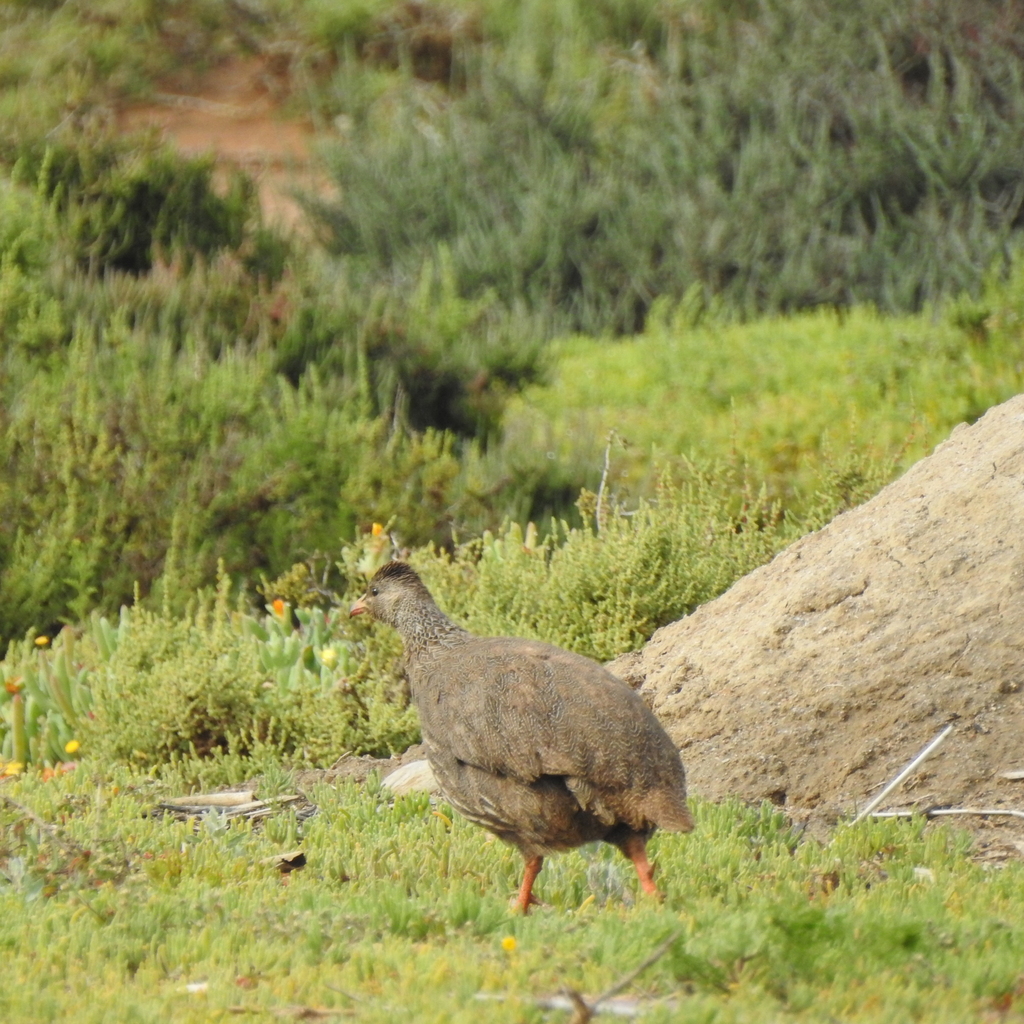
Cape Spurfowl
Photo © Noeleen du Toit
Photo © Noeleen du Toit — CC BY-SA 4.0 — Source: iNaturalist #181513586Identification
The Cape spurfowl is southern Africa's largest francolin, measuring 40–42 cm in length. At first glance, it appears dark, but closer inspection reveals finely vermiculated grey and white plumage with a plainer crown and nape. The most striking field mark is its bright red legs. Males are noticeably larger than females, weighing 600–915 g compared to the female's 435–659 g, and can be distinguished by the presence of two leg spurs, while females have at most one short spur. Juveniles resemble adults but display duller legs and clearer vermiculations. In its range, this large, dark francolin is unlikely to be confused with any other species.
Range & Habitat
Endemic to southern Africa, the Cape spurfowl is a common resident of the Western Cape's strandveld, renosterveld, and fynbos regions, particularly at lower altitudes. Its range extends locally northwards to southern Namibia. The species frequents scrubby open areas, preferably close to running water, and is present in the succulent karoo at lower densities and along the banks of the lower Orange and Fish Rivers. It has shown remarkable adaptability to human-altered habitats, foraging in parks, croplands, orchards, vineyards, and stands of invasive rooikrans, though scrubby roosting and nesting space remains essential.
Behaviour & Diet
The Cape spurfowl favours scrubby open areas near water and can become remarkably tame when disturbance is limited, often feeding in gardens, by roadsides, or alongside farmyard chickens. When disturbed, it characteristically runs rather than flies, though young birds and adults alike fly readily and strongly when pressed or startled. The species breeds in spring and early summer, when it becomes most vocal. Its loud, distinctive call is a repeated cackalac-cackalac-cackalac. Nesting consists of a grass-lined scrape under a bush, where females lay six to eight eggs, though occasionally two females may share a single nest.
Best Time & Places to See It
Spring and early summer offer the best opportunities to encounter and hear Cape spurfowls, as their breeding season coincides with increased vocalization. The Western Cape's strandveld, renosterveld, and fynbos regions, particularly at lower altitudes, provide the most reliable viewing. Robben Island, where the species was introduced and thrives in a parasite-free environment, is another accessible location. Early morning is typically the best time to hear their loud calls and locate birds in scrubby habitats.
Photography Tips
Photographing Cape spurfowls requires patience and early starts to capture birds during their most active periods. Their preference for running rather than flying when disturbed means approaching on foot through scrubby habitat may yield closer shots than in open areas. The bright red legs provide an excellent colour contrast for compelling images. Good light is essential to reveal the fine grey and white vermiculations that distinguish this species, so avoid harsh midday sun. The loud calls can help locate birds during breeding season, making spring the most rewarding time for photographers seeking this attractive francolin.
Garden Route National Park
George, South Africa
+353 birds+54 mammals
Sweeping across the Western Cape's coastal and mountainous terrain, this sprawling national park encompasses over five thousand square kilometers of extraordinarily diverse landscape—from coastal limestone cliffs…
VIEW NATIONAL PARKCederberg Wilderness Area
Cederberg Local Municipality, South Africa
+136 birds+12 mammals
Where ancient sandstone ridges rise dramatically from the semi-arid lowlands of Western Cape, the Cederberg Wilderness Area spreads across nearly 1,700 square kilometres of some of…
VIEW NATIONAL PARKAgulhas National Park
Cape Agulhas Local Municipality, South Africa
+224 birds+13 mammals
Where the Atlantic and Indian Oceans meet at Africa's southernmost tip, Agulhas National Park stretches across 892 square kilometres of windswept coastal landscape and rugged limestone…
VIEW NATIONAL PARKTankwa-Karoo National Park
Hantam Local Municipality, South Africa
+201 birds+20 mammals
Across the semi-arid heartland of the Northern Cape, where winter rains carve ephemeral watercourses through endless ochre plains, Tankwa-Karoo National Park sprawls across more than 3,100…
VIEW NATIONAL PARKBontebok National Park
Swellendam Local Municipality, South Africa
+204 birds+11 mammals
Where the Cape Fold Mountains give way to coastal lowlands, a landscape of rolling sandstone hills and fynbos heathland creates one of South Africa's most compact…
VIEW NATIONAL PARKAugrabies Falls National Park
Kai !Garib Local Municipality, South Africa
+176 birds+20 mammals
Where the Orange River cuts a dramatic scar through the Northern Cape's arid interior, Augrabies Falls National Park sprawls across nearly 1,200 square kilometers of raw,…
VIEW NATIONAL PARKSperrgebiet National Park
Barcelona, Namibia
+181 birds+18 mammals
Where the Namib's ancient gravel plains meet the Atlantic coast, one of Africa's most remote and geologically austere landscapes unfolds across more than 56,000 square kilometres.…
VIEW NATIONAL PARKNo community photos yet. Log in to add the first one.
No community observations of this species yet.