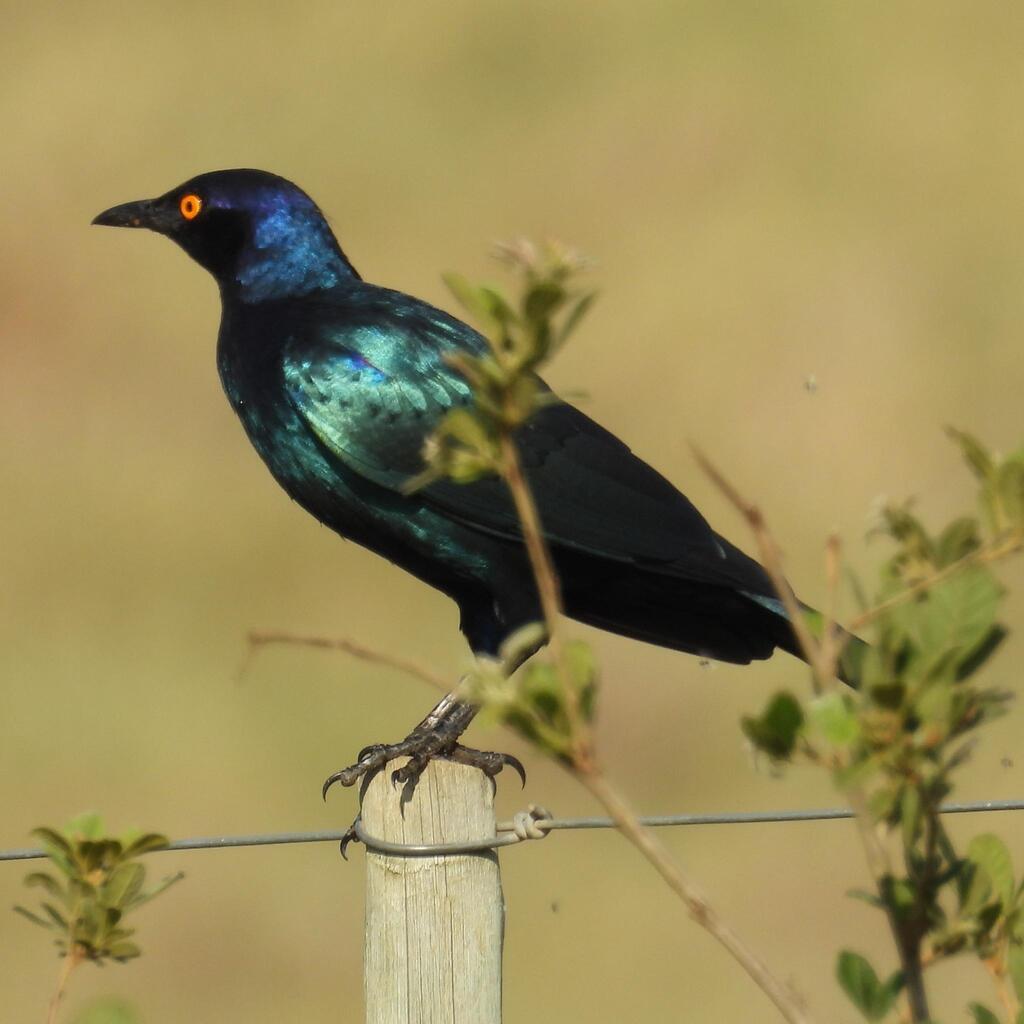
Cape Starling
Photo © Henry de Lange
Photo © Henry de Lange — CC BY 4.0 — Source: iNaturalist #342717357Identification
The Cape Starling is a compact bird, measuring about 25 cm in length and weighing around 100 grams. Its most striking feature is its brilliantly glossy plumage, which gives the species its alternative names of red-shouldered glossy-starling or Cape glossy starling. The head is distinctly blue with darker ear coverts, while the upper parts of the body display a beautiful greenish-blue colouration. Two subspecies are recognised: L. n. phoenicopterus, which is widespread across Southern Africa, and L. n. culminator, found in the Eastern Cape of South Africa, which is larger with greener wing and tail plumage and glossy secondary remiges on both vanes.
Beyond its visual appeal, the Cape Starling is also notable for its lengthy warbling song, which often incorporates imitations of sounds from its environment—a delightful characteristic that adds to its charm for birdwatchers and nature photographers.
Range & Habitat
The Cape Starling is found throughout the southern part of Africa, with a range encompassing the extreme south of Gabon, the west and south of Angola, the extreme south of Zambia, Zimbabwe, Namibia, Botswana, Lesotho, and South Africa. The species is a vagrant to the Republic of the Congo but does not breed there. In all other countries within its range, it is a resident, non-migratory species, with a total extent of occurrence of approximately 3,000,000 square kilometres.
This starling favours open woodland, plantations, savannah, bushveld, and rough grassland, along with parks and gardens. Notably, it is quite numerous in the central Kalahari where isolated trees occur, and is not associated with any particular plant type. However, it avoids dense forest and open pasture, requiring trees for roosting and nesting.
Behaviour & Diet
The Cape Starling is a highly gregarious species, forming large flocks during the non-breeding season. It is habituated to humans and frequently forages on the ground alongside other starling species, including the pied starling, common starling, greater blue-eared starling, and several others. This social feeding behaviour makes it relatively easy to observe in suitable habitat.
Its diet is remarkably diverse and opportunistic. Cape Starlings feed on fruit, insects, and nectar, and have developed the interesting behaviour of picking ectoparasites from the backs of larger animals. They will also visit bird tables for scraps, demonstrating their adaptability to human-modified landscapes.
Best Time & Places to See It
The Cape Starling is resident throughout most of Southern Africa, making it available for viewing year-round in suitable habitat. However, breeding activity occurs mainly between October and February, with breeding potentially continuing into April in Namibia, which may offer opportunities to observe nesting behaviour and family groups.
The species is widespread and numerous across open woodlands, bushveld, and parks throughout Southern Africa. The central Kalahari is a particularly good location where isolated trees provide suitable roosting and feeding habitat. Given its habituation to humans, Cape Starlings can often be found in suburban gardens and parks across the region.
Photography Tips
The Cape Starling's glossy plumage presents exciting photographic opportunities, particularly when light catches the brilliant blue and greenish-blue colouration of the head and upper body. Bright, clear conditions will best showcase the bird's iridescent qualities. Since these birds are gregarious and often form flocks on the ground, photographers can position themselves to capture multiple birds in their natural foraging behaviour.
The species' habituation to humans makes it relatively approachable in parks and gardens, and its tendency to forage on the ground or visit bird tables offers opportunities for ground-level or close-range photography. Early morning light is particularly effective for highlighting the glossy plumage details that make this species so visually distinctive.
Mapungubwe National Park
Musina Local Municipality, South Africa
+358 birds+29 mammals
Where the Limpopo River cuts through sandstone ridges at the convergence of South Africa, Botswana, and Zimbabwe, Mapungubwe National Park preserves a landscape of profound ecological…
VIEW NATIONAL PARKChobe National Park
Botswana
+446 birds+45 mammals
Where the Chobe River cuts a sinuous path through northern Botswana, the landscape transforms into one of Africa's most dynamic wetland-savanna mosaics. This national park encompasses…
VIEW NATIONAL PARKNxai Pan National Park
Botswana
+226 birds+16 mammals
Across the northwestern reaches of Botswana stretches a landscape of profound seasonal transformation—a sprawling pan system where shallow depressions fill and empty with the rains, creating…
VIEW NATIONAL PARKKhaudum National Park
Botswana
+213 birds+13 mammals
Where the Okavango's northern tributaries meander through miombo woodland and riverine forest, Khaudum National Park unfolds across a landscape of profound ecological richness and isolation. This…
VIEW NATIONAL PARKGarden Route National Park
George, South Africa
+353 birds+54 mammals
Sweeping across the Western Cape's coastal and mountainous terrain, this sprawling national park encompasses over five thousand square kilometers of extraordinarily diverse landscape—from coastal limestone cliffs…
VIEW NATIONAL PARKPilanesberg National Park
Moses Kotane Local Municipality, South Africa
+364 birds+49 mammals
Granite peaks and volcanic ridges rise unexpectedly from the savanna floor across this 734-square-kilometre expanse in the North West province, creating a landscape of profound ecological…
VIEW NATIONAL PARKMokala National Park
Siyancuma Local Municipality, South Africa
+246 birds+35 mammals
Across the semi-arid savanna of the Northern Cape, where red earth meets sparse acacia woodland and open grassland punctuated by rocky outcrops, lies a landscape shaped…
VIEW NATIONAL PARKKruger National Park
Ba-Phalaborwa Local Municipality, South Africa
+540 birds+91 mammals
Across the low-lying savanna of northeastern South Africa unfolds one of Africa's largest and most ecologically intact protected areas, where acacia woodlands merge into mopane scrub…
VIEW NATIONAL PARKMountain Zebra National Park
Inxuba Yethemba Local Municipality, South Africa
+265 birds+35 mammals
Across the windswept plateaus and deeply incised valleys of the Eastern Cape's interior, Mountain Zebra National Park unfolds as a landscape of geological drama and ecological…
VIEW NATIONAL PARKAugrabies Falls National Park
Kai !Garib Local Municipality, South Africa
+176 birds+20 mammals
Where the Orange River cuts a dramatic scar through the Northern Cape's arid interior, Augrabies Falls National Park sprawls across nearly 1,200 square kilometers of raw,…
VIEW NATIONAL PARKAddo Elephant National Park
Sundays River Valley Local Municipality, South Africa
+388 birds+55 mammals
Where the Eastern Cape's semi-arid scrublands meet transitional woodland, Addo sprawls across 13,478 square kilometres of one of southern Africa's most biodiverse landscapes. The terrain rises…
VIEW NATIONAL PARKIthala Game Reserve
uPhongolo Local Municipality, South Africa
+328 birds+26 mammals
Rolling thornbush savanna and acacia woodland dominate the landscape of this 494-square-kilometre national park in KwaZulu-Natal's uPhongolo Local Municipality, where granite outcrops punctuate grassland plateaus and…
VIEW NATIONAL PARKMarakele National Park
Modimolle Local Municipality, South Africa
+341 birds+36 mammals
Granite ridges and sprawling grasslands dominate this 1,176-square-kilometre reserve in Limpopo's heartland, where bushveld transitions between rocky outcrops and open savanna. The park's rugged topography creates…
VIEW NATIONAL PARKCamdeboo National Park
Camdeboo Local Municipality, South Africa
+272 birds+24 mammals
Granite ridges and weathered sandstone cliffs rise across a semi-arid landscape where the Karoo transitions into the eastern escarpment of South Africa, creating Camdeboo National Park's…
VIEW NATIONAL PARKKhaudum National Park
Namibia
+221 birds+13 mammals
Where the Kavango River flows through northeastern Namibia, vast miombo woodlands and riverine forests create one of southern Africa's most remote and biodiverse wilderness corridors. Khaudum…
VIEW NATIONAL PARKDorob National Park
Henties Bay, Namibia
+230 birds+13 mammals
Where the Skeleton Coast meets the Namib Desert's inland reaches, Dorob National Park sprawls across 34,021 square kilometres of one of southern Africa's most austere and…
VIEW NATIONAL PARKSkeleton Coast Park
Barcelona, Namibia
+143 birds+7 mammals
Where the Atlantic's cold Benguela Current collides with one of Africa's most hostile coastlines, the Skeleton Coast Park sprawls across more than 104,000 square kilometres of…
VIEW OBSERVATION POINTNamib-Naukluft National Park
Namibia
+217 birds+33 mammals
Across nearly 94,000 square kilometers of southwestern Namibia, a landscape of extremes unfolds where towering sand dunes meet rugged mountain ranges, and ancient riverbeds carve through…
VIEW NATIONAL PARKNkasa Rupara National Park
Namibia
+283 birds+17 mammals
Where the Zambezi's floodplains spill across the border between Namibia and Botswana, Nkasa Rupara National Park unfolds across 518 square kilometers of wetland and woodland mosaic.…
VIEW NATIONAL PARKBwabwata National Park
Namibia
+377 birds+35 mammals
Where the Kavango River winds through northeastern Namibia, vast floodplains and dense riparian woodland create one of southern Africa's most ecologically dynamic protected landscapes. Spanning 14,249…
VIEW NATIONAL PARKEtosha National Park
Namibia
+356 birds+58 mammals
Across northern Namibia's stark semi-arid plateau, a vast shallow depression transforms seasonally into one of Africa's most dramatic wildlife theaters. Etosha National Park, encompassing more than…
VIEW NATIONAL PARKNamibRand Nature Reserve
Hammerstein, Namibia
+107 birds+12 mammals
Where rust-coloured dunes surrender to sculpted granite outcrops and vast plains stretch toward an endless horizon, one of southern Africa's most pristine wilderness areas unfolds. The…
VIEW NATURE RESERVEWaterberg Plateau National Park
Okambukonde, Namibia
+198 birds+27 mammals
Where ancient sandstone cliffs rise 200 metres above the surrounding bushveld, a fortress of geology creates one of southern Africa's most compelling ecosystems. The plateau's steep…
VIEW NATIONAL PARKMakgadikgadi Pans National Park
Gucta, Botswana
+272 birds+27 mammals
Where salt-crusted flatlands stretch endlessly toward a shimmering horizon, one of Africa's most extraordinary ecosystems awakens with the rains. The Makgadikgadi Pans comprise vast mineral-rich basins…
VIEW NATIONAL PARKNo community photos yet. Log in to add the first one.
No community observations of this species yet.