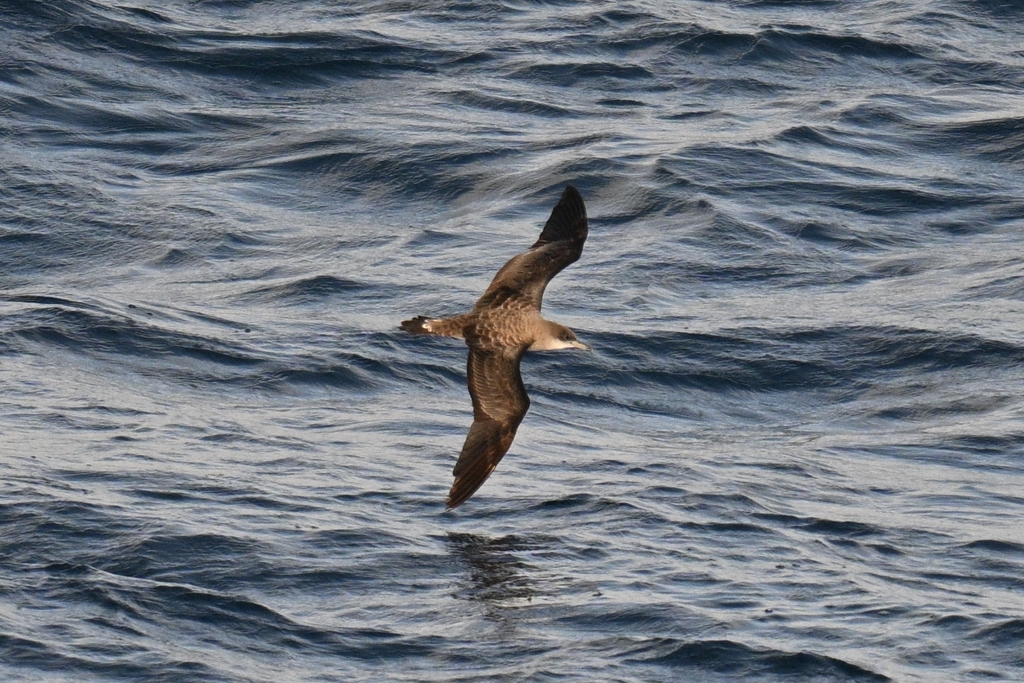
Cape Verde Shearwater
Photo © Charlotte Kirchner
Photo © Charlotte Kirchner — CC BY 4.0 — Source: iNaturalist photo #333340894Identification
The Cape Verde shearwater is a medium-large seabird with a notably slim, dark bill and a more angular silhouette than its close relative, Cory's shearwater. The head and upperparts are distinctly darker than those of Cory's, giving the bird a more uniformly shadowed appearance. In flight, the Cape Verde shearwater exhibits a characteristic shearwater-like style with stiffer and more rapid wing beats, appearing overall smaller, slimmer and more angular than Cory's shearwater.
Range & Habitat
Endemic to the Cape Verde archipelago in the Atlantic Ocean off the coast of West Africa, the Cape Verde shearwater breeds exclusively within these islands. The largest breeding colonies are found on Brava, Branco and Raso, though smaller populations nest on other islands throughout the archipelago. The birds nest in cliff hollows, on offshore rocks, and under large boulders.
Following the breeding season, birds disperse across pelagic waters, with some individuals traveling to the upwelling zone in Senegalese waters—about 10% of the population has been recorded there in October. Vagrants have occasionally been documented as far as the South Atlantic and the eastern coast of North America, with records from offshore Maryland and North Carolina.
Behaviour & Diet
Cape Verde shearwaters are highly pelagic, spending most of the year at sea. Following a three-month absence, mature birds return to breeding colonies in late February and March. Females lay a single egg each season, with incubation occurring from May to July. Chicks fledge between late September and November, after which all birds remain at sea until the next breeding season.
Like other shearwaters, this species feeds exclusively at sea, consuming small fish, squid and other marine organisms obtained during foraging dives and surface feeding.
Best Time & Places to See It
The best time to observe Cape Verde shearwaters is during the breeding season from late February through November, when birds are regularly seen around the archipelago. The largest breeding colonies on Brava, Branco and Raso offer the most reliable opportunities for sightings. Outside the breeding season, the species is more dispersed and harder to locate, though some birds may be found in Senegalese waters in October.
Photography Tips
Photographing Cape Verde shearwaters is most productive during the breeding season when birds are present around the islands. Look for their characteristic stiff, rapid wing beats in flight—this distinctive flight style distinguishes them from Cory's shearwater. The bird's dark plumage and slim profile require good light and fast shutter speeds to capture their rapid movements. Seabirds in flight benefit from anticipatory focusing and continuous shooting modes. Patient observers stationed near breeding colonies during arrival and fledging periods will have the best opportunities for compelling images.
Nothing matches these filters.
No community photos yet. Log in to add the first one.
No community observations of this species yet.