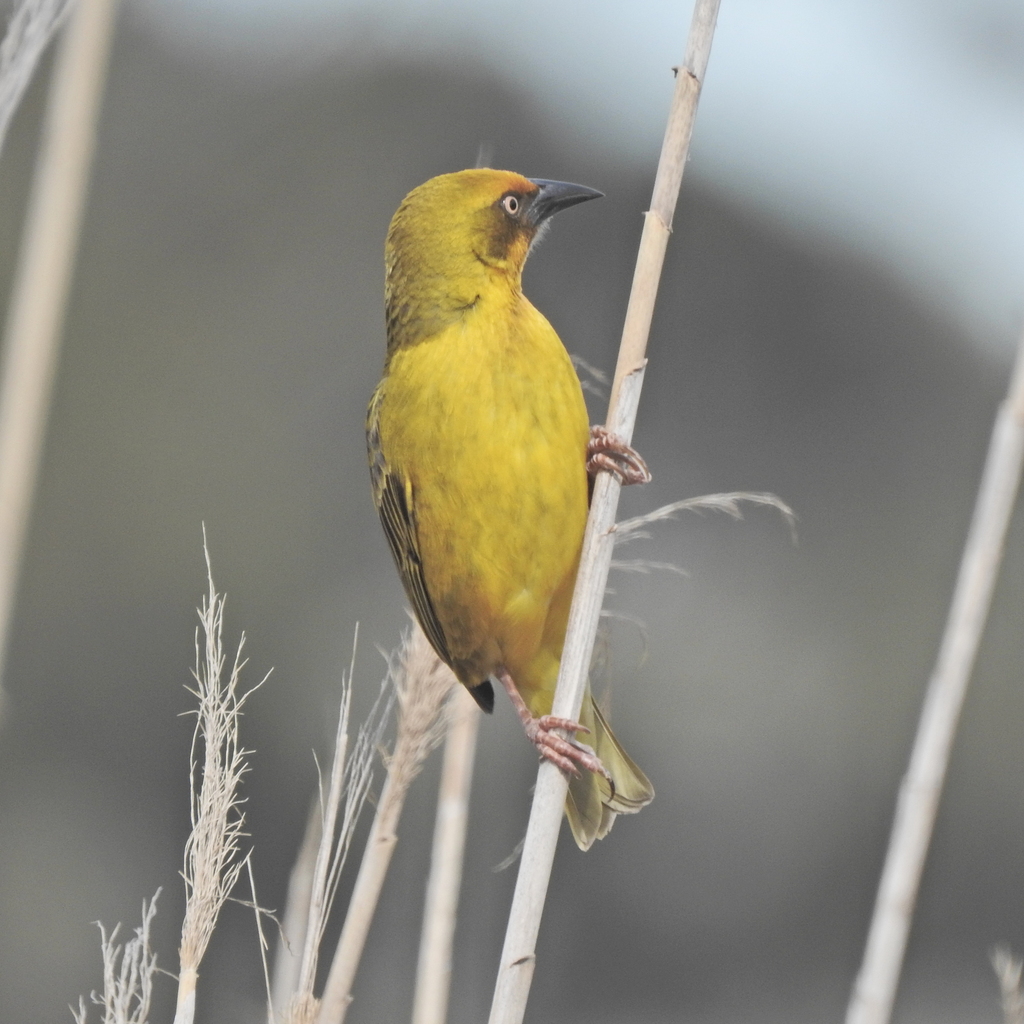
Cape Weaver
Photo © Noeleen du Toit
Photo © Noeleen du Toit — CC BY-SA 4.0 — Source: iNaturalist #173040684Identification
The Cape weaver is a compact 17 cm bird with a distinctive pointed conical bill and streaked olive-brown upperparts. Males in breeding plumage are unmistakable, displaying a bright yellow head and underparts contrasted with an orange face and striking white iris. Females are more subtly coloured, with olive-yellow heads and breasts that shade to pale yellow on the lower belly, and typically have brown eyes—though about 19% show pale eyes in summer, making eye colour an unreliable field mark for sexing. Young birds resemble females. The species' harsh, hysterical sizzle song, sharp double-chip alarm call, and distinctive "azwit" contact call are useful for identification by ear.
Range & Habitat
The Cape weaver is endemic to South Africa, Lesotho and Eswatini, with a distribution spanning much of the region from the Orange River in the Northern Cape south to the Cape of Good Hope, then eastward to northern KwaZulu-Natal and inland almost to Bloemfontein in the Free State. The species notably avoids the Kalahari Desert. These birds favour open grasslands, lowland fynbos, coastal thicket and farmland, provided that permanent water and trees are present. In hotter, more arid regions they are restricted to upland areas, and they never occur in closed forest.
Behaviour & Diet
Cape weavers are highly social outside the breeding season, forming flocks and congregating in large roosts shared with other bird species. During breeding, males are territorial colonial nesters, typically forming colonies of 2 to 20 individuals. Each male is polygynous, potentially attracting up to seven females per breeding season, and constructs multiple nests within his defended territory. Males build distinctive kidney-shaped, fully waterproof nests from woven grass or reed strips in about a week, attaching them to tree branches—often exotic species like eucalyptus or willow—or to wetland vegetation, utility lines and fences near water.
The Cape weaver is omnivorous with an evenly balanced diet of animal and plant matter, including seeds, fruit, nectar, insects and spiders. They forage opportunistically on the ground, in foliage, by gleaning from bark and by hawking insects in flight. Their long bills are specially adapted for this dietary flexibility. Females enjoy more varied diets than males. These birds serve as major pollinators of aloes in South Africa and are generalist nectar-feeders.
Best Time & Places to See It
The Cape weaver is common throughout its range and can be found year-round, though breeding activity peaks from October to January in summer rainfall areas and August to October in the winter rainfall zone of the Western Cape. Look for them in open grasslands, coastal thickets, farmland and wetland areas where trees or tall vegetation stand near permanent water. Large roosts are a reliable place to observe them, particularly during non-breeding months. In agricultural regions of the Western Cape, they are so abundant they can become conspicuous pests in orchards.
Photography Tips
Breeding males in their bright yellow and orange plumage offer stunning photographic subjects, particularly during peak breeding season. Photograph them against the characteristic backdrop of their distinctive woven nests, which are themselves remarkable subjects. Early morning light will best render the males' vibrant colours and distinctive white irises. During non-breeding season, capture images of their gregarious behaviour at large communal roosts. The birds' active foraging behaviour—gleaning, hawking and probing flowers—provides excellent opportunities for action shots. Wide-angle compositions showing colonies of nests on trees or wetland vegetation convey the species' fascinating colonial breeding biology.
Tsavo West National Park
Mwatate, Kenya
+513 birds+49 mammals
Where volcanic ridges and weathered lava flows meet the semi-arid lowlands of south-central Kenya, Tsavo West National Park unfolds across a landscape sculpted by fire and…
VIEW NATIONAL PARKAmboseli National Park
Etonet/Lenkism ward, Kenya
+501 birds+43 mammals
Where the Amboseli basin opens toward the Tanzanian frontier, a shallow alkaline lake mirrors vast skies across one of East Africa's most iconic savanna landscapes. The…
VIEW NATIONAL PARKGarden Route National Park
George, South Africa
+353 birds+54 mammals
Sweeping across the Western Cape's coastal and mountainous terrain, this sprawling national park encompasses over five thousand square kilometers of extraordinarily diverse landscape—from coastal limestone cliffs…
VIEW NATIONAL PARKPilanesberg National Park
Moses Kotane Local Municipality, South Africa
+364 birds+49 mammals
Granite peaks and volcanic ridges rise unexpectedly from the savanna floor across this 734-square-kilometre expanse in the North West province, creating a landscape of profound ecological…
VIEW NATIONAL PARKMokala National Park
Siyancuma Local Municipality, South Africa
+246 birds+35 mammals
Across the semi-arid savanna of the Northern Cape, where red earth meets sparse acacia woodland and open grassland punctuated by rocky outcrops, lies a landscape shaped…
VIEW NATIONAL PARKCederberg Wilderness Area
Cederberg Local Municipality, South Africa
+136 birds+12 mammals
Where ancient sandstone ridges rise dramatically from the semi-arid lowlands of Western Cape, the Cederberg Wilderness Area spreads across nearly 1,700 square kilometres of some of…
VIEW NATIONAL PARKKruger National Park
Ba-Phalaborwa Local Municipality, South Africa
+540 birds+91 mammals
Across the low-lying savanna of northeastern South Africa unfolds one of Africa's largest and most ecologically intact protected areas, where acacia woodlands merge into mopane scrub…
VIEW NATIONAL PARKAgulhas National Park
Cape Agulhas Local Municipality, South Africa
+224 birds+13 mammals
Where the Atlantic and Indian Oceans meet at Africa's southernmost tip, Agulhas National Park stretches across 892 square kilometres of windswept coastal landscape and rugged limestone…
VIEW NATIONAL PARKSehlabathebe National Park
South Africa
+60 birds+1 mammals
Where the Drakensberg escarpment rises to meet the sky, Sehlabathebe National Park unfolds across a landscape of dramatic basalt cliffs, rolling alpine grassland, and crystal-clear mountain…
VIEW NATIONAL PARKTankwa-Karoo National Park
Hantam Local Municipality, South Africa
+201 birds+20 mammals
Across the semi-arid heartland of the Northern Cape, where winter rains carve ephemeral watercourses through endless ochre plains, Tankwa-Karoo National Park sprawls across more than 3,100…
VIEW NATIONAL PARKMountain Zebra National Park
Inxuba Yethemba Local Municipality, South Africa
+265 birds+35 mammals
Across the windswept plateaus and deeply incised valleys of the Eastern Cape's interior, Mountain Zebra National Park unfolds as a landscape of geological drama and ecological…
VIEW NATIONAL PARKBontebok National Park
Swellendam Local Municipality, South Africa
+204 birds+11 mammals
Where the Cape Fold Mountains give way to coastal lowlands, a landscape of rolling sandstone hills and fynbos heathland creates one of South Africa's most compact…
VIEW NATIONAL PARKAugrabies Falls National Park
Kai !Garib Local Municipality, South Africa
+176 birds+20 mammals
Where the Orange River cuts a dramatic scar through the Northern Cape's arid interior, Augrabies Falls National Park sprawls across nearly 1,200 square kilometers of raw,…
VIEW NATIONAL PARKAddo Elephant National Park
Sundays River Valley Local Municipality, South Africa
+388 birds+55 mammals
Where the Eastern Cape's semi-arid scrublands meet transitional woodland, Addo sprawls across 13,478 square kilometres of one of southern Africa's most biodiverse landscapes. The terrain rises…
VIEW NATIONAL PARKIthala Game Reserve
uPhongolo Local Municipality, South Africa
+328 birds+26 mammals
Rolling thornbush savanna and acacia woodland dominate the landscape of this 494-square-kilometre national park in KwaZulu-Natal's uPhongolo Local Municipality, where granite outcrops punctuate grassland plateaus and…
VIEW NATIONAL PARKMarakele National Park
Modimolle Local Municipality, South Africa
+341 birds+36 mammals
Granite ridges and sprawling grasslands dominate this 1,176-square-kilometre reserve in Limpopo's heartland, where bushveld transitions between rocky outcrops and open savanna. The park's rugged topography creates…
VIEW NATIONAL PARKCamdeboo National Park
Camdeboo Local Municipality, South Africa
+272 birds+24 mammals
Granite ridges and weathered sandstone cliffs rise across a semi-arid landscape where the Karoo transitions into the eastern escarpment of South Africa, creating Camdeboo National Park's…
VIEW NATIONAL PARKSperrgebiet National Park
Barcelona, Namibia
+181 birds+18 mammals
Where the Namib's ancient gravel plains meet the Atlantic coast, one of Africa's most remote and geologically austere landscapes unfolds across more than 56,000 square kilometres.…
VIEW NATIONAL PARKNairobi National Park
Nairobi, Kenya
+515 birds+35 mammals
Just minutes from Kenya's capital, where the Nairobi River winds through acacia woodland and open grassland, lies one of Africa's most paradoxical wildlife sanctuaries. The park's…
VIEW NATIONAL PARKLake Nakuru National Park
Nakuru West, Kenya
+494 birds+32 mammals
Alkaline waters ringed by acacia woodland and grassland create one of East Africa's most distinctive wetland ecosystems, where the interplay of geology and climate sustains a…
VIEW NATIONAL PARKAberdare National Park
Mweiga ward, Kenya
+394 birds+30 mammals
Where the central highlands of Kenya rise to their elemental grandeur, the Aberdare range unfolds across Nyeri County as a montane stronghold of cool, misty forest…
VIEW NATIONAL PARKHell’s Gate National Park
Olkaria ward, Kenya
+388 birds+18 mammals
Volcanic scarps and geothermal vents dominate the floor of Hell's Gate, where the East African Rift has carved a dramatic gorge through crystalline rock formations. The…
VIEW NATIONAL PARKChyulu Hills National Park
Kibwezi East, Kenya
+232 birds+30 mammals
Volcanic cones rise abruptly from the Kenyan savanna floor, their flanks clothed in dense acacia woodland and grassland that transforms the Chyulu Hills into an ecological…
VIEW NATIONAL PARKNo community photos yet. Log in to add the first one.
No community observations of this species yet.