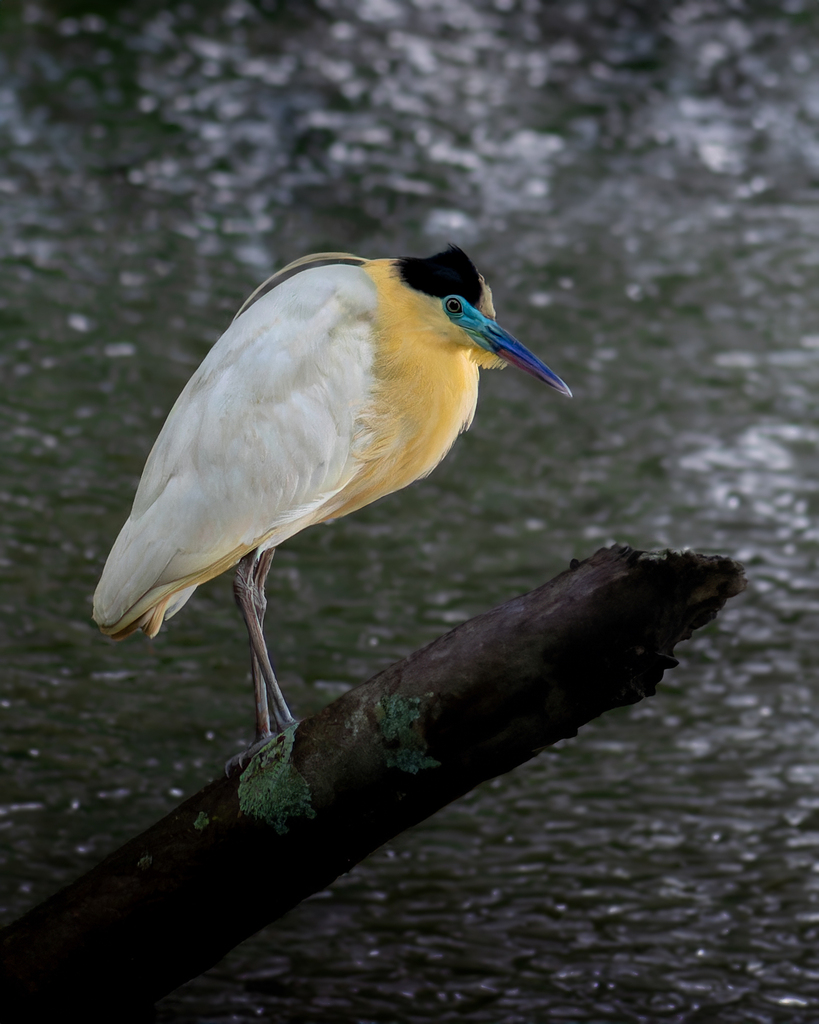
Capped Heron
Photo © Enéas V. Gouvêa Junior
Photo © Enéas V. Gouvêa Junior — CC BY-SA 4.0 — Source: iNaturalist photo #621069453Identification
The capped heron is one of the most distinctive herons in the Americas, instantly recognizable by its striking blue beak and face paired with a distinctive black crown. From this crown extend three to four elegant white feathers that give the species its common name. The underparts—belly, chest, and neck—are covered in yellowish-white or light-cream plumage, while the wings and back are pure white. Adults are compact herons, measuring between 510 and 590 mm in body length and weighing 444 to 632 grams. Juveniles closely resemble adults but are slightly smaller, with white feathers that appear faintly grey. Notably, there is no sexual dimorphism in plumage color or brightness, making male and female birds indistinguishable by appearance alone.
Despite superficial similarities to night herons in overall form, the capped heron differs fundamentally in its active daytime or twilight hunting behavior. As the sole species in its genus Pilherodius, it stands alone among herons, with molecular studies confirming its closest living relative to be the whistling heron.
Range & Habitat
The capped heron is endemic to the neotropics, inhabiting rainforest from Panama through to southern Brazil. Its range spans Bolivia, Brazil, Colombia, Ecuador, French Guiana, Panama, Paraguay, Peru, Suriname, and Venezuela. The species is found in lowland areas up to 900 meters above sea level, though altitudinal limits vary by region—occurring only below 500 meters in Venezuela and below 400 meters in Ecuador. The bird appears to be sedentary with no registered migrations, though seasonal movements may occur in Darien, Panama.
This water bird shows a strong preference for swamps, ditches, and wet grasslands within rainforest environments. It typically forages along shorelines and floating vegetation but is adaptable enough to venture into deeper ponds, rivers, and even human-modified landscapes such as coffee plantation trenches and flooded rice fields. The species is almost exclusively associated with rainforest habitats, making it a characteristic bird of South America's wetland ecosystems.
Behaviour & Diet
Capped herons are primarily fish hunters, employing a distinctive hunting technique that begins with the bird standing erectly to scan for prey. Once a target is spotted, the heron crouches slowly, extends its neck, and strikes with explosive speed, introducing its beak into the water to capture small fish typically between 1 and 5 centimeters long. Success rates average around 23 percent. In addition to fish, they hunt aquatic insects, larvae, tadpoles, and frogs, gleaning insects from nearby vegetation while fishing in shallow water. These herons are highly mobile, frequently moving between feeding sites and sometimes flying up to 100 meters between locations. They typically hunt in solitude, though aerial hunting, foot paddling, dipping, and swimming feeding have all been recorded.
The species is strongly territorial, with individual birds maintaining the same foraging site for weeks at a time. Capped herons are normally solitary but occasionally appear in pairs or small groups. Though sometimes seen alongside snowy egrets, scarlet ibis, and other species, they avoid large mixed-species feeding flocks and appear submissive to great egrets while dominating smaller species like striated herons. Very little is known about breeding, though captive birds in Miami have produced clutches of 2–4 dull white eggs with an incubation period of 26–27 days.
Best Time & Places to See It
Capped herons inhabit rainforest wetlands throughout their range from Panama to southern Brazil. Look for them in swamps, wet grasslands, ditches, pond margins, and along riverbanks. The species may be crepuscular but is readily observed foraging during daylight hours, unlike nocturnal night herons, making them accessible to daytime birders and wildlife photographers. Their territorial nature means that the same individual can often be relocated to its preferred foraging site on multiple visits, increasing the likelihood of productive encounters.
The bird's preference for shallow water edges, floating vegetation, and shorelines makes waterside habitats the most productive for observation. Given the species' rarity in birding literature and its elusive nature, patience and persistence at known wetland sites within its range will offer the best opportunities for sightings.
Photography Tips
The capped heron's striking field marks—the blue face, black crown, and contrasting white plumage—make it a visually rewarding photographic subject when located. Position yourself quietly along shorelines or pond edges where the bird forages, as its solitary hunting behavior means it can be approached with care and stealth. Early morning and late afternoon light will highlight the brilliant blue facial coloring and the delicate white crown feathers to best effect.
Capture the characteristic hunting posture by waiting for the moment when the heron extends its neck prior to striking. The bird's frequent movement between feeding sites means you may need to follow it quietly at a distance, relocating to new vantage points as it works along the water's edge. The strongly territorial nature of these birds suggests that returning to the same location on successive days increases the probability of obtaining quality images of individual birds in their familiar habitat.
Tijuca National Park
Brazil
+317 birds+13 mammals
Where the Atlantic forest rises steeply from Rio de Janeiro's urban edge, Tijuca National Park encompasses a landscape of dramatic granite peaks, cascading waterfalls, and closed-canopy…
VIEW NATIONAL PARKSerra do Cipó National Park
Brazil
+379 birds+5 mammals
Where granite escarpments rise above the Atlantic Forest transition zone in southeastern Brazil, Serra do Cipó National Park unfolds across a landscape of dramatic ridges, cascading…
VIEW NATIONAL PARKYasuní National Park
Aguarico, Ecuador
+601 birds+43 mammals
Where the western Amazon basin converges with Ecuador's Orellana Province, lowland rainforest reaches toward the horizon in an unbroken canopy of staggering botanical density. Yasuní National…
VIEW NATIONAL PARKNatural Sierra de Chiribiquete National Park
Solano, Colombia
+359 birds+27 mammals
Massive table-top mountains rise abruptly from the lowland rainforest of southeastern Colombia, their sheer sandstone cliffs and isolated summits creating some of the most dramatic topography…
VIEW NATIONAL PARKNatural Utría National Park
Alto Baudó (Pie de Pató), Colombia
+372 birds+11 mammals
Where the Chocó's coastal mountains plunge toward the Pacific, Utría National Park preserves one of Colombia's most biodiverse and least-visited wilderness expanses. Sprawling across 1,287 square…
VIEW NATIONAL PARKNatural la Paya National Park
Puerto Leguízamo, Colombia
+262 birds+4 mammals
Where the Amazon's western reaches fold into the Andes foothills, La Paya National Park sprawls across more than 8,500 square kilometers of pristine Amazonian rainforest in…
VIEW NATIONAL PARKMorrocoy National Park
Municipio Silva
+290 birds
Where the Caribbean coast of northwestern Venezuela meets protected coastal waters, a mosaic of mangrove forests, sandy beaches, and coral reef systems defines Morrocoy National Park.…
VIEW NATIONAL PARKNatural Sierra de la Macarena National Park
Vista Hermosa, Colombia
+566 birds+15 mammals
Across nearly 20,000 square kilometres of Colombia's Meta Department, the terrain rises from lowland savanna into Andean foothills through a mosaic of gallery forests, palm-fringed wetlands,…
VIEW NATIONAL PARKAmacayacu National Park
Leticia, Colombia
+567 birds+25 mammals
Where the Rio Amazonas curves through the tri-border region where Colombia, Peru, and Brazil converge, Amacayacu National Park sprawls across more than 5,250 square kilometres of…
VIEW NATIONAL PARKItatiaia National Park
Brazil
+519 birds+12 mammals
Where granite peaks pierce the Atlantic rainforest canopy in southeastern Brazil, Itatiaia National Park rises as one of the country's oldest and most ecologically vital protected…
VIEW NATIONAL PARKViruá National Park
Brazil
+389 birds+6 mammals
Across the northern frontier of Roraima, where the forest canopy rises from ancient Amazonian lowlands, Viruá National Park protects nearly 3,700 square kilometres of terra firme…
VIEW NATIONAL PARKIguaçu National Park
Brazil
+387 birds+17 mammals
Where the Paraná Plateau plunges toward the Atlantic watershed, six thousand square kilometers of subtropical rainforest cling to steep gorges and river valleys in this corner…
VIEW NATIONAL PARKSerra dos Órgãos National Park
Brazil
+446 birds+13 mammals
Granite peaks thrust skyward through the Atlantic Forest canopy in the mountains immediately north of Rio de Janeiro, their bare rock faces rising above a landscape…
VIEW NATIONAL PARKChapada dos Guimarães National Park
Brazil
+450 birds+1 mammals
Where weathered sandstone plateaus rise above the cerrado grasslands of central Brazil, Chapada dos Guimarães National Park protects 624 square kilometres of ecological transition zone that…
VIEW NATIONAL PARKChapada dos Veadeiros National Park
Brazil
+324 birds+6 mammals
Where granite plateaus rise above the cerrado savanna in central Brazil, Chapada dos Veadeiros National Park unfolds across 6,665 square kilometres of some of the world's…
VIEW NATIONAL PARKPantanal Matogrossense National Park
Brazil
+322 birds+17 mammals
Where the flooded forests of central Brazil meet vast seasonally inundated grasslands, Pantanal Matogrossense National Park sprawls across nearly 2,900 square kilometers of one of the…
VIEW NATIONAL PARKBrasília National Park
Plano Piloto, Brazil
+338 birds+15 mammals
Cerrado grassland and scattered woodland sweep across the central Brazilian plateau where this national park sprawls across more than a thousand square kilometres of the Federal…
VIEW NATIONAL PARKAmazônia National Park
Brazil
+439 birds+6 mammals
Where the Rio Amazonas and its tributaries weave through the heart of Pará state, a vast tapestry of rainforest stretches across 23,611 square kilometers of unbroken…
VIEW NATIONAL PARKMapinguari National Park
Brazil
+354 birds
Vast tracts of western Amazonian rainforest blanket the remote terrain of this 56,827 square kilometre national park in Amazonas state, where seasonal rivers wind through dense…
VIEW NATIONAL PARKJaú National Park
Brazil
+354 birds+3 mammals
Vast floodplain forests and blackwater rivers define this remote corner of western Amazonas, where the Rio Negro and its tributaries have carved an intricate mosaic of…
VIEW NATIONAL PARKAnavilhanas National Park
Brazil
+468 birds+8 mammals
Across the Rio Negro in central Amazonas, an archipelago of over a thousand islands rises from the world's largest rainforest river system, creating a labyrinth of…
VIEW NATIONAL PARKCampos Amazónicos National Park
Amazonas, Brazil
+434 birds+7 mammals
Sprawling across the southwestern Amazon basin in Amazonas state, this 27,263-square-kilometre national park encompasses some of the region's most pristine lowland rainforest, where terra firme forest…
VIEW NATIONAL PARKSerra do Divisor National Park
Brazil
+448 birds+10 mammals
Where the western Amazon meets the Andes foothills, Serra do Divisor National Park sprawls across one of South America's most biodiverse and least accessible frontiers. Spanning…
VIEW NATIONAL PARKYanachaga–chemillén National Park
Palcazu, Peru
+639 birds+6 mammals
Where the eastern slopes of Peru's central cordillera plunge into cloud forest, Yanachaga–Chemillén National Park protects nearly three thousand square kilometres of montane wilderness that few…
VIEW NATIONAL PARKManu National Park
Manu, Peru
+892 birds+26 mammals
Across the eastern slopes of the Peruvian Andes, tropical rainforest descends into the Amazon basin with a complexity that few terrestrial ecosystems match. Manu National Park…
VIEW NATIONAL PARKSierra del Divisor National Park
Alto Tapiche, Peru
+298 birds+2 mammals
Where the western Amazon meets the Andes foothills, nearly 41,000 square kilometres of pristine rainforest rise across Peru's Alto Tapiche region in a landscape of extraordinary…
VIEW NATIONAL PARKBahuaja Sonene National Park
San Pedro de Putina Punco, Peru
+602 birds+8 mammals
Where the Madre de Dios and Heath rivers converge in southeastern Peru rises one of South America's most biodiverse wilderness regions: a vast protected realm of…
VIEW NATIONAL PARKIchigkat Muja – Cordillera del Cóndor National Park
Río Santiago, Peru
+101 birds
Where the Andes descend into the western Amazon, the Río Santiago carves through a landscape of profound biological complexity. Ichigkat Muja – Cordillera del Cóndor National…
VIEW NATIONAL PARKTingo Maria National Park
Mariano Dámaso Beraún, Peru
+423 birds
Where the eastern slopes of the Peruvian Andes descend toward the Amazon basin, the landscape fractures into a maze of limestone ridges, humid gorges, and cloud-wrapped…
VIEW NATIONAL PARKCordillera Azul National Park
Pampa Hermosa, Peru
+322 birds+1 mammals
Where the eastern Andes descend into the western Amazon basin, Cordillera Azul National Park sprawls across nearly 38,000 square kilometres of some of Peru's most pristine…
VIEW NATIONAL PARKSoberanía National Park
Cristóbal, Panama
+495 birds+34 mammals
Rainforest and riverine woodland blanket the rolling terrain of this 714-square-kilometre national park in Colón Province, where the Caribbean watershed feeds a maze of streams and…
VIEW NATIONAL PARKChagres National Park
Caimitillo, Panama
+486 birds+19 mammals
Where the Chagres River carves through the humid tropics of central Panama, a vast montane and lowland forest sprawls across more than 2,300 square kilometers, anchoring…
VIEW NATIONAL PARKDarién National Park
Tucutí, Panama
+534 birds+13 mammals
Where the spine of Central America crumbles into wetland and rainforest, Darién National Park sprawls across more than 20,000 square kilometres of some of the tropics'…
VIEW NATIONAL PARKPortobelo National Park
Portobelo, Panama
+366 birds+9 mammals
Where the Caribbean's turquoise waters meet the Darién's verdant shore, Portobelo National Park sprawls across 570 square kilometers of coastal forest, mangrove wetland, and coral-fringed islands…
VIEW NATIONAL PARKIguazú National Park
Puerto Iguazú, Argentina
+346 birds+15 mammals
Where the Paraná Plateau plunges toward the Atlantic watershed, nearly 800 square kilometers of subtropical rainforest drape across Misiones Province in a landscape carved by millennia…
VIEW NATIONAL PARKNo community photos yet. Log in to add the first one.
No community observations of this species yet.