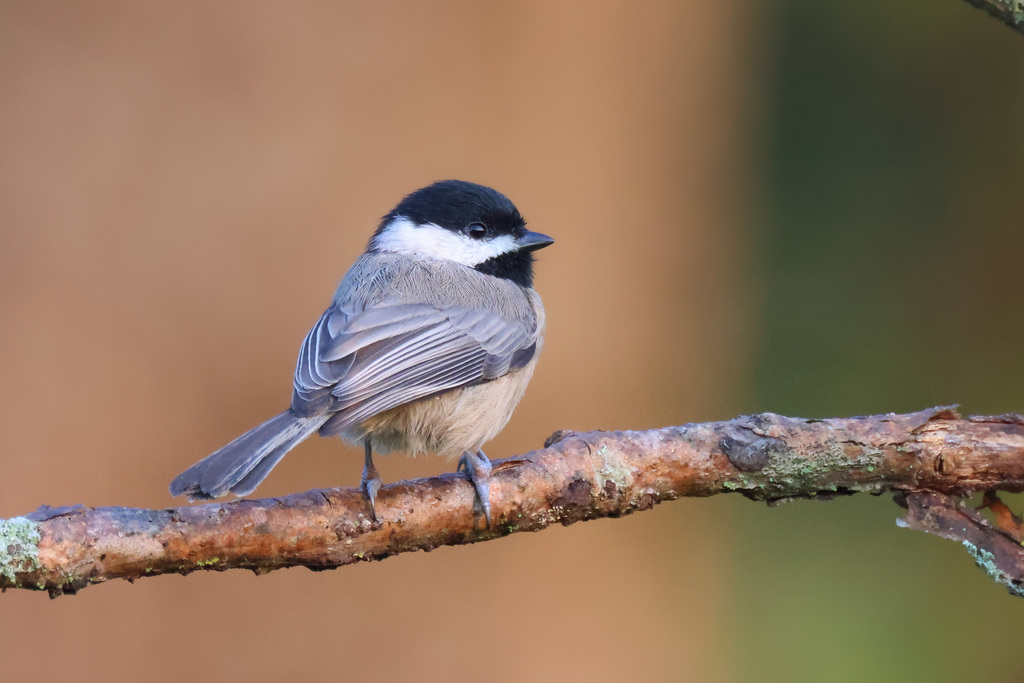
Carolina Chickadee
Photo © Andy Wilson
Photo © Andy Wilson — CC0 1.0 — Source: iNaturalist photo #231142329The Carolina chickadee (Poecile carolinensis) is a small passerine bird in the tit family Paridae. It is largely found in the Southern United States. == Taxonomy == The Carolina chickadee was often placed in the genus Parus with most other tits, but mtDNA cytochrome b sequence data and morphology suggest that separating Poecile more adequately expresses these birds' relationships. The American Ornithologists' Union has been treating Poecile as distinct genus since 1998. Although it and the black-capped chickadee most likely diverged about 2.5 million years ago, the birds still hybridize in the areas where their ranges overlap. The offspring of mated pairs of hybrid chickadees suffer from lower hatching success, and a male bias sex ratio, consistent with Haldane's rule. == Description == Adults are 11.5–13 cm (4.5–5.1 in) long with a weight of 9–12 g (0.32–0.42 oz), and have a black cap and bib with white sides to the face. Their underparts are white with rusty brown on the flanks; their back is gray. They have a short dark bill, short wings and a moderately long tail. Very similar to the black-capped chickadee, the Carolina chickadee is distinguished by the slightly browner wing with the greater coverts brown (not…
New River Gorge National Park
Fayette County, United States
+183 birds+13 mammals
Where the New River carves its ancient path through the Appalachian plateau, a landscape of towering sandstone cliffs and dense deciduous forest creates one of the…
VIEW NATIONAL PARKMammoth Cave National Park
Edmonson County, United States
+179 birds+13 mammals
Beneath the rolling hills of central Kentucky lies one of North America's most extensive cave systems, where limestone passages descend through a landscape shaped by water…
VIEW NATIONAL PARKEverglades National Park
Monroe County, United States
+345 birds+22 mammals
Where freshwater marsh meets subtropical sky, the Everglades sprawls across southwestern Florida as one of North America's most expansive wetland ecosystems. Spanning over 13,000 square kilometers,…
VIEW NATIONAL PARKGreat Smoky Mountains National Park
Sevier County, United States
+244 birds+40 mammals
Where the southern Appalachian ridgeline reaches its most densely forested expression, over 4,200 square kilometres of temperate woodland rise and fall across Tennessee and North Carolina,…
VIEW NATIONAL PARKCongaree National Park
Richland County, United States
+205 birds+12 mammals
Where the Congaree River winds through the lowlands of South Carolina, an old-growth bottomland forest of extraordinary character rises from a landscape shaped by seasonal floods…
VIEW NATIONAL PARKHot Springs National Park
Hot Springs, United States
+168 birds+8 mammals
Thermal waters rising from deep within the Ouachita Mountains have carved a landscape unlike anywhere else in the continental United States, where 47 natural hot springs…
VIEW NATIONAL PARKShenandoah National Park
Page County, United States
+243 birds+31 mammals
Ridges of ancient quartzite rise above the Shenandoah Valley floor, their slopes dressed in a mosaic of oak and hickory forest that yields to cove hardwoods…
VIEW NATIONAL PARKMerritt Island National Wildlife Refuge
Brevard County, United States
+341 birds+19 mammals
Brackish marshes and palmetto scrub define this wildlife sanctuary spanning the coastal lowlands of central Florida, where the Atlantic tide meets freshwater systems in a dynamic…
VIEW WILDLIFE SANCTUARYOkefenokee National Wildlife Refuge
Charlton County, United States
+206 birds+14 mammals
Vast wetlands of cypress and blackwater creeks define this wildlife sanctuary straddling the Georgia–Florida border, where the landscape shifts between open marsh, dense swamp forest, and…
VIEW WILDLIFE SANCTUARYChincoteague National Wildlife Refuge
Chincoteague, United States
+362 birds+16 mammals
Across the barrier islands and salt marshes of Virginia's Eastern Shore, where Atlantic tides sculpt an intricate mosaic of sandy spits and tidal flats, lies one…
VIEW WILDLIFE SANCTUARYWheeler National Wildlife Refuge
Triana, United States
+268 birds+10 mammals
Shallow impoundments and meandering channels spread across northern Alabama's humid subtropical landscape, where Wheeler National Wildlife Sanctuary anchors a critical junction of wetland and woodland habitat.…
VIEW WILDLIFE SANCTUARYBombay Hook National Wildlife Refuge
Kent County, United States
+323 birds+15 mammals
Tidal marshes and brackish shallows define this sanctuary on Delaware's Atlantic coast, where the meeting of freshwater and salt creates some of the Mid-Atlantic's most dynamic…
VIEW WILDLIFE SANCTUARYBlackwater National Wildlife Refuge
Fishing Creek, United States
+293 birds+15 mammals
Tidal marshes and brackish waterways define this wildlife sanctuary where the Chesapeake Bay's influence reshapes the landscape with every rise and fall of the water. Shallow…
VIEW WILDLIFE SANCTUARYAlligator River National Wildlife Refuge
Dare County, United States
+288 birds+17 mammals
Where the coastal plain of North Carolina meets the Albemarle Peninsula, a sprawling mosaic of freshwater marshes, pocosins, and swamp forest creates one of the Atlantic…
VIEW WILDLIFE SANCTUARYPea Island National Wildlife Refuge
Dare County, United States
+356 birds+15 mammals
Where the Outer Banks taper toward the Atlantic, a sliver of barrier island creates a microcosm of coastal ecology. Pea Island National Wildlife Sanctuary spans over…
VIEW WILDLIFE SANCTUARYSt. Marks National Wildlife Refuge
Saint Marks, United States
+324 birds+16 mammals
Where the Apalachee Bay begins to define the Florida coastline, salt marshes and freshwater impoundments merge into one of the southeastern United States' most productive wildlife…
VIEW WILDLIFE SANCTUARYCedar Keys National Wildlife Refuge
Levy County, United States
+268 birds+8 mammals
Where the Florida Gulf Coast transitions from mainland to archipelago, Cedar Keys National Wildlife Sanctuary protects a mosaic of salt marshes, shallow estuaries, and maritime hammocks…
VIEW WILDLIFE SANCTUARYChassahowitzka National Wildlife Refuge
Homosassa, United States
+299 birds+14 mammals
Where the Gulf of Mexico's coastal marshes dissolve into brackish tidal flats and mangrove thickets, the Chassahowitzka National Wildlife Sanctuary near Homosassa represents one of Florida's…
VIEW WILDLIFE SANCTUARYNo community photos yet. Log in to add the first one.
No community observations of this species yet.