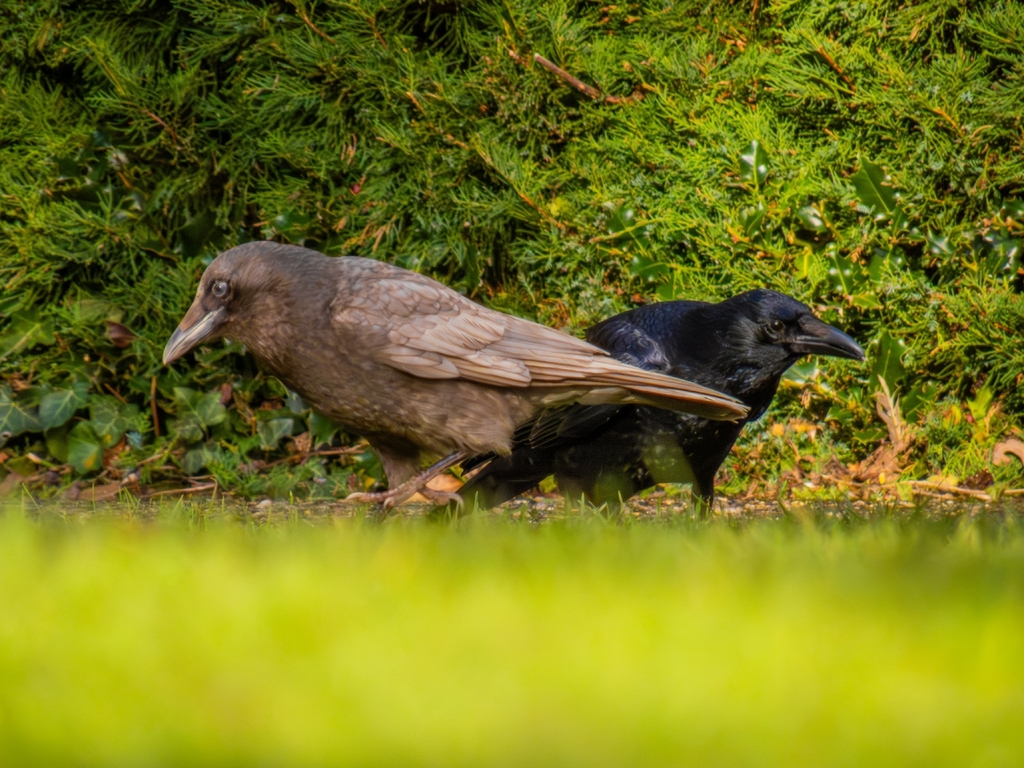
Carrion Crow
Photo © Rhys
Photo © Rhys — CC BY 4.0 — Source: iNaturalist photo #616972759Identification
The carrion crow is a large, all-black passerine with distinctive plumage that shows a green or purple sheen—noticeably greener than that of the rook. Measuring 48–52 cm in length with a wingspan of 84–100 cm and weighing 400–600 g, it is smaller than the common raven (which averages 63 cm) but larger and stockier than the American crow. The bill, legs, and feet are entirely black. Juvenile carrion crows are distinguishable by their brownish plumage and blue eyes, which darken to black and brown as they mature.
The carrion crow is most easily confused with the hooded crow, from which it differs by its completely black plumage rather than the hooded crow's grey torso. The two species are so genetically similar that they can hybridize, yet they maintain distinct populations through assortative mating, preferring to breed with others of their own appearance.
Range & Habitat
Native to western Europe and the eastern Palearctic, the carrion crow occupies a similar ecological niche across Eurasia to the American crow in North America. The species is also found in the mountains, forests, and cities of Japan. Geographic distribution varies between the closely related carrion crow and hooded crow, with their ranges shaped by Pleistocene glaciation cycles that caused population splits and subsequent range re-expansion.
Carrion crows are highly adaptable and frequent diverse habitats including cities, moors, woodland, sea cliffs, and farmland. They thrive near areas of human activity and habitation, where they compete with gulls, other corvids, and ducks for food in parks and gardens.
Behaviour & Diet
Unlike the gregarious rook, the carrion crow is largely solitary, though it may feed alongside rooks and often joins winter roosts. The species is vocal and noisy, perching on prominent vantage points such as buildings or treetops and calling three or four times in quick succession with slight pauses between series. Its distinctive guttural, deeper croaked "kraa" differs markedly from the rook's high-pitched call. While calling, crows typically raise their shoulders and bow their heads and necks downward with each caw, and their wingbeats are notably slower and more deliberate than those of rooks.
Like other corvids, carrion crows are highly intelligent, capable of discriminating between numbers up to 30, flexibly switching between rules, and recognizing both human and crow faces. They actively harass predators and competitors, engaging in group mobbing behaviour to defend territory and offspring. Though named for their consumption of carrion, they are opportunistic omnivores eating insects, earthworms, invertebrates, grain, fruits, seeds, nuts, small mammals, amphibians, fish, human food scraps, and stolen eggs. They frequently harass birds of prey or foxes to steal their kills and are natural scavengers drawn to human habitation by household waste.
Best Time & Places to See It
Carrion crows are year-round residents throughout their range and can be encountered in virtually any season. They become particularly visible in winter when they congregate at roosts. Look for them perching prominently on buildings, trees, and other vantage points where their loud calls make them easy to locate. Urban parks, farmland, coastal cliffs, and woodland edges all offer good opportunities for observation, especially in areas with human activity where they scavenge for food.
Photography Tips
The carrion crow's all-black plumage can be challenging to expose correctly; meter carefully to retain detail and avoid blown highlights on the glossy feathers. Position yourself to capture the characteristic calling posture—the raised shoulders and bowed head and neck—which makes for dynamic and behavioural photographs. Early morning and late afternoon light will best reveal the bird's green or purple sheen. Photograph birds in flight to showcase their deliberate wingbeats, and capture them on prominent perches where they naturally position themselves. Urban and suburban settings provide accessible subjects with manageable backgrounds.
Bearded Vulture photography workshop at Buseu
Nothing matches these filters.
Nothing matches these filters.
Abruzzo, Lazio and Molise National Park
Alpilles Regional Nature Park
Altai Tavan Bogd National Park
Asinara National Park
Avesnois Regional Nature Park
Baikal National Park
Baima Snow Mountain National Nature Reserve
Bannau Brycheiniog National Park
Bardenas Reales
Nothing matches these filters.
No community photos yet. Log in to add the first one.
No community observations of this species yet.