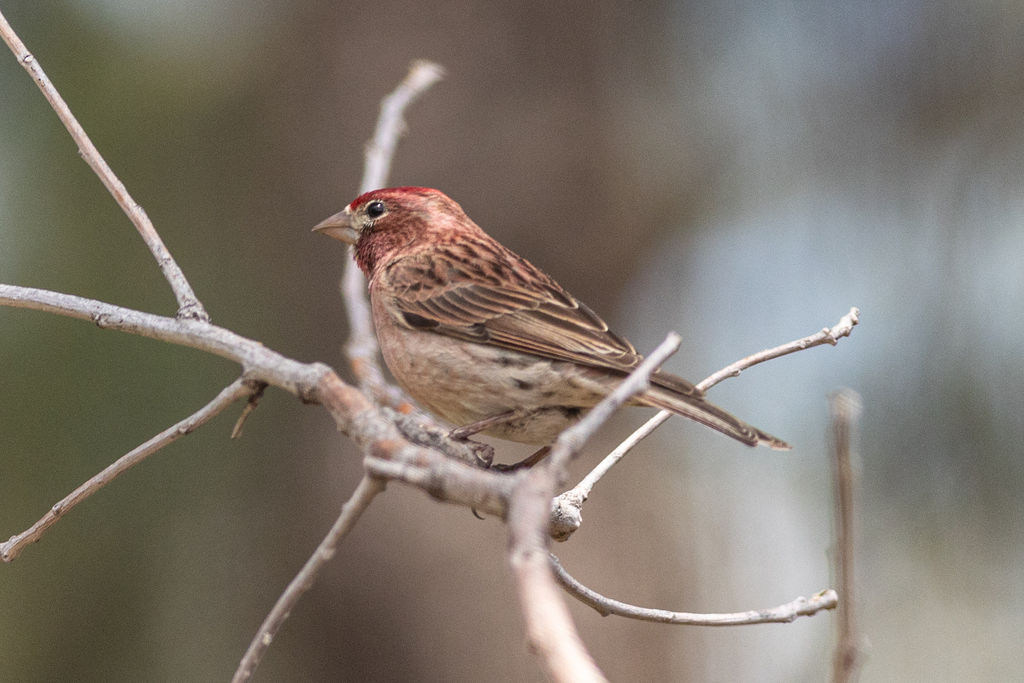
Cassin’s Finch
Photo © Craig Martin
Photo © Craig Martin — CC0 1.0 — Source: iNaturalist photo #381571031Identification
Cassin's Finch is a small finch measuring 6.3 inches (16 cm) in length with a wingspan of 9.8–10.6 inches (25–27 cm) and weighing 0.8–1.2 oz (24–34 g). The species is distinguished by a relatively long, pointed bill—longer than that of the similar Purple Finch. Both sexes display a short, forked brown tail and brown wings.
Adult males are striking, with raspberry-red plumage on the head, breast, back, and rump, though the back and under-tail show brown streaking. Females are considerably duller, with light brown upper-parts and light underparts streaked with brown throughout; their facial markings are less pronounced than those of female Purple Finches. Interestingly, individuals of both sexes can display brown, red, or white eyes.
Range & Habitat
This western North American species breeds in coniferous mountain forests from British Columbia south to northern New Mexico, Arizona, and Southern California near Baja California. They nest in large conifers and favour high-elevation habitats during breeding season. In winter, the species moves to lower elevations; northernmost populations migrate south, while many individuals throughout the range remain as permanent residents. Some non-breeding birds winter as far south as central interior Mexico.
Behaviour & Diet
Cassin's Finches are primarily seed-eaters, supplementing their diet with buds, berries, and insects—the latter being more prevalent during summer months. They forage actively in trees and occasionally on the ground, and outside the breeding season often congregate in small feeding flocks. Nesting occurs in large conifers, and occasionally in deciduous trees or human-modified habitats such as farmland. Females construct open-cup nests from sticks, weeds, roots, bark, grass, plant fibres, animal hair, and lichens. Clutches typically contain 4–5 bluish-green eggs spotted with brown and black; incubation lasts 12–14 days and is performed by the female alone, while both parents feed nestlings until fledging at approximately 2 weeks of age.
Best Time & Places to See It
The best opportunities to observe Cassin's Finch occur during the breeding season in western montane coniferous forests. Target high-elevation pine and fir forests in ranges such as the Rocky Mountains, Sierra Nevada, and Cascade Range. Winter birdwatching can be productive at lower elevations and in interior valleys where flocking birds gather at seed sources. Visit protected forest areas and nature reserves within the species' breeding range for reliable sightings.
Photography Tips
The bright red plumage of breeding males makes them visually striking subjects, particularly when perched prominently in conifers. The species' habit of foraging in trees and visiting seed sources offers steady photography opportunities. Early morning light best captures the vivid raspberry-red tones of males. Patience is rewarded when photographing flocking birds in winter, as feeding flocks often provide multiple subjects in a single location. A telephoto lens (400–600 mm) is recommended to capture fine detail without disturbing the birds.
Alaska Maritime National Wildlife Refuge
Arches National Park
Banff National Park
Bear River Migratory Bird Refuge
Big Bend National Park
Black Canyon of the Gunnison National Park
Bosque del Apache National Wildlife Refuge
Bryce Canyon National Park
Canyonlands National Park
Nothing matches these filters.
No community photos yet. Log in to add the first one.
No community observations of this species yet.