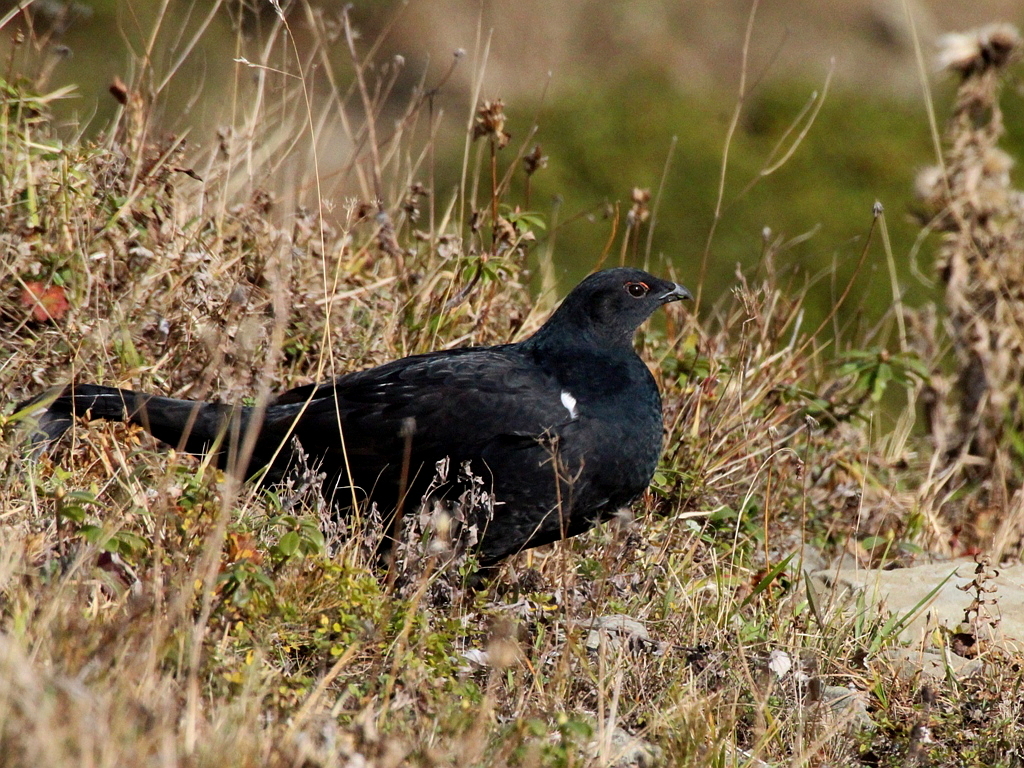
Caucasian Grouse
Photo © Andrew Bazdyrev
Photo © Andrew Bazdyrev — CC BY 4.0 — Source: iNaturalist photo #67094840Identification
The Caucasian grouse is a large gamebird with striking sexual dimorphism. Males are unmistakable: measuring 50–55 cm in length, they display all-black plumage offset by distinctive red eyebrows and a long, deeply forked tail that is their most prominent feature. Females are considerably smaller at 37–42 cm, with grey plumage marked by dark barring throughout, making them less conspicuous in their mountain habitat. The species is closely related to the black grouse, though the Caucasian grouse occupies a distinctly separate geographic range.
Range & Habitat
This sedentary species is found in extreme southeastern Europe and adjacent regions, with its range centred on the Caucasus and Pontic Mountains of northeast Turkey and Iran. The bird favours open slopes with low vegetation, particularly Rhododendron scrubland and other low scrubs, though it maintains proximity to deciduous broad-leaf forest. This preference for mixed terrain—combining open ground for display and foraging with nearby woodland for shelter—defines its narrow ecological niche in this mountainous region.
Behaviour & Diet
The Caucasian grouse is remarkable for its unusually quiet breeding displays. Unlike the vocal Eurasian black grouse, males gather in traditional lek sites during May and June where they perform an almost silent display: cocks flutter their wings and leap and turn through the air, briefly flashing white underwing feathers in dramatic aerial acrobatics accompanied only by thin whistling sounds. This striking yet subdued performance is quite unlike the boisterous displays of related species. Females handle all breeding responsibilities, laying up to ten eggs in a simple ground scrape and caring for the chicks alone, as is typical among gamebirds.
Best Time & Places to See It
May and June offer the prime opportunity to observe Caucasian grouse during their breeding season when males gather at traditional lek sites on open mountain slopes. The bird's sedentary nature means populations remain within the Caucasus and Pontic Mountains year-round, making the habitat relatively predictable for visitors, though the species' remote and mountainous range demands considerable effort to access. The bird remains perhaps the least-studied grouse species in the world, reflecting both its restricted range and the challenging terrain it inhabits.
Photography Tips
Photographing Caucasian grouse requires patience and early starts, as the most dramatic displays occur at dawn during the May and June lek season. Position yourself to capture the distinctive forked tail of displaying males and the characteristic flash of white underwing feathers revealed during their leaping displays. The male's all-black plumage with red eyebrows and pale underparts provides striking contrast, while females' grey and dark barring require careful exposure metering in variable mountain light. The bird's quietness and relatively unobtrusive display compared to other grouse species mean sustained observation is essential to capture natural behaviour effectively.
Racha-Lechkhum-Kvemo Svaneti Planned National Park
Zeskho, Georgia
+57 birds+1 mammals
Where granite gorges cut through the southern Caucasus, pristine alpine meadows cascade downward into temperate beech forests of extraordinary primeval character. This emerging protected landscape sprawls…
VIEW NATIONAL PARKTusheti National Park
Shavtskala, Georgia
+97 birds+4 mammals
Where granite peaks pierce the Caucasian sky at over 4,600 meters, ancient river valleys carve their way through one of Europe's most untamed wilderness regions. Tusheti's…
VIEW NATIONAL PARKZemo Svaneti Planned National Park
Hamashi-Totoleshi, Georgia
+159 birds+6 mammals
Where granite peaks pierce the clouds above the Caucasus, sweeping alpine meadows give way to pristine beech and spruce forests that have remained largely untouched for…
VIEW NATIONAL PARKNo community photos yet. Log in to add the first one.
No community observations of this species yet.