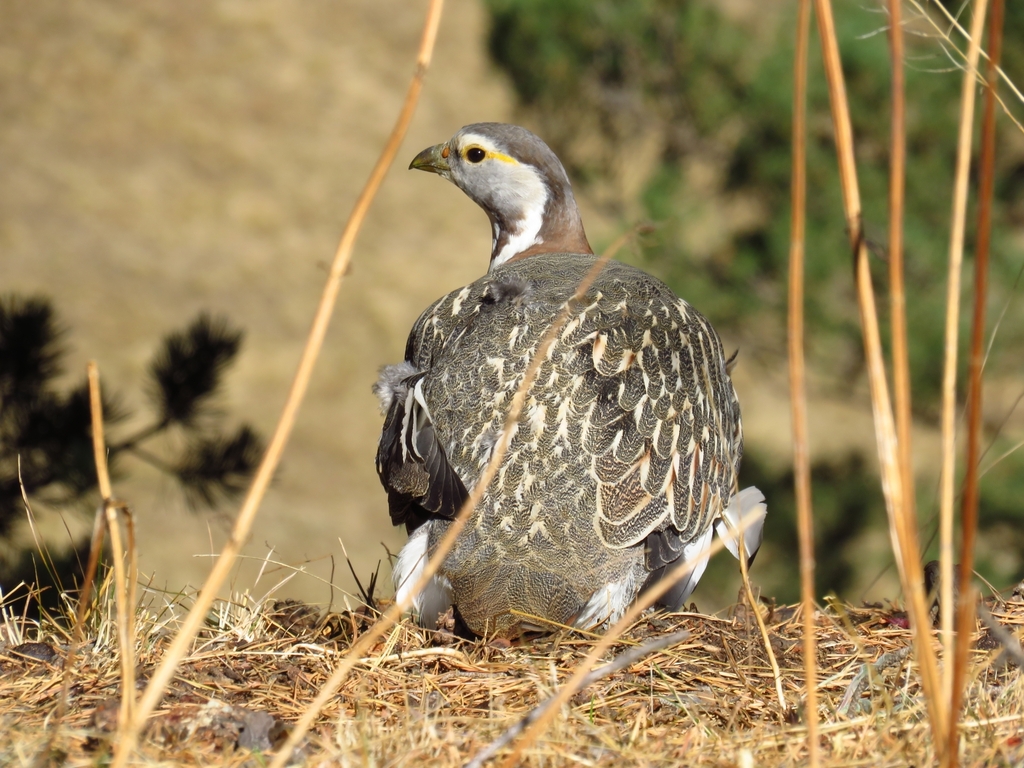
Caucasian Snowcock
Photo © Сергей Грабчак
Photo © Сергей Грабчак — CC BY 4.0 — Source: iNaturalist #188273187Identification
The Caucasian snowcock is a medium-sized game bird, measuring 50–60 cm in length. At a distance, it appears predominantly grey, but closer inspection reveals a subtle patterning of grey, brown, white, and black plumage. Distinctive field marks include a white throat, a white patch on the side of the neck, and a rust-colored nape. The breast is noticeably darker than the rest of the body, while the flanks show a ruddier tone. In flight, watch for white flight feathers and undertail coverts, contrasting with reddish sides to the tail. Male and female plumages are similar, though juveniles are slightly smaller and duller overall.
Range & Habitat
This species is endemic to the Caucasus Mountains, with populations concentrated in the Western Caucasus. The Caucasian snowcock breeds at high altitudes, typically between 2000 and 4000 meters, on bare, stony mountainous terrain. Its poor flight ability confines it to these montane regions; the bird is unable to travel far distances and therefore occurs nowhere else in the world. During spring and summer, birds occupy high-elevation nesting areas, descending to warmer elevations as winter approaches.
Behaviour & Diet
The Caucasian snowcock's behavior is shaped by its limited flight capacity. Rather than flying, it relies primarily on its legs, bouncing nimbly across rocky slopes. Its daily routine follows a simple pattern: birds coast downhill in early morning to feed, then gradually make their way back up the mountainside throughout the day to reach their nocturnal roosting sites. Outside the breeding season, the species forms small flocks, exhibiting strong social bonds and intact family units.
Diet consists almost entirely of seeds and vegetable matter, including small shrubs and plant species; invertebrates are rarely if ever consumed. During the breeding season, from February to April, males become aggressive competitors for mates and establish monogamous pairs. Nests are placed on bare ground scrapes at elevations between 2600 and 3500 meters, where females incubate clutches of typically 5–6 greenish eggs.
Best Time & Places to See It
The breeding season from February to April offers opportunities to observe this species at high elevations in the Western Caucasus, where pairs establish territories on bare stony slopes. However, accessibility to these remote alpine zones can be challenging and weather-dependent. The bird's wariness and preference for desolate, high-altitude terrain make sightings unpredictable, though early morning hours when birds descend to feed may offer the best chance of observation. Local knowledge of the region is invaluable for locating this species.
Photography Tips
Photographing the Caucasian snowcock demands patience and physical fitness, as it inhabits steep, rocky alpine terrain at considerable elevations. Early morning light during the descent to feeding areas may provide the best opportunities, though the bird's naturally wary nature requires careful stalking and distance. The subtle grey plumage can be challenging to render convincingly; meter carefully to avoid underexposure on the greyish tones while preserving detail in the distinctive white throat patch and neck markings. The bird's distinctive vocalizations—its desolate whistling song and loud cackling calls—can help locate birds in the rocky landscape.
Tusheti National Park
Shavtskala, Georgia
+97 birds+4 mammals
Where granite peaks pierce the Caucasian sky at over 4,600 meters, ancient river valleys carve their way through one of Europe's most untamed wilderness regions. Tusheti's…
VIEW NATIONAL PARKZemo Svaneti Planned National Park
Hamashi-Totoleshi, Georgia
+159 birds+6 mammals
Where granite peaks pierce the clouds above the Caucasus, sweeping alpine meadows give way to pristine beech and spruce forests that have remained largely untouched for…
VIEW NATIONAL PARKNo community photos yet. Log in to add the first one.
No community observations of this species yet.