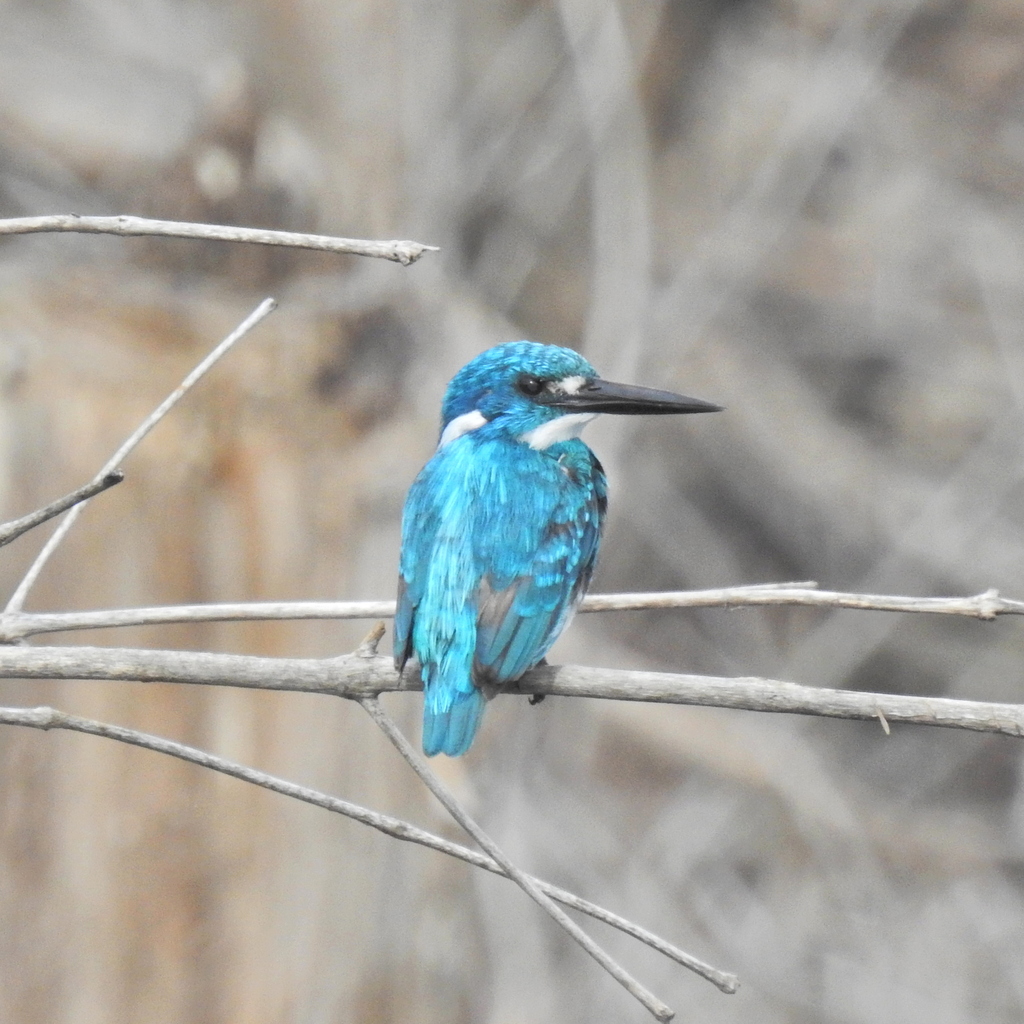
Cerulean Kingfisher
Photo © Hamas Fathani
Photo © Hamas Fathani — CC BY-SA 4.0 — Source: iNaturalist #145654489Identification
The cerulean kingfisher is a small kingfisher measuring just 13 cm in length, instantly recognizable by its striking metallic blue upperparts. Unlike the similar common kingfisher, this species has white underparts rather than orange, making it distinctive among its relatives. The face displays white lores and a prominent white patch on each side of the neck, while the breast is marked by an azure-blue band. The bill is blackish and the legs are dark brown.
Sexual dimorphism is subtle but noticeable to the careful observer. Males are more intensely blue overall, while females display duller plumage with a greenish cast and a narrower breast band, appearing less vibrant in direct comparison.
Range & Habitat
This species is endemic to Indonesia, with a distribution across several key islands including Sumatra, Java, Bali, Lombok, Sumbawa, and the Kangean Islands. As a resident species, it remains in its range year-round rather than undertaking seasonal migrations.
The cerulean kingfisher favors low-lying wetland habitats, typically found near freshwater streams and canals. It also frequents flooded paddy-fields and tidal estuaries, showing a preference for areas where shallow water provides ideal hunting grounds for small fish and aquatic prey.
Behaviour & Diet
Like all kingfishers, the cerulean kingfisher is a specialized fish-eater, hunting by perching alertly above water before diving rapidly to snatch small fish from the shallows. Its compact size and agility make it perfectly suited to navigating narrow streams and confined waterways where larger kingfishers cannot operate effectively.
Best Time & Places to See It
As a resident species present throughout the year, the cerulean kingfisher can be encountered in any season across its Indonesian range. The most productive locations are wetland areas in Sumatra, Java, and Bali, particularly around streams, canals, and the margins of flooded rice paddies during the agricultural season. Early morning hours typically offer the best viewing opportunities when the bird is most active.
Photography Tips
The cerulean kingfisher's small size and preference for low perches near water make it a rewarding but challenging photographic subject. Position yourself quietly along stream banks or canal edges and wait for the bird to emerge from cover. The metallic blue plumage photographs beautifully in soft, diffuse light—harsh midday sun can create reflective glare on the feathers. A telephoto lens (at least 300–400 mm equivalent) is essential given the species' wariness and small stature, and fast shutter speeds are necessary to freeze the bird's rapid hunting dives.
Taman Nasional Baluran
Situbondo, Indonesia
+189 birds+9 mammals
Across the northeastern tip of East Java, where monsoon winds sweep down from the Bali Strait, a landscape of contrasts unfolds within 374 square kilometres of…
VIEW NATIONAL PARKTaman Nasional Meru Betiri
Jember, Indonesia
+93 birds+1 mammals
Across East Java's southeastern coast, where the Indian Ocean meets a landscape of volcanic soils and monsoon-fed forests, sprawls a national park that epitomizes the ecological…
VIEW NATIONAL PARKWest Bali National Park
Gerokgak, Indonesia
+240 birds+8 mammals
Across West Bali's northwestern reaches, where the Indian Ocean meets volcanic slopes and limestone cliffs plunge toward turquoise shallows, sprawls a protected realm of roughly 325…
VIEW NATIONAL PARKGunung Merbabu National Park
Magelang, Indonesia
+61 birds+2 mammals
Where volcanic slopes rise sharply from the plateau of Central Java, Gunung Merbabu National Park encompasses nearly 200 square kilometers of montane forest that transitions through…
VIEW NATIONAL PARKMount Merapi National Park
Hargobinangun, Indonesia
+150 birds+3 mammals
Where the volcanic slopes of central Java rise into mist and montane forest, Mount Merapi National Park guards one of Indonesia's most dynamic landscapes. Spanning roughly…
VIEW NATIONAL PARKSembilang National Park
Banyuasin, Indonesia
+56 birds+3 mammals
Where tidal mangroves grade into freshwater swamp forest and the Musi River delta spreads across more than 7,000 square kilometres, Sembilang National Park represents one of…
VIEW NATIONAL PARKWay Kambas National Park
Lampung Timur, Indonesia
+237 birds+20 mammals
Across the low swamplands of eastern Lampung, where freshwater wetlands merge into tidal mangrove forests along the Sunda Strait, sprawls one of Sumatra's most vital sanctuaries.…
VIEW NATIONAL PARKKomodo National Park
Komodo, Indonesia
+155 birds+14 mammals
Where volcanic peaks rise dramatically from turquoise waters, a primordial landscape unfolds across three main islands and countless smaller ones scattered throughout the Lesser Sunda archipelago.…
VIEW NATIONAL PARKNo community photos yet. Log in to add the first one.
No community observations of this species yet.