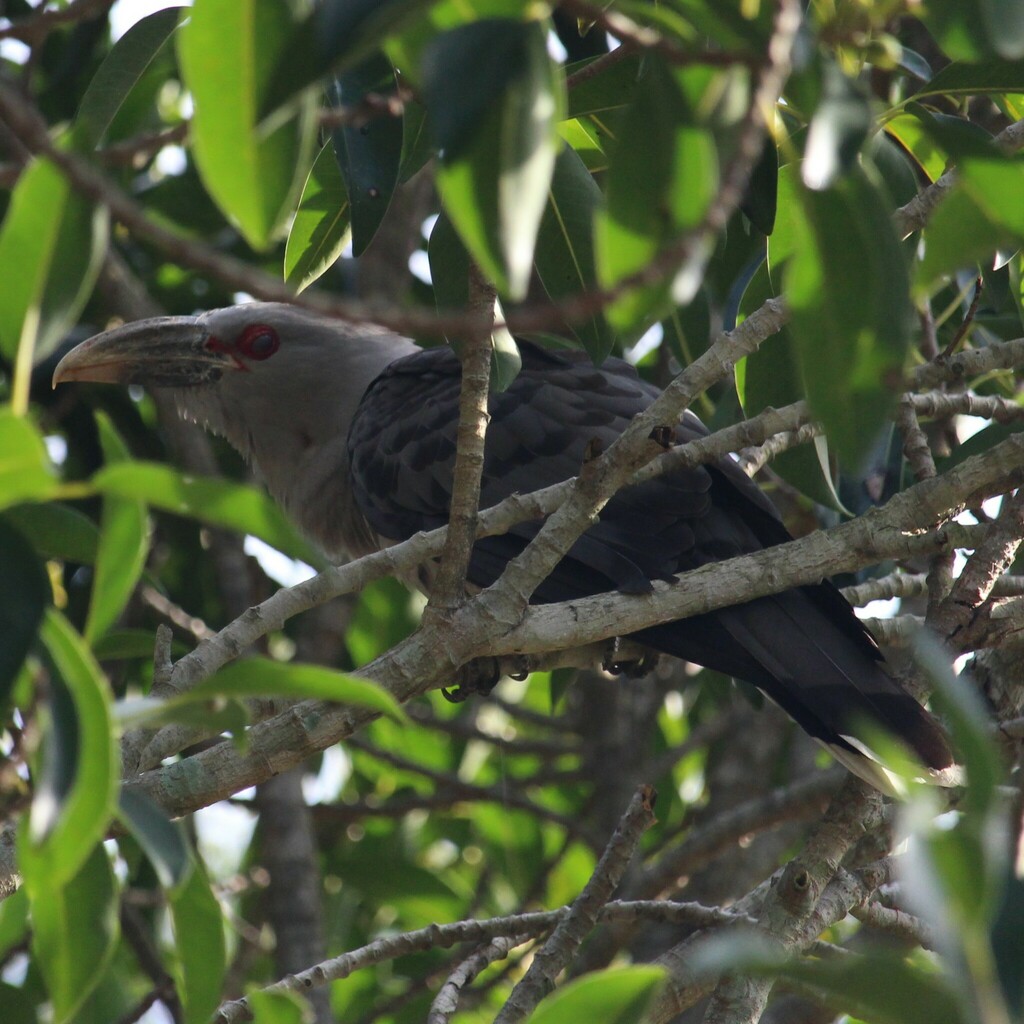
Channel-billed Cuckoo
Photo © Natasha Taylor
Photo © Natasha Taylor — CC BY 4.0 — Source: iNaturalist #187454547Identification
The channel-billed cuckoo is the world's largest cuckoo, measuring 56–70 cm in length with a wingspan of 88–107 cm. Its most distinctive feature is its massive, slightly curved bill—bi-coloured with a grey base and straw-coloured tip—which resembles that of a hornbill, leading to early colonial misidentification. Adults display pale grey plumage on the head, chest, belly and back, becoming paler and barred on the lower underparts. The wings are darker grey with dark-tipped feathers, and the tail is dark grey above with barring underneath, a black band, and a white tip. A striking red patch of bare skin surrounds each eye, and the legs and feet are black.
Juveniles appear similar but with buff-coloured plumage instead of pale grey, pale-tipped wing feathers, and a less massive, dirty-pink bill; the distinctive red eye-patch is absent in young birds. Females are noticeably smaller than males, with a smaller bill and paler, more heavily barred underparts. In flight, this large cuckoo displays a distinctive hawk-like, cross-shaped silhouette, and is a strong, capable flier despite its size.
Range & Habitat
This species has a widespread distribution across northern and eastern Australia, New Guinea, the Bismarck Archipelago, and eastern Indonesian islands as far west as Sulawesi. In Australia, the breeding range extends from north-eastern Western Australia through the Northern Territory and Queensland down the eastern coast to Sydney, with recent years showing range extensions further down the NSW south coast. A few stragglers occasionally reach Victoria, and vagrant birds have appeared in New Zealand and New Caledonia.
The species is partially migratory: birds are permanent residents in the Bismarck Archipelago, Flores and Sulawesi, while those breeding in Australia migrate northwards after breeding season (February–April) to wintering grounds in New Guinea and Indonesia, crossing the Torres Strait individually or in small groups. Return migration to Australia occurs from August through September. The species is fairly arboreal, equally capable in trees and on the ground, and remains largely hidden in tree canopies while foraging.
Behaviour & Diet
Often shy and elusive, the channel-billed cuckoo spends much of its time in tree canopies feeding on fruit, being most active during early morning and evening hours. Despite its secretive nature, it is frequently detected by its loud, raucous call. The species faces regular harassment from other birds: crows and miners actively swoop and chase channel-billed cuckoos when encountered, indicating their unpopular status among local avifauna.
Like all cuckoos, channel-billed cuckoos are brood parasites, laying their eggs in the nests of other bird species rather than raising their own young. They are thought to form pair bonds during the breeding season, engaging in calling and gift-giving displays in which males present food items such as insects to females. During egg-laying, pairs coordinate their efforts: the male flies over a host nest to provoke occupants into a mobbing response, creating an opportunity for the female to lay her eggs in the nest.
Best Time & Places to See It
August through September offers the best opportunity to observe returning breeding birds in eastern Australia, particularly in Queensland and New South Wales up to Sydney. Early morning and evening hours maximize viewing chances, as the species is most active during these times. Listen for its distinctive loud, raucous call, which often betrays the bird's presence before visual contact is made.
Photography Tips
The channel-billed cuckoo's shy nature and tendency to remain hidden in dense tree canopies present significant photographic challenges. Focus on early morning and evening hours when activity peaks. The bird's striking red eye-patch, massive distinctive bill, and pale grey plumage create compelling photographic subjects when successfully located. Its hawk-like flight silhouette in open air offers additional shooting opportunities, and the strong flier may be observed crossing open areas between foraging sites.
Annan River (Yuku Baja-Muliku) National Park
Barrington Tops National Park
Ben Boyd National Park
Blue Mountains National Park
Bogani Nani Wartabone National Park
Boodjamulla National Park
Bouddi National Park
Bribie Island National Park
Bunya Mountains National Park
Nothing matches these filters.
No community photos yet. Log in to add the first one.
No community observations of this species yet.