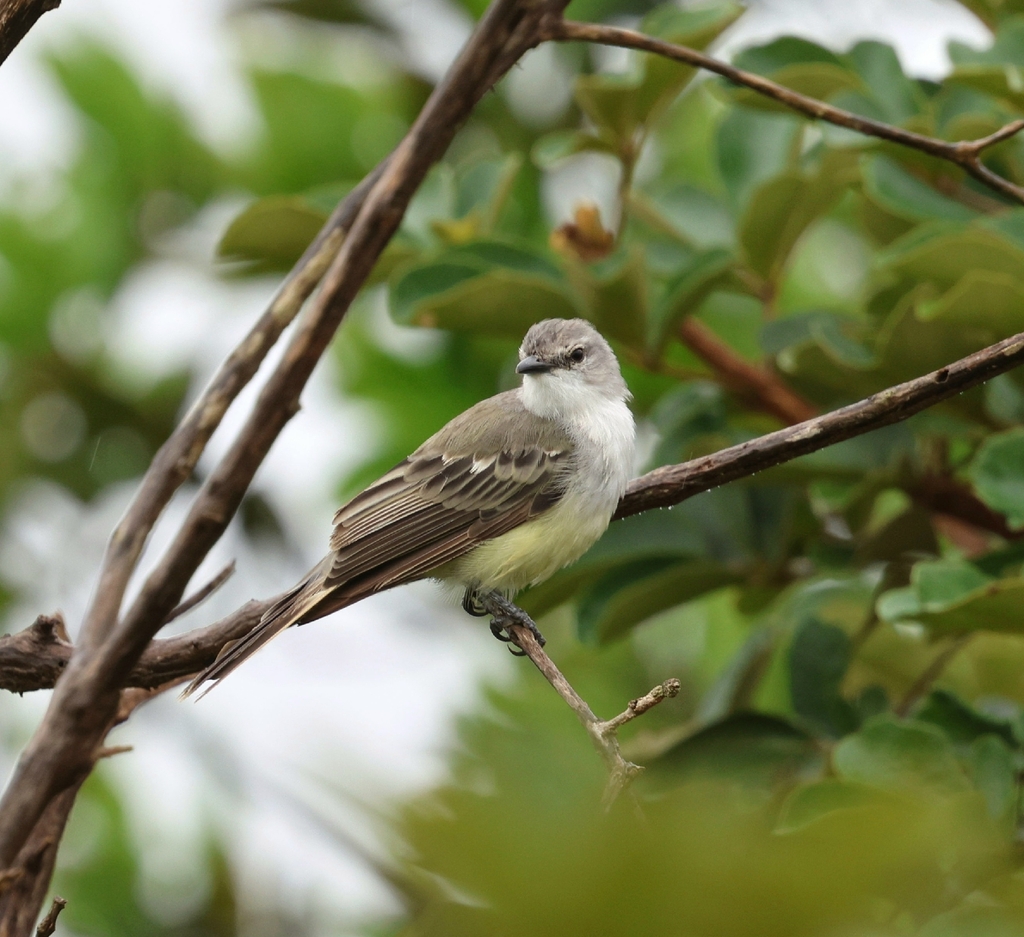
Chapada Flycatcher
Photo © Miguel
Photo © Miguel — CC BY-SA 4.0 — Source: iNaturalist #332723408The chapada flycatcher (Guyramemua affine) is a Near Threatened species of bird in subfamily Fluvicolinae of family Tyrannidae, the tyrant flycatchers. It is found in Bolivia and Brazil. == Taxonomy and systematics == The chapada flycatcher has a complicated taxonomic history. It was originally described as Suiriri islerorum in 2001, having been previously thought to be a variant of subspecies S. suiriri affinis of the suiriri flycatcher. Based on a study published in 2014 its binomial was changed to S. affinis. (That change necessitated renaming S. s. affinis to S. s. burmeisteri.) A study published in 2017 found that the chapada flycatcher was not related to the suiriri flycatcher but rather to the members of genus Sublegatus. That relationship was not extremely close so the authors proposed a new genus Guyramemua, and because Guyramemua is neuter the specific epithet had to be changed to affine. Taxonomic systems soon adopted the new binomial. == Description == The chapada flycatcher is about 16 cm (6.3 in) long and weighs 21 to 23 g (0.74 to 0.81 oz). It is a medium-sized flycatcher. The sexes have the same plumage. Adults have a gray crown and nape with a light olive wash. They have…
Emas National Park
Brazil
+333 birds+23 mammals
Across the high plateaux of central Brazil, where the cerrado grasslands roll toward distant horizons under an immense sky, Emas National Park anchors one of South…
VIEW NATIONAL PARKChapada dos Guimarães National Park
Brazil
+450 birds+1 mammals
Where weathered sandstone plateaus rise above the cerrado grasslands of central Brazil, Chapada dos Guimarães National Park protects 624 square kilometres of ecological transition zone that…
VIEW NATIONAL PARKChapada dos Veadeiros National Park
Brazil
+324 birds+6 mammals
Where granite plateaus rise above the cerrado savanna in central Brazil, Chapada dos Veadeiros National Park unfolds across 6,665 square kilometres of some of the world's…
VIEW NATIONAL PARKNo community photos yet. Log in to add the first one.
No community observations of this species yet.