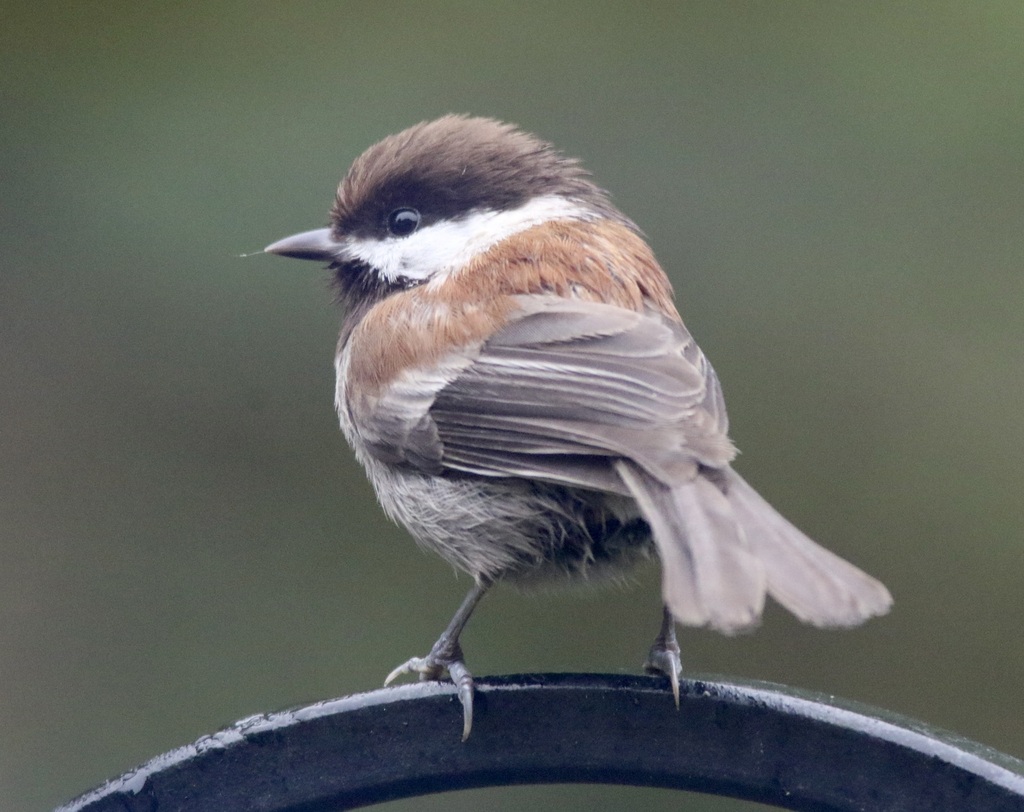
Chestnut-backed Chickadee
Photo © Cricket Raspet
Photo © Cricket Raspet — CC BY 4.0 — Source: iNaturalist photo #360940244Identification
The chestnut-backed chickadee is a small passerine, measuring 11.5–12.5 cm long and weighing 8.5–12.6 g. It is often considered the most vibrant of all chickadees. The bird features a dark blackish-brown head with distinctive white cheeks, a bright rufous-brown mantle, and dark gray wing feathers with paler fringes. The underparts are white to pale grayish-white, with rufous or pale gray flanks. Plumage intensity varies geographically: northern populations display deeper, richer chestnut coloring, while southern populations show lighter, grayer tones.
The species is readily identifiable by its characteristic "chick-a-dee" call, with the "dee" repeated several times. Adults and older nestlings also produce a distinctive hissing noise that mimics a snake, used to protect their nests.
Range & Habitat
The chestnut-backed chickadee is native to western North America, found in the Pacific Northwest from southeastern Alaska to southwestern California, with its range hugging the humid, foggy coasts. It is a permanent resident throughout its range, though it makes seasonal movements as feeding flocks search for food, typically moving to lower elevations in winter and returning to higher elevations in late summer. It is the only chickadee species that resides on the British Columbia Islands.
This species inhabits low-elevation coniferous and mixed coniferous forests, consisting mainly of Douglas fir, western hemlock, and western redcedar. The abundance of Douglas fir trees serves as a helpful indicator of chestnut-backed chickadee populations. In the San Francisco Bay Area, the bird has readily adapted to suburban settings, thriving in gardens and parks by making good use of planted trees and shrubs that resemble their natural forest habitat.
Behaviour & Diet
Chestnut-backed chickadees feed largely on insects and other invertebrates gleaned from foliage, especially Douglas fir. They often move through forests in mixed feeding flocks, frequently spotted in large groups with bushtits, warblers, red-breasted nuthatches, and kinglets. They also consume seeds and plant matter from conifers, as well as fruit, and readily visit bird feeders, particularly favoring suet and hummingbird feeders.
The species demonstrates remarkable adaptability to changing environments. During range expansion in the mid-20th century, chestnut-backed chickadees successfully altered their foraging behavior and habitat use to reduce competition with resident species, changing where they foraged within trees and the types of vegetation they used. They employ nocturnal hypothermia to regulate energy expenditure during harsh winters, conserving energy by up to an estimated 32%.
Best Time & Places to See It
Chestnut-backed chickadees are year-round residents throughout their range, making them accessible to observers in all seasons. They are most easily observed in their preferred low-elevation coniferous and mixed forests dominated by Douglas fir, western hemlock, and western redcedar. In the Pacific Northwest, from Alaska south through coastal forests to California, these birds are reliable sightings in appropriate habitat.
In the San Francisco Bay Area and other suburban regions, they have adapted well to gardens and parks, making them accessible to urban and suburban birders. Visiting bird feeders, especially those offering suet, significantly increases chances of encounter, while listening for their distinctive "chick-a-dee" calls helps locate them in mixed feeding flocks moving through forest canopies.
Photography Tips
The chestnut-backed chickadee's vibrant coloring—particularly its bright rufous-brown mantle and distinctive white cheeks—makes it an engaging photographic subject. The variation in plumage intensity across subspecies and geographic populations offers opportunities to capture regional color differences. Focus on the clean contrast between the dark head, white cheeks, and rufous flanks to showcase the species' distinctive markings.
These active birds frequently move through mixed feeding flocks, providing dynamic shooting opportunities. Photographing them near bird feeders or suet feeders allows for controlled, predictable compositions. Early morning light works well to highlight their vibrant plumage. Include surrounding Douglas fir, western hemlock, or western redcedar in forest habitat shots to provide ecological context and illustrate their specialized forest preferences.
Gulf Islands National Park Reserve
Southern Gulf Islands Electoral Area, Canada
+268 birds+26 mammals
Scattered across the Salish Sea in British Columbia's southwestern corner, this national park reserve stitches together a fragmented archipelago of forested islands and rocky outcrops where…
VIEW NATIONAL PARKGlacier National Park
Glacier, Canada
+162 birds+12 mammals
Where granite peaks pierce the clouds above the Columbia River valley, Glacier National Park protects one of the most dramatic mountain wilderness areas in western Canada.…
VIEW NATIONAL PARKMount Revelstoke National Park
Area B (Shelter Bay/Mica Creek), Canada
+155 birds+8 mammals
Where the Columbia River carves through the western ranges of British Columbia, Shelter Bay and Mica Creek mark the entrance to a wilderness where subalpine meadows…
VIEW NATIONAL PARKJasper National Park
Improvement District No. 12, Canada
+235 birds+34 mammals
Where the Canadian Rockies rise in dramatic succession across western Alberta, Jasper National Park spans over 11,000 square kilometres of subalpine and alpine terrain, glaciated valleys,…
VIEW NATIONAL PARKKenai Fjords National Park
Kenai Peninsula Borough, United States
+164 birds+19 mammals
Granite peaks and tidewater glaciers dominate Alaska's Kenai Peninsula, where nearly 7,900 square kilometers of pristine coastal wilderness descend from the Harding Icefield toward the Gulf…
VIEW NATIONAL PARKLassen Volcanic National Park
Shasta County, United States
+239 birds+18 mammals
Volcanic peaks and geothermal upheaval have sculpted 545 square kilometers of Northern California into a landscape where fire and water engage in perpetual dialogue. Lassen Peak…
VIEW NATIONAL PARKPinnacles National Park
San Benito County, United States
+197 birds+33 mammals
Jagged volcanic spires thrust from chaparral-covered ridges across 222 square kilometers of central California's inner Coast Ranges, their pale stone crowns catching the afternoon light like…
VIEW NATIONAL PARKGlacier Bay National Park
Unorganized Borough, United States
+221 birds+15 mammals
Tidewater glaciers calving into fjords of impossible blue, where temperate rainforest rises steeply from the water's edge and alpine peaks pierce the clouds—this is the ecological…
VIEW NATIONAL PARKYosemite National Park
Mariposa County, United States
+224 birds+28 mammals
Granite cliffs soar nearly a kilometer above the valley floor in this expanse of high Sierra wilderness, where glacial U-shaped valleys sculpt a landscape of dramatic…
VIEW NATIONAL PARKMount Rainier National Park
Pierce County, United States
+187 birds+25 mammals
A volcanic colossus dominates the Cascade Range in western Washington, its 4,392-meter summit crowned year-round with glacial ice that cascades down toward temperate rainforest and subalpine…
VIEW NATIONAL PARKCrater Lake National Park
Klamath County, United States
+174 birds+13 mammals
At 1,949 metres above sea level, a volcanic caldera of impossible clarity holds one of North America's deepest and most pristine alpine lakes, ringed by pumice-and-ash…
VIEW NATIONAL PARKRedwood National Park
Humboldt County, United States
+343 birds+43 mammals
Where the Pacific fog rolls deep into northern California's coastal valleys, some of the tallest trees on Earth rise from a landscape shaped by tectonic forces…
VIEW NATIONAL PARKOlympic National Park
Jefferson County, United States
+263 birds+35 mammals
Where temperate rainforest meets alpine wilderness, Olympic National Park sprawls across nearly 11,000 square kilometers of the Pacific Northwest's most pristine landscape. The park's three distinct…
VIEW NATIONAL PARKWaterton Lakes National Park
Improvement District No. 04, Canada
+252 birds+31 mammals
Where the Continental Divide plunges toward the prairies of Alberta, glacier-carved valleys and emerald lakes pierce a landscape where montane forest meets alpine tundra. Waterton Lakes…
VIEW NATIONAL PARKYoho National Park
Area A (Kicking Horse/Kinbasket Lake), Canada
+207 birds+19 mammals
Where the Canadian Rockies meet the Columbia River watershed, a vast wilderness of 2,211 square kilometres unfolds across Yoho National Park in British Columbia. The landscape…
VIEW NATIONAL PARKGwaii Haanas National Park Reserve and Haida Heritage Site
Area E (Moresby Island), Canada
+98 birds+8 mammals
Where temperate rainforest meets the Pacific's edge, the islands of southern Haida Gwaii rise as one of North America's most pristine coastal wilderness areas. Spanning approximately…
VIEW NATIONAL PARKGlacier National Park
United States
+246 birds+39 mammals
Where jagged peaks pierce a subarctic sky and glacial valleys carve through ancient rock, Glacier National Park spans the spine of the Northern Rockies along Montana's…
VIEW NATIONAL PARKNorth Cascades National Park
Whatcom County, United States
+120 birds+18 mammals
Jagged peaks rise abruptly from the western foothills of Washington's Cascade Range, where glaciers cling to elevations above 10,000 feet and meltwater feeds a landscape of…
VIEW NATIONAL PARKAlaska Maritime National Wildlife Refuge
Alaska, United States
+391 birds+58 mammals
Where the North Pacific collides with Alaska's rugged coastline, a sprawling archipelago of islands, rocky outcrops, and coastal headlands forms one of North America's most remote…
VIEW WILDLIFE SANCTUARYKlamath Marsh National Wildlife Refuge
Klamath County, United States
+219 birds+7 mammals
Where the volcanic plateau of south-central Oregon slopes into a broad, shallow basin lies one of the Pacific Northwest's most underappreciated wetland sanctuaries. Klamath Marsh National…
VIEW WILDLIFE SANCTUARYUpper Klamath National Wildlife Refuge
Klamath County, United States
+217 birds
Where shallow marshes and open water meet the high desert of south-central Oregon, the Upper Klamath National Wildlife Sanctuary creates a landscape of startling contrasts. Fed…
VIEW WILDLIFE SANCTUARYDon Edwards San Francisco Bay National Wildlife Refuge
Fremont, United States
+286 birds+20 mammals
Where the San Francisco Bay's shallow margins dissolve into tidal salt marshes and mudflats, this wildlife sanctuary preserves one of California's most ecologically vital estuarine systems.…
VIEW WILDLIFE SANCTUARYNo community photos yet. Log in to add the first one.
No community observations of this species yet.