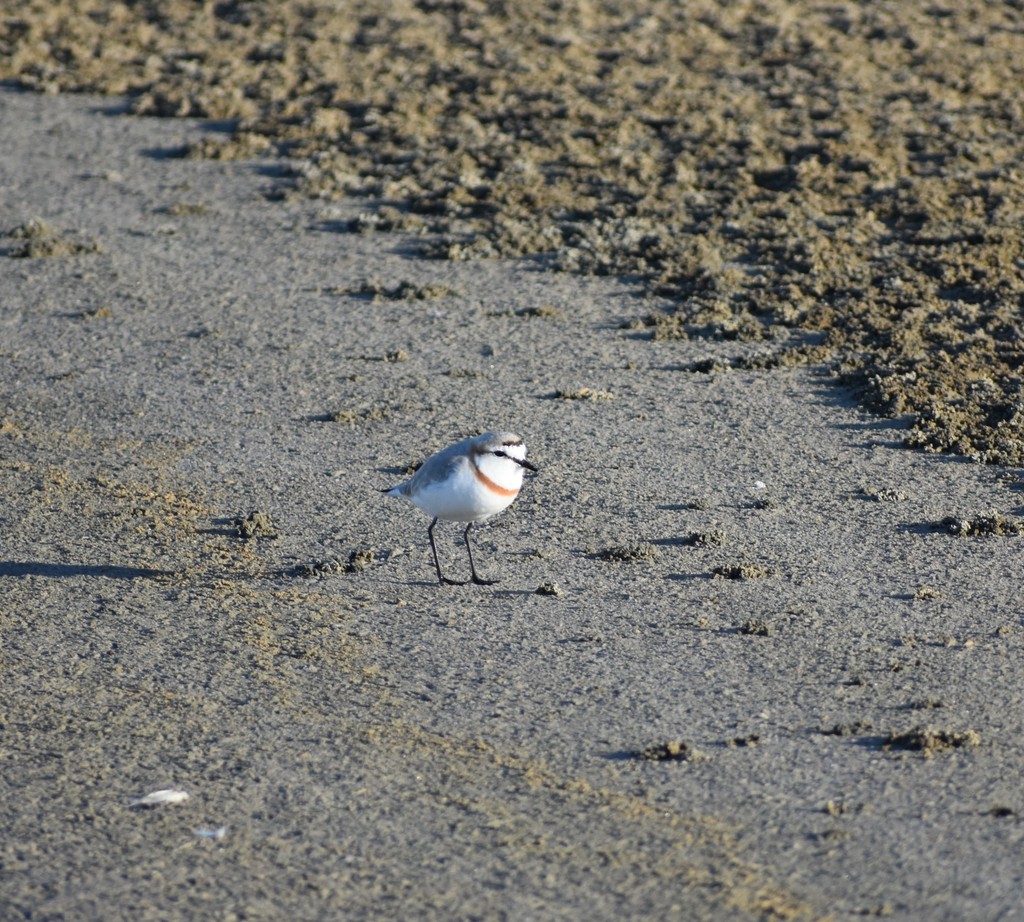
Chestnut-banded Plover
Photo © Justin Ponder
Photo © Justin Ponder — CC BY 4.0 — Source: iNaturalist #97889188Identification
The Chestnut-banded Plover is a small shorebird, growing to about 15 cm in height. Despite its diminutive size, it is distinctive and relatively easy to identify in the field. Look for a white forehead, throat and belly contrasted with a striking chestnut breast-band that connects to a matching band on the fore-crown. The back and crown are greyish-brown. The bird has proportionally long dark legs, black lores and eye-stripes, and a black bill. These field marks combine to create a neat, compact appearance characteristic of plovers.
Range & Habitat
The Chestnut-banded Plover is distributed across Southern Africa, with two distinct populations. The nominate subspecies occupies a wide range including Angola, Botswana, Kenya, Mozambique, Namibia, South Africa, Tanzania, Zambia and Zimbabwe, while the subspecies venustus is confined to the Rift Valley in Kenya and Tanzania. Despite this broad distribution, the species occupies a rather small total area and is evaluated as Near Threatened, occurring at fewer than ten locations during the non-breeding season.
This plover is strongly associated with alkaline and saline water environments. It breeds in alkaline and saline wetlands, inland salt pans and man-made salt ponds, as well as coastal lagoons and salt marshes. The bird favours areas devoid of vegetation, rarely venturing more than 50 metres from the water's edge during breeding season, though in non-breeding season it may range up to 1 km away from water.
Behaviour & Diet
The Chestnut-banded Plover is a partial migrant whose movements vary throughout its range and remain poorly understood. Population numbers fluctuate significantly from year to year at any given site, particularly in response to droughts at inland breeding sites. The species typically occurs in pairs or small groups, with pairs defending territories during breeding season. Outside the breeding season, it forms very large communities, and a single gathering of 375 birds was recorded in Namibia. The plover may forage in loose flocks of up to 60 birds and occasionally roosts alongside other plover species.
Breeding timing varies geographically: in South Africa, breeding occurs between March and May, and again from September to January. In the African Great Lakes region, breeding takes place between March and October, with peak numbers at Lake Manyara occurring between July and September. The exact diet is unknown but is believed to consist of insect larvae and small crustaceans.
Best Time & Places to See It
The global population is estimated at around 17,500 individuals, with 87% concentrated in just three non-breeding sites. The most important locations are Walvis Bay and Sandwich Harbour in Namibia, and Lake Natron in Tanzania. For the best chance of encountering large numbers, visit these sites during the non-breeding season. In Namibia's Walvis Bay, expect to find birds year-round, though populations concentrate there especially during droughts. In Tanzania, Lake Manyara is a prime location between July and September. South African coastal populations are mostly resident, making them reliable viewing options, particularly around breeding season (March to May and September to January).
Photography Tips
The Chestnut-banded Plover's small size and preference for open, sparsely vegetated habitats make it relatively approachable compared to many shorebirds. Photograph during early morning or late afternoon light to highlight the chestnut colouration on the breast and crown. The bird's striking black and white facial markings and long dark legs provide excellent contrast in images. Visit non-breeding sites where large flocks gather for opportunities to capture behavioural shots and flock dynamics. Patience is essential—the bird's habit of forming very large communities during non-breeding season means you may encounter dozens of individuals, allowing for varied compositions and behaviour documentation.
No community photos yet. Log in to add the first one.
No community observations of this species yet.