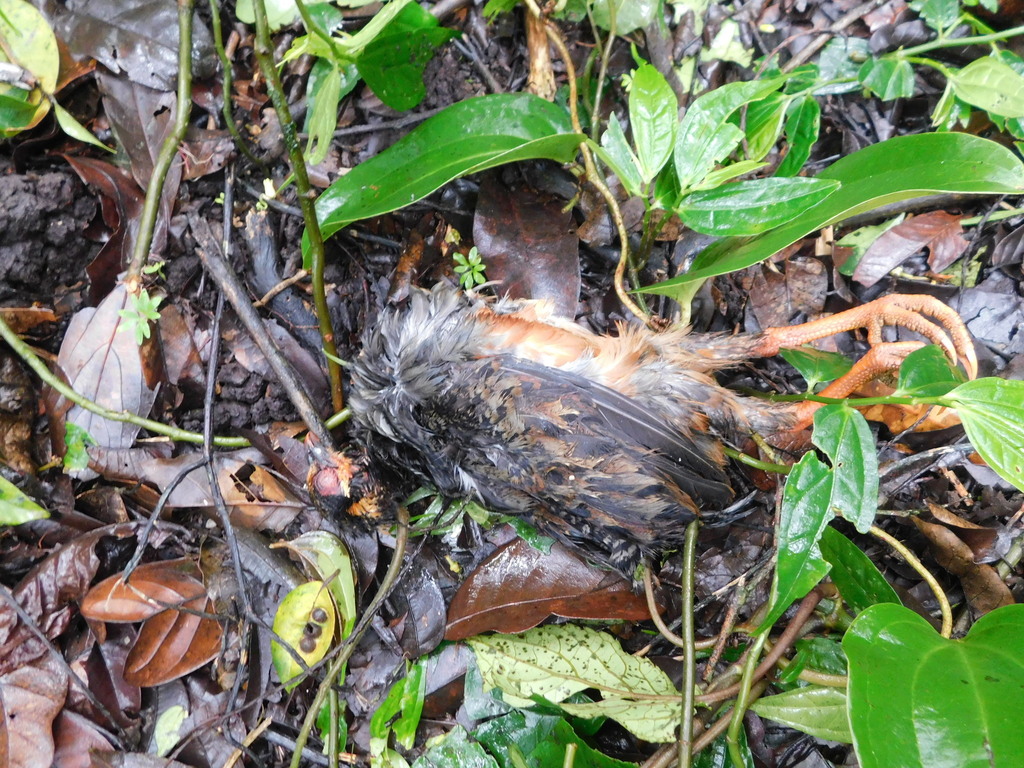
Chestnut-bellied Partridge
Photo © Ganjar Cahyadi
Photo © Ganjar Cahyadi — CC BY 4.0 — Source: iNaturalist #255254228Identification
The chestnut-bellied partridge is a small partridge, reaching up to 28 cm in length. Both sexes are similar in appearance, making field identification straightforward within its range. The most distinctive features include a rufous crown and nape, contrasting with a grey breast and brown wings. The bird's face is striking, with bare red facial skin framed by a bold black mask, black throat, and black bill. The belly is rufous with white markings down the middle, giving the species its common name. Young birds differ noticeably from adults, displaying a whitish face and reddish-brown bill rather than the stark facial markings of mature birds. The red legs are also a useful identifying feature.
Range & Habitat
This partridge is endemic to Indonesia, found exclusively on the island of Java in hill and mountain forests. The species is distributed across both western and eastern Java, occupying montane regions. Two subspecies are recognized: A. j. javanica inhabits montane areas of Java, while A. j. lawuana is found in montane forests of east-central Java. Despite its restricted range, the chestnut-bellied partridge remains common within its limited distribution.
Behaviour & Diet
The chestnut-bellied partridge exhibits typical ground-nesting behaviour for its family. The female lays up to four eggs in a domed nest constructed from long grasses, which is built by the male. This nest architecture provides shelter and concealment in the forest understory. The species is adapted to life in montane forest environments, though detailed information on its feeding ecology and daily behaviour patterns remains limited in scientific literature.
Best Time & Places to See It
As a common species within its range, the chestnut-bellied partridge offers good opportunities for observation in Java's hill and mountain forests. The species' year-round presence on the island suggests it is not migratory. Visitors seeking this endemic bird should focus on montane forest habitats in both western and eastern Java, though specific seasonal patterns of activity or movement are not well documented. The bird's common status in suitable habitat increases the likelihood of encounters for patient observers.
Photography Tips
The chestnut-bellied partridge's striking facial markings—the black mask, red facial skin, and contrasting crown—provide excellent photographic subjects. The bird's compact size of 28 cm or less means a telephoto lens will be valuable for obtaining frame-filling images from a distance. The rufous and chestnut tones of the plumage photograph well in soft, diffused forest light, which is typical of montane habitats. Since the species nests on the ground in domed grass structures, photographers should be cautious and respectful during breeding season to avoid disturbing nesting birds. The similarity between the sexes means field identification challenges will be minimal, allowing photographers to focus on capturing the distinctive facial pattern and body coloration.
No community photos yet. Log in to add the first one.
No community observations of this species yet.