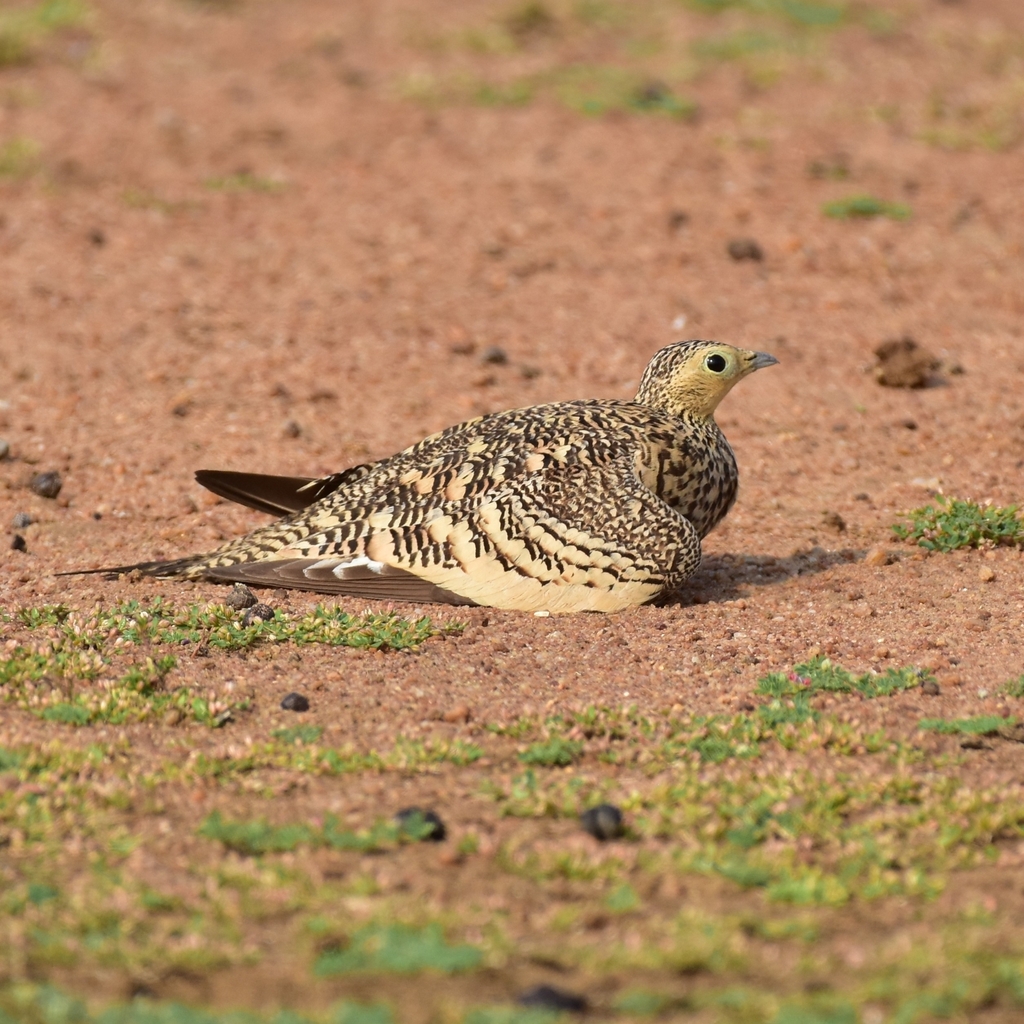
Chestnut-bellied Sandgrouse
Photo © Renjith Jacob Mathews
Photo © Renjith Jacob Mathews — CC BY 4.0 — Source: iNaturalist #169946652Identification
The Chestnut-bellied Sandgrouse is a small to medium-sized bird with distinctive characteristics that change depending on viewing angle and subspecies. In flight, look for an elongated, pointed tail and brownish overall plumage. When grounded, the bird appears short-legged with a small head, though it will stretch its long neck when alert. Plumage varies considerably across its six subspecies: the nominate subspecies from West Africa is warmer-toned, while populations from the Nile Valley are darker and greyer. Eastern populations tend to be paler overall. Males and females show clear sexual dimorphism, with males displaying distinctive chest markings and warm ochre or orange tones on the face and neck, while females are more heavily streaked and barred with duller coloration.
Range & Habitat
This species ranges across northern and central Africa and extends eastward into western and southern Asia, occupying the Afrotropic and Indomalayan biogeographic realms. Six recognized subspecies are distributed from Senegal and Gambia across Sudan and the Nile Valley, through the Horn of Africa, East Africa, and into the Arabian Peninsula, Iran, Pakistan, and India. The Chestnut-bellied Sandgrouse is a bird of barren, semi-desert environments where water sources are scarce and vegetation is sparse.
Behaviour & Diet
Despite inhabiting hot, arid climates, this species is heavily reliant on water and will travel considerable distances—up to 50 miles in a single day—to reach drinking sites. This water dependency shapes much of its daily movement patterns. The Chestnut-bellied Sandgrouse is a selective feeder, subsisting primarily on seeds and showing a preference for consuming small seeds in large quantities. Like other sandgrouse, it is more closely related to pigeons and doves than to true grouse, despite its common name. The species exhibits both sedentary and nomadic behaviours depending on local conditions.
Best Time & Places to See It
The Chestnut-bellied Sandgrouse can be found year-round across its range, though the specific subspecies and plumage patterns you encounter will depend on your location. In Africa, search suitable semi-desert habitats from West Africa through the Sahel, Nile Valley, and East Africa. In Asia, the species occurs in desert regions of the Arabian Peninsula, Iran, Pakistan, and India. Water holes and sparse, barren terrain are your best bet for locating these birds, particularly during early morning or late afternoon when they are most active and water-seeking.
Photography Tips
Position yourself near water sources in semi-desert regions, particularly during dawn and dusk when sandgrouse are most active. The bird's cryptic brown and buff plumage blends remarkably well with arid terrain, so scan carefully and use binoculars to locate individuals before approaching. Males are more distinctive than females, with warmer tones and clearer markings that make them easier to photograph. The elongated tail is most visible in flight, so be prepared for quick shots as birds arrive at and depart from water. The short legs and small head are characteristic features worth capturing, and the sexual dimorphism makes photographing both sexes rewarding for documenting subspecific variation.
Serengeti National Park
Tanzania
+558 birds+57 mammals
Across Tanzania's northern plateau, where volcanic soils meet acacia woodland and open grassland, unfolds one of Earth's most dynamic ecosystems. The Serengeti National Park sprawls across…
VIEW NATIONAL PARKArusha National Park
Tanzania
+555 birds+16 mammals
Where the slopes of Mount Mawenzi rise above the Arusha region, a compact yet ecologically rich national park unfolds across montane forest, moorland, and alpine zones.…
VIEW NATIONAL PARKTsavo East National Park
Athi ward, Kenya
+468 birds+50 mammals
Across the semi-arid lowlands of southeastern Kenya, where acacia woodland fragments into scrubland and the landscape rolls toward the Indian Ocean horizon, lies one of Africa's…
VIEW NATIONAL PARKTsavo West National Park
Mwatate, Kenya
+513 birds+49 mammals
Where volcanic ridges and weathered lava flows meet the semi-arid lowlands of south-central Kenya, Tsavo West National Park unfolds across a landscape sculpted by fire and…
VIEW NATIONAL PARKAmboseli National Park
Etonet/Lenkism ward, Kenya
+501 birds+43 mammals
Where the Amboseli basin opens toward the Tanzanian frontier, a shallow alkaline lake mirrors vast skies across one of East Africa's most iconic savanna landscapes. The…
VIEW NATIONAL PARKRanthambhore National Park
Sawai Madhopur, India
+294 birds+20 mammals
Granite ridges and ravines carved through the Aravalli Range frame this protected landscape in eastern Rajasthan, where deciduous forest mingles with open scrubland and seasonal water…
VIEW NATIONAL PARKNgorongoro Conservation Area
Tanzania
+626 birds+55 mammals
Volcanic calderas and open grassland dominate this high plateau in northern Tanzania, where the landscape rises above 2,000 metres and ancient geological forces have shaped both…
VIEW WILDLIFE MANAGEMENT AREATadoba National Park
Palasgaon Singru, India
+270 birds+20 mammals
Where sal forests meet open grasslands and rocky outcrops rise from red laterite soil, central India's landscape unfolds in raw, untamed beauty. Ancient teak woodlands and…
VIEW NATIONAL PARKPanna National Park
Badgadi Kalan, India
+271 birds+17 mammals
Where granite gorges slice through central India's Vindhyan plateau, a landscape of stark beauty unfolds across nearly six hundred square kilometers. The Ken River carves through…
VIEW NATIONAL PARKKeoladeo National Park
Shreenagar Rural, India
+326 birds+14 mammals
Where shallow wetlands shimmer beneath vast Rajasthani skies, one of Asia's finest bird sanctuaries pulses with extraordinary life. This former maharaja's hunting reserve, now spanning 29…
VIEW NATIONAL PARKAbijata-Shalla Lakes National Park
Ethiopia
+438 birds+7 mammals
Two crater lakes of contrasting chemistry define this remote corner of Ethiopia's Rift Valley, where soda lakes and freshwater basins create a mosaic of distinct aquatic…
VIEW NATIONAL PARKOmo National Park
Ethiopia
+61 birds+4 mammals
Where the Omo River carves through southwestern Ethiopia, a landscape of riverine woodland, acacia savanna, and scattered grassland unfolds across one of East Africa's most remote…
VIEW NATIONAL PARKAwash National Park
Didiga, Ethiopia
+473 birds+23 mammals
Where the Ethiopian Rift Valley carves through volcanic plateaus, a ribbon of riverine forest winds through acacia scrubland and grassland, creating a mosaic of habitats that…
VIEW NATURAL PARKGir National Park
Asundrali, India
+258 birds+13 mammals
Dry deciduous forests cloak the rolling hills of western Gujarat where the Gir landscape rises as a final sanctuary for one of the world's rarest felids:…
VIEW NATIONAL PARKNairobi National Park
Nairobi, Kenya
+515 birds+35 mammals
Just minutes from Kenya's capital, where the Nairobi River winds through acacia woodland and open grassland, lies one of Africa's most paradoxical wildlife sanctuaries. The park's…
VIEW NATIONAL PARKMeru National Park
Igembe Central, Kenya
+408 birds+38 mammals
Granite outcrops and acacia woodland rise across the northern reaches of Meru, where semi-arid savanna transitions into drier scrubland under the fierce equatorial sun. The park's…
VIEW NATIONAL PARKSamburu National Reserve
Samburu, Kenya
+430 birds+42 mammals
Across the arid plains of northern Kenya, where scattered acacia woodland gives way to rocky outcrops and dry riverbeds, Samburu National Park unfolds as one of…
VIEW NATURE RESERVESibiloi National Park
Kenya
+118 birds
Where the northern deserts of Kenya meet the volcanic Chalbi Plain, Sibiloi National Park sprawls across a landscape shaped by millennia of tectonic upheaval and semi-arid…
VIEW NATIONAL PARKNo community photos yet. Log in to add the first one.
No community observations of this species yet.