Chestnut-breasted Malkoha
Photo © Chrissy McClarren and Andy Reago
Photo © Chrissy McClarren and Andy Reago — CC0 1.0 — Source: iNaturalist #255729157Identification
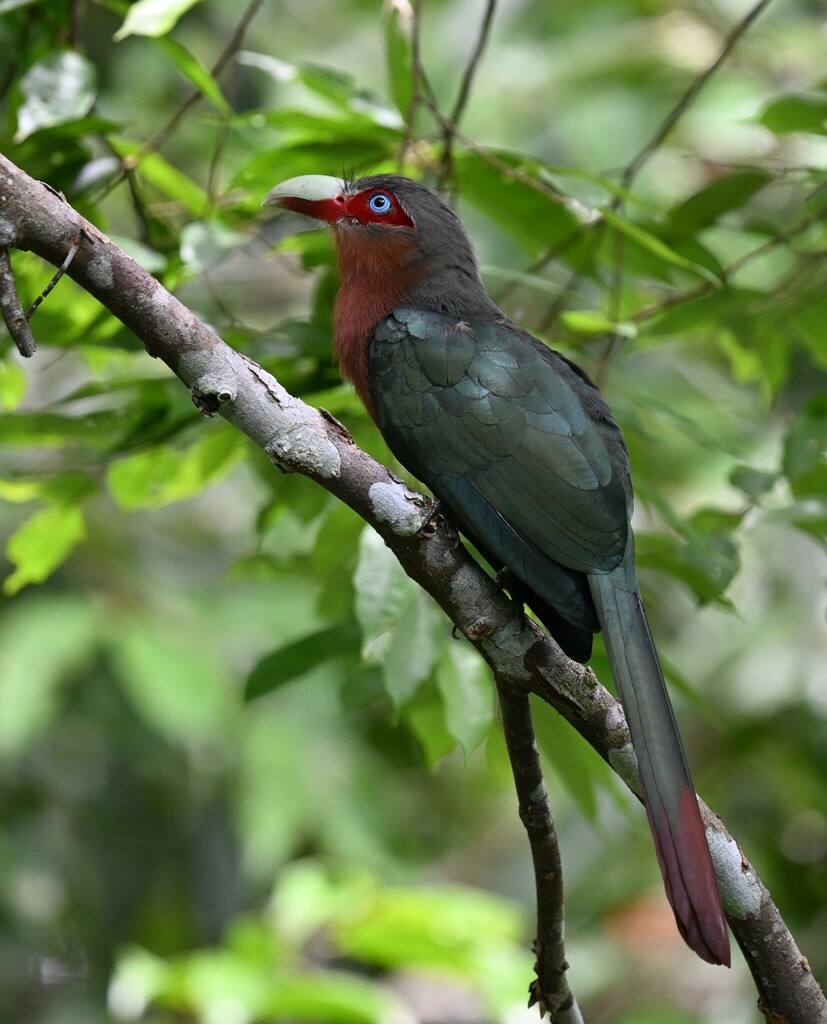
The chestnut-breasted malkoha is a large cuckoo measuring 42–49 cm in length, making it unmistakable in its Southeast Asian range. Its most distinctive feature is a prominent curved, pale yellow upper mandible contrasting with a darker red or black lower mandible. The head is grey, the wings are dark green (fading to blue with age), and the underparts and rump are warm chestnut—the namesake feature that identifies this species at a glance. A bare red patch of rough skin around the eye adds character to its face. Males and females are similar in plumage, though males display a pale blue iris while females have yellow eyes. The dark grey feet complete a striking overall appearance.
Range & Habitat
Found across Southeast Asia from Myanmar through Thailand, Malaysia, and Sumatra, this species also inhabits Brunei, Indonesia, Borneo, Bali, Java, and the western Philippine islands including Palawan and its satellite islands. Five recognized subspecies reflect this wide distribution. The chestnut-breasted malkoha favours subtropical and tropical moist lowland forests as well as mangrove forests, typically spending most of its time in the middle storey amid dense foliage where it remains relatively inconspicuous despite its large size. Unfortunately, much of its forest habitat is being cleared, making it important to seek out protected forest reserves.
Behaviour & Diet
Unlike the majority of cuckoos, which are nest parasites, the chestnut-breasted malkoha is a responsible parent that builds its own nest and raises its own young. It hunts a varied diet of small vertebrates including small lizards, frogs, and baby birds, supplemented by a wide range of insects: caterpillars, grasshoppers, cicadas, stick insects, mantises, cockroaches, beetles, bugs, and spiders, as well as small crabs. This opportunistic feeding strategy allows it to thrive in forested environments where prey diversity is high.
Best Time & Places to See It
Breeding season varies across its range: in Borneo it occurs from August to December, while in other parts of Southeast Asia it extends from January to September. During breeding, pairs become more vocal and active as they build substantial nests of small branches and twigs and raise their young. Visiting protected lowland and mangrove forests during these periods offers the best chance of encounters. Look in the middle storey of dense forest, particularly where foliage is thickest, and listen for calling birds during early morning hours.
Photography Tips
The pale curved mandible and red orbital patch provide excellent contrasting subjects for close-up photography. Position yourself to capture the profile view of the head, which best showcases the distinctive curved bill. The chestnut underparts photograph well in soft, diffused light, which reveals the warm coloration without harsh shadows. Since this species frequents the middle storey, a sturdy tripod and patience are essential; early mornings when birds are more active will reward persistent photographers with better opportunities to frame feeding or nesting behaviour.
Taman Negara National Park
Kampong Samas, Malaysia
+393 birds+48 mammals
Where ancient rainforest meets limestone peaks, one of Southeast Asia's oldest protected wilderness preserves sprawls across 4,343 square kilometers of primordial landscape. Dipterocarp giants tower overhead,…
VIEW NATIONAL PARKPenang National Park
Balik Pulau, Malaysia
+107 birds+2 mammals
Granite peaks rise abruptly from the Andaman Sea where tropical rainforest clings to steep slopes in one of Malaysia's oldest protected landscapes. Mangrove forests fringe the…
VIEW NATIONAL PARKTaman Negara Bukit Lambir National Park
Miri, Malaysia
+153 birds+7 mammals
Rainforest cascades down sandstone ridges where crystal streams carve through ancient geology, creating a landscape of profound biological richness in Sarawak's interior. This 68-square-kilometre sanctuary protects…
VIEW NATIONAL PARKGunung Mulu National Park
Long Seridan, Malaysia
+280 birds+39 mammals
Where granite monoliths pierce the rainforest canopy of Sarawak, an ancient limestone karst landscape reveals one of Southeast Asia's most biodiverse strongholds. Soaring peaks cloaked in…
VIEW NATIONAL PARKTaman Nasional Baluran
Situbondo, Indonesia
+189 birds+9 mammals
Across the northeastern tip of East Java, where monsoon winds sweep down from the Bali Strait, a landscape of contrasts unfolds within 374 square kilometres of…
VIEW NATIONAL PARKTaman Nasional Meru Betiri
Jember, Indonesia
+93 birds+1 mammals
Across East Java's southeastern coast, where the Indian Ocean meets a landscape of volcanic soils and monsoon-fed forests, sprawls a national park that epitomizes the ecological…
VIEW NATIONAL PARKWest Bali National Park
Gerokgak, Indonesia
+240 birds+8 mammals
Across West Bali's northwestern reaches, where the Indian Ocean meets volcanic slopes and limestone cliffs plunge toward turquoise shallows, sprawls a protected realm of roughly 325…
VIEW NATIONAL PARKGunung Ciremai National Park
Majalengka, Indonesia
+116 birds+1 mammals
Volcanic slopes rise sharply from West Java's interior, where Gunung Ciremai's 3,078-metre summit dominates a landscape carved by geological upheaval and shaped by equatorial monsoon rainfall.…
VIEW NATIONAL PARKMount Merapi National Park
Hargobinangun, Indonesia
+150 birds+3 mammals
Where the volcanic slopes of central Java rise into mist and montane forest, Mount Merapi National Park guards one of Indonesia's most dynamic landscapes. Spanning roughly…
VIEW NATIONAL PARKKerinci Seblat National Park
Kerinci, Indonesia
+228 birds+16 mammals
Across nearly 67,000 square kilometres of Sumatra's spine, a mountainous realm of equatorial rainforest rises from steaming lowlands to volcanic peaks shrouded in cloud. Kerinci Seblat…
VIEW NATIONAL PARKWay Kambas National Park
Lampung Timur, Indonesia
+237 birds+20 mammals
Across the low swamplands of eastern Lampung, where freshwater wetlands merge into tidal mangrove forests along the Sunda Strait, sprawls one of Sumatra's most vital sanctuaries.…
VIEW NATIONAL PARKNo community photos yet. Log in to add the first one.
No community observations of this species yet.