Identification
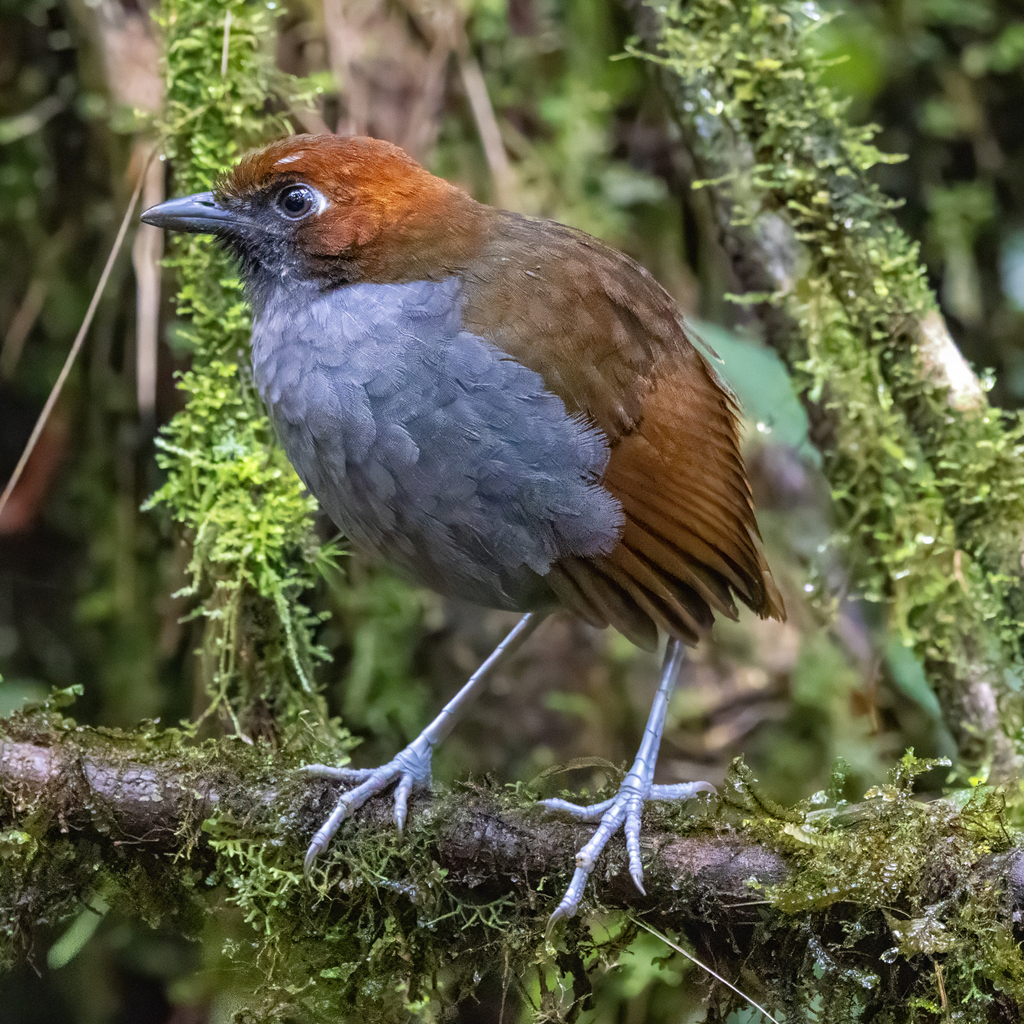
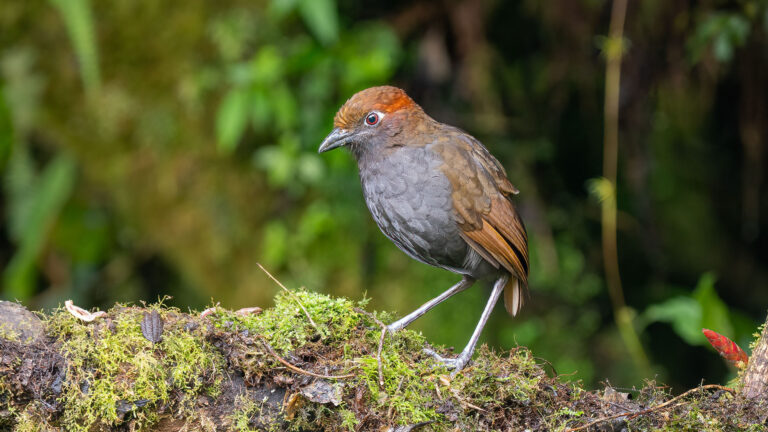
The chestnut-naped antpitta is a compact, round-bodied bird measuring 19.5 to 21 cm in length and weighing 104 to 122 g. Like all antpittas, it is characterized by a plump frame, stout bill, and very short tail. The nominate subspecies displays a dark chestnut crown with a rufous-chestnut hindcrown, nape, and face, contrasting with gray lores and a distinctive patch of bare white skin behind the eye. The upperparts and tail are brown, with tawny-brown primaries on mostly brown wings. The underparts are ashy gray, darkest on the throat. All subspecies share a gray iris, black bill, and pale blue-gray legs and feet. There is no plumage difference between males and females. Two other subspecies occur across the range: G. n. ruficeps shows brighter rufous-chestnut coloring and lighter gray underparts, while G. n. obsoleta has a browner crown, more chestnut face, and darker underparts.
Range & Habitat
The chestnut-naped antpitta is found in Colombia, Ecuador, and Peru, with a disjunct distribution across the Andes. The nominate subspecies inhabits the eastern slope from Ecuador's Pichincha Province south to northern Peru's Department of Piura, with possible northern extension into Colombian Nariño Department. Subspecies G. n. ruficeps occurs on the western slope of Colombia's Eastern Andes and Central Andes, while G. n. obsoleta is restricted to the western slope in northern Ecuador. The species is a permanent resident throughout its range, occupying temperate to humid montane forest between 2,000 and 3,000 m (6,600–9,800 ft) in Colombia and Ecuador, and 2,200 to 3,000 m (7,200–9,800 ft) in Peru. It has an almost exclusive association with dense bamboo stands, though it also uses undergrowth in adjacent bamboo-free forest.
Behaviour & Diet
The chestnut-naped antpitta is primarily terrestrial, hopping on the ground usually deep within bamboo thickets. It feeds on insects and other invertebrates, though detailed foraging behavior remains poorly documented. The species is most vocal at dawn and dusk, singing from hidden low perches. Its distinctive song consists of a series of 4–7 well-enunciated, emphatic whistled notes, with the first set similar and the final note long and sharply upslurred—rendered as 'keeu, kew-kew-kew k-wheeeei?' The bird also produces shorter calls with fewer initial notes. Most observer sightings occur along forest trails in early dawn hours.
Best Time & Places to See It
Early morning is the optimal time to encounter this species, when it is most vocal and active along forest trails. The chestnut-naped antpitta is considered locally fairly common in Colombia, uncommon in eastern Ecuador (and scarcer in the west), and fairly common in Peru. Within its montane forest range, concentrate efforts near dense bamboo stands between 2,000 and 3,000 m elevation. Patient listening for its distinctive dawn and dusk songs will improve detection chances. The species' resident status means it is present year-round throughout its range, though its breeding season appears to include November to January.
Photography Tips
Photographing the chestnut-naped antpitta presents considerable challenges, as the species remains mostly hidden deep within dense bamboo vegetation and other thick undergrowth. Early morning visits to forest trails offer the best opportunities, as birds are more active and vocal at dawn. Work quietly and patiently, listening for the distinctive whistled song to locate individuals. The bare white skin patch behind the eye, chestnut crown, and contrasting throat are key field marks worth capturing. Given the bird's small size (around 110 g), use appropriate focal lengths and expect to work in low-light forest conditions typical of montane cloud forest habitat. Patience and persistence, combined with familiarity with the species' vocalizations, will ultimately yield the best results.