Chestnut-rumped Thornbill
Photo © Thomas Mesaglio
Photo © Thomas Mesaglio — CC BY 4.0 — Source: iNaturalist #133413215Identification
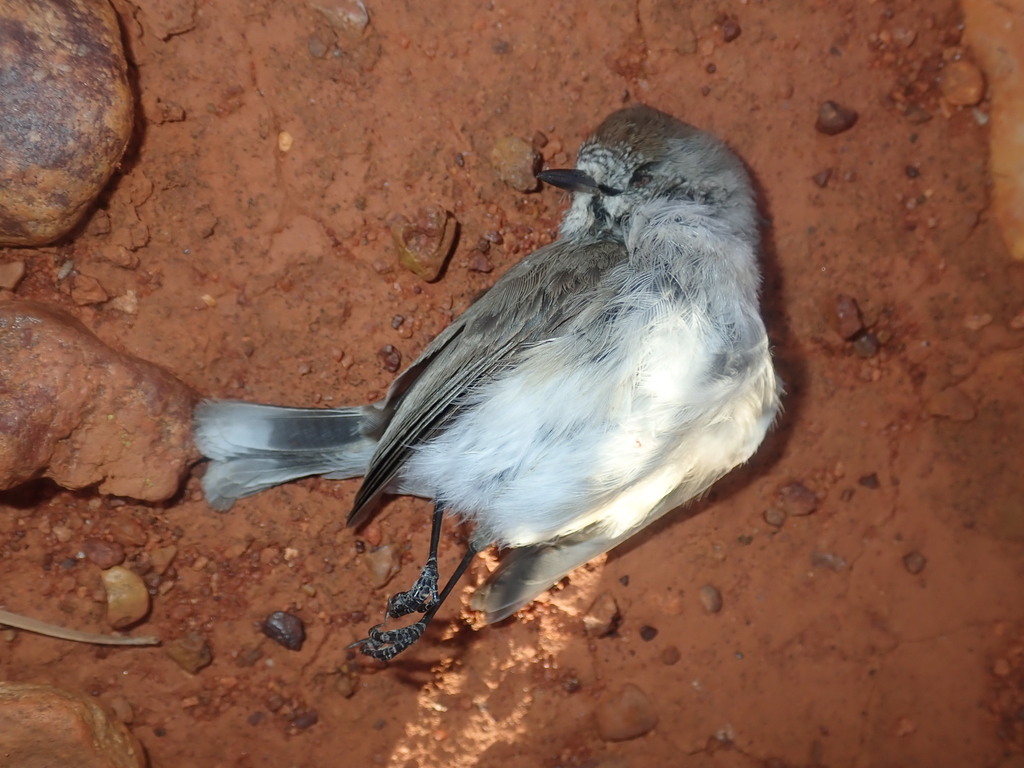
The Chestnut-rumped Thornbill is a small passerine, measuring just 9.8 cm in length with a wingspan of 15.5 cm. Its name derives from its most distinctive feature: a rich chestnut rump that contrasts with pale grey-brown upperparts. The bird has a mostly black tail with pale tips, pale mottled ear-coverts, and rufous suffusion on the forehead and crown, with a plain whitish underbody and characteristically pale iris. The sexes are alike with no seasonal variation. Inland birds are notably paler and greyer above with cleaner white underparts than their coastal counterparts, reflecting adaptation to arid conditions.
This plain, pale thornbill can be confused with several similar species, particularly the Brown, Inland, and Slaty-backed Thornbills, all of which possess rufous-brown rump patches. Juveniles are duller and plainer than adults, with buff rather than white tail tips and a slightly duller iris. Nearly fledged juveniles display pale yellow gapes.
Range & Habitat
Endemic to mainland Australia, the Chestnut-rumped Thornbill is widespread throughout inland regions west of the Great Dividing Range, extending from Queensland's southern interior to the West Australian coast. It is absent from the far north and the humid southwest of Western Australia. The species is generally resident or sedentary, though some individuals occasionally undertake longer movements, and non-breeding flocks disperse before the breeding season.
These thornbills favour dry woodlands and shrublands dominated by mulga and mallee eucalypts, as well as thickets of saltbush, bluebush, and lignum. They inhabit arid and semi-arid zones extending into temperate and subtropical regions, occurring across diverse landforms including sand dunes, flood plains, rocky hillsides, plateaux, gorges, and open pastoral country with dead trees and stumps.
Behaviour & Diet
Chestnut-rumped Thornbills are primarily insectivorous, though they occasionally consume seeds, buds, and plant matter. Stomach content studies reveal they feed on spiders, insects, seeds, and buds. Foraging occurs predominantly in foliage and tree branches through gleaning (81.8% of feeding), with smaller proportions achieved by sallying (4.4%) and probing into bark (13.9%). They also regularly search the ground among fallen debris. Young are fed tiny insects and small white grubs.
These birds are highly gregarious and rarely seen singly, typically foraging in small parties of up to ten individuals, occasionally reaching twenty. They frequently associate with other small passerines including Brown Thornbills, Yellow-rumped Thornbills, Southern Whitefaces, White-browed Scrubwrens, Redthroats, and occasionally Silvereyes. In South Australian winters, mixed feeding groups with yellow, yellow-rumped, and buff-rumped thornbills can congregate with over 100 birds. The species is a cooperative breeder, with most breeding records involving pairs, though occasional cooperative breeding has been documented.
Best Time & Places to See It
The Chestnut-rumped Thornbill is widespread and relatively common throughout its range in inland Australia. Look for them in mulga and mallee woodlands, particularly in South Australia, inland New South Wales and Victoria, Queensland's inland regions, and western Australian interior. They are active and restless foragers, moving briskly through shrubs and low trees, making them reasonably conspicuous despite their small size.
Winter aggregations in South Australia offer exceptional viewing opportunities, particularly in areas where mixed feeding flocks of thornbills and associated small passerines congregate. Their non-breeding dispersal periods may also yield sightings in varied habitats across the arid and semi-arid zones.
Photography Tips
Photograph these tiny thornbills in early morning when they are most active and light is favourable. Their restless, flitting behaviour demands fast shutter speeds (at least 1/1000s) and continuous autofocus. Focus on the distinctive chestnut rump and pale eye to capture diagnostic features. Wide habitat shots showing mulga or mallee woodland provide valuable context, as the bird's plain, pale plumage can appear washed out without proper exposure compensation.
When birds are in mixed feeding flocks, position yourself to isolate individuals against darker foliage. The contrast between their pale underbody and dark tail makes backlighting or side-lighting particularly effective. Capture behavioural sequences of foraging—gleaning from leaves and branches, ground-hopping, and bark-probing—to document the range of feeding techniques. Patient observation will reward you with natural, unforced images of this engaging inhabitant of Australia's inland woodlands.
Uluru-Kata Tjuta National Park
Petermann, Australia
+146 birds+10 mammals
Uluru-Kata Tjuta National Park is one of Australia’s most iconic protected areas, renowned for its breathtaking desert landscapes, extraordinary geological formations, and deep cultural significance. Located…
VIEW NATIONAL PARKGreater Bendigo National Park
Whipstick, Australia
+202 birds+8 mammals
Across the red volcanic plains of inland Victoria, Greater Bendigo National Park sprawls across more than 1,000 square kilometres of eucalyptus woodland, open grassland, and scattered…
VIEW NATIONAL PARKIkara-Flinders Ranges National Park
Australia
+149 birds+10 mammals
Where ancient quartzite ridges rise across the semi-arid heart of South Australia, Ikara-Flinders Ranges National Park unfolds across nearly two thousand square kilometres of one of…
VIEW NATIONAL PARKLittle Desert National Park
Australia
+200 birds+11 mammals
Across northwestern Victoria's semi-arid interior, sandstone ridges and heathland plateaus rise from red earth in a landscape sculpted by fire and drought rather than water. Little…
VIEW NATIONAL PARKLincoln National Park
Australia
+149 birds+5 mammals
Across the mid-north of South Australia, where the landscape transitions from coastal lowlands toward semi-arid interior plains, sprawls a wilderness of 2,671 square kilometres where red-earth…
VIEW NATIONAL PARKVulkathunha-Gammon Ranges National Park
Australia
+97 birds+8 mammals
Granite ridges and quartzite peaks rise abruptly from the red earth of South Australia's mid-north, their steep slopes carved into gorges where seasonal waterfalls cascade through…
VIEW NATIONAL PARKMungo National Park
Australia
+135 birds+7 mammals
Across the semi-arid inland plains of New South Wales, where sparse shrubland and scattered grassland stretch beneath enormous skies, lies a landscape shaped by ancient geological…
VIEW NATIONAL PARKWarrumbungle National Park
Coonabarabran, Australia
+183 birds+22 mammals
Volcanic peaks and weathered ridges rise abruptly from the inland tablelands of central New South Wales, their exposed rock faces glowing ochre and rust in the…
VIEW NATIONAL PARKGrampians National Park
Australia
+214 birds+18 mammals
Where sandstone ridges rise above the Western District of Victoria, Grampians National Park unfolds across rolling terrain sculpted by ancient geology and sustained by a temperate…
VIEW NATIONAL PARKMurray-Sunset National Park
Australia
+205 birds+2 mammals
Across the semi-arid borderlands of northwestern Victoria, where the Murray River defines the state's edge, sprawls a landscape of remarkable resilience and subtle beauty. Murray-Sunset National…
VIEW NATIONAL PARKKalbarri National Park
Australia
+157 birds+6 mammals
Where ochre cliffs and weathered gorges slice through Western Australia's semi-arid interior, Kalbarri National Park reveals a landscape shaped by millions of years of erosion and…
VIEW NATIONAL PARKKarijini National Park
Australia
+117 birds+5 mammals
Ochre ridges and rust-coloured gorges slice through the Pilbara's ancient landscape, where Karijini National Park sprawls across a wilderness of iron-rich plateaus and plunging ravines carved…
VIEW NATIONAL PARKNambung National Park
Grey, Australia
+124 birds+2 mammals
Where limestone pinnacles rise like sharpened teeth from golden sand, Nambung National Park unveils one of Western Australia's most distinctive landscapes. The Pinnacles Desert, the park's…
VIEW NATIONAL PARKNo community photos yet. Log in to add the first one.
No community observations of this species yet.