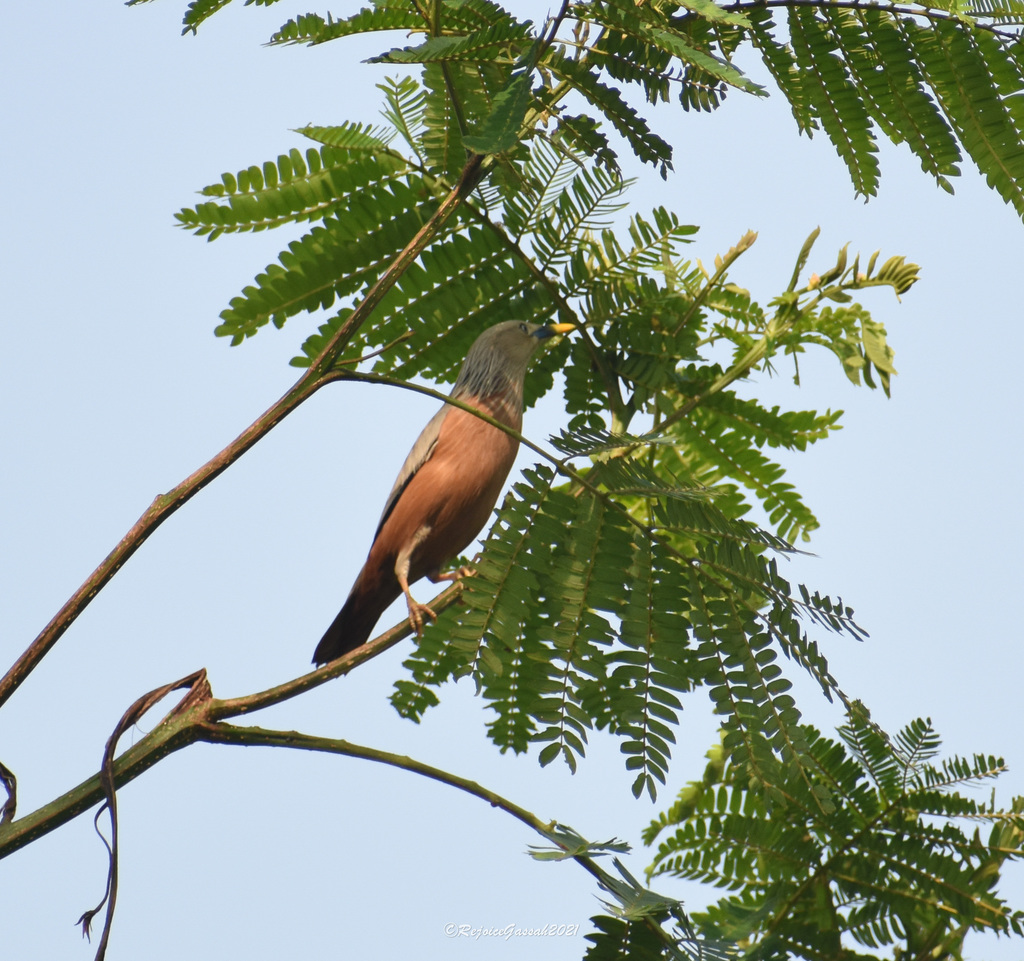
Chestnut-tailed Starling
Photo © Rejoice Gassah
Photo © Rejoice Gassah — CC BY 4.0 — Source: iNaturalist #99060655Identification
The Chestnut-tailed Starling is a compact bird approximately 20 cm in length, readily identified by its grey upperparts contrasting with distinctive rufous underparts. Adults display a pale grey head with whitish streaking, particularly noticeable on the crown and collar region, paired with a striking yellow bill featuring a pale blue base. The white irises are a key identifying feature. Sexual dimorphism is minimal, though juveniles appear distinctly different with whitish underparts and only chestnut tips to the tail feathers rather than the rich chestnut of adults.
Subspecies variation exists across the species' range. The nominate subspecies (S. m. malabarica) and the closely related Malabar Starling display rufous underparts including the undertail coverts, while the northeastern subspecies nemoricola shows whitish underparts tinged with rufous, particularly on the flanks and undertail region. The blackish flight feathers provide useful contrast to the overall plumage coloration.
Range & Habitat
The Chestnut-tailed Starling is found across India and Southeast Asia, with distribution varying by subspecies and seasonal movement. The nominate subspecies occurs throughout most of India except the southwest and northeast, extending into south Nepal and Bangladesh. The subspecies nemoricola inhabits south Assam and ranges from Myanmar through to north and central Indochina. The species exhibits partial migratory behaviour, with some populations performing poorly understood movements, and the nominate subspecies is known as a winter visitor to peninsular India.
This species shows a clear preference for wooded habitats and cultivated areas, nesting in open woodland environments where suitable cavities are available. It has also been recorded in Pakistan and central and southern India beyond its core range, suggesting occasional vagrancy or irregular movements.
Behaviour & Diet
Like most starlings, the Chestnut-tailed Starling is fairly omnivorous, feeding on fruit, nectar, and insects. A particularly distinctive behaviour is its highly synchronized flocking, where birds fly in tight formations and execute rapid directional changes with remarkable coordination, creating dynamic and visually impressive flight displays.
The species nests in cavities within trees, typically selecting old barbet or woodpecker holes located 3 to 12 metres above ground. The breeding season normally extends from March to June, during which females lay clutches of 3 to 5 pale blue, unmarked eggs. This cavity-nesting habit makes them dependent on the availability of suitable dead trees or previous excavations by other species.
Best Time & Places to See It
The breeding season from March to June offers optimal viewing opportunities, particularly in open woodland and cultivation habitats where the species is most active and conspicuous. In peninsular India, the winter months provide the best chance to encounter the nominate subspecies as a winter visitor. For the subspecies nemoricola, the forested regions of south Assam, Myanmar, and Indochina are the primary locations.
The species' habit of flying in tight, coordinated flocks makes it relatively easy to locate visually, particularly during feeding periods when birds gather in productive fruiting trees or flowering plants. Open woodland areas with scattered mature trees containing nesting cavities are particularly rewarding locations.
Photography Tips
The pale grey head with whitish streaking and distinctive white irises provide excellent focal points for portraiture. The contrast between grey upperparts and rufous underparts is striking and renders well in natural light. Capture the yellow bill with its pale blue base in sharp detail to demonstrate key identifying features.
The coordinated flocking behaviour presents unique photographic opportunities; attempt to capture birds in flight executing synchronized directional changes, which can produce dynamic compositional images. Early morning and late afternoon light will enhance the subtle grey and rufous tones. When photographing birds at nest holes, use a long lens and patient positioning to avoid disturbance during the critical breeding season from March to June.
Langtang National Park
Helambu, Nepal
+364 birds+14 mammals
Where the southern slopes of the Himalayan highlands descend toward the subtropical valleys of central Nepal, Langtang National Park sprawls across one of the subcontinent's most…
VIEW NATIONAL PARKOrang National Park
Rangagarapathar, India
+298 birds+1 mammals
Where the Brahmaputra's floodplains meet the foothills of Assam, Orang National Park unfolds across a mosaic of riverine grasslands, forests and wetlands that pulse with the…
VIEW NATIONAL PARKRanthambhore National Park
Sawai Madhopur, India
+294 birds+20 mammals
Granite ridges and ravines carved through the Aravalli Range frame this protected landscape in eastern Rajasthan, where deciduous forest mingles with open scrubland and seasonal water…
VIEW NATIONAL PARKSagarmatha National Park
Khumjung, Nepal
+219 birds+7 mammals
Soaring peaks and deep glacial valleys define this alpine wilderness in northeastern Nepal, where the terrain rises from forested foothills into a realm of high-altitude tundra…
VIEW NATIONAL PARKKhangchendzonga National Park
Sakkyong, India
+290 birds+1 mammals
Where the eastern Himalayas surge toward their crowning peaks, Khangchendzonga National Park embraces a landscape of almost overwhelming vertical drama. Rising from subtropical river valleys into…
VIEW NATIONAL PARKEravikulam National Park
Devikulam, India
+192 birds+7 mammals
High in the Western Ghats of Kerala, where monsoon mists cling to slopes that rise above 2,000 metres, Eravikulam National Park preserves one of South India's…
VIEW NATIONAL PARKKhao Laem National Park
Sangkhla Buri District, Thailand
+197 birds
Where the Vajiralongkorn Reservoir sprawls across the forested valleys of Kanchanaburi's northern borderlands, Khao Laem National Park protects a landscape where limestone ridges rise dramatically from…
VIEW NATIONAL PARKKanha Tiger Reserve
Kanha Kisli F.V., India
+321 birds+23 mammals
Where sal forests give way to emerald meadows and crystalline streams carve through ancient valleys, one of India's finest wilderness reserves unfolds across the Maikal Range.…
VIEW NATIONAL PARKTadoba National Park
Palasgaon Singru, India
+270 birds+20 mammals
Where sal forests meet open grasslands and rocky outcrops rise from red laterite soil, central India's landscape unfolds in raw, untamed beauty. Ancient teak woodlands and…
VIEW NATIONAL PARKBandhavgarh National Park
Garhpuri, India
+285 birds+17 mammals
Where granite ridges rise dramatically above sal and bamboo forests, one of India's most pristine tiger reserves unfolds across the Vindhyan plateau. Ancient rock formations tower…
VIEW NATIONAL PARKPanna National Park
Badgadi Kalan, India
+271 birds+17 mammals
Where granite gorges slice through central India's Vindhyan plateau, a landscape of stark beauty unfolds across nearly six hundred square kilometers. The Ken River carves through…
VIEW NATIONAL PARKKaziranga National Park
Kohora, India
+422 birds+26 mammals
Dawn breaks over the floodplains of the Brahmaputra, where tall grasslands stretch endlessly beneath monsoon-heavy skies. This sprawling wilderness of northeastern Assam is a mosaic of…
VIEW NATIONAL PARKKeoladeo National Park
Shreenagar Rural, India
+326 birds+14 mammals
Where shallow wetlands shimmer beneath vast Rajasthani skies, one of Asia's finest bird sanctuaries pulses with extraordinary life. This former maharaja's hunting reserve, now spanning 29…
VIEW NATIONAL PARKPeriyar National Park
Mlappara, India
+232 birds+4 mammals
Dawn breaks over mist-shrouded ridges where the Western Ghats tumble toward Kerala's spice-scented lowlands. Here, ancient tropical forests envelope a glittering artificial lake, creating a mosaic…
VIEW NATIONAL PARKPampadum Shola National Park
Vattavada, India
+258 birds+14 mammals
Where misty shola forests cling to the high plateaus of the Nilgiri Mountains, ancient evergreen remnants create a world apart. This 2,316-hectare reserve protects one of…
VIEW NATIONAL PARKBandipur National Park
Hirehalli, India
+302 birds+19 mammals
Where the Western Ghats descend into the Deccan plateau, ancient deciduous forests blanket a landscape carved by the Nugu River. Bandipur unfolds across 880 square kilometres…
VIEW NATIONAL PARKNagarahole Tiger Reserve
Nalkeri Forest, India
+323 birds+23 mammals
Where granite escarpments rise above dense deciduous forests and the Kabini River carves through pristine wilderness, one of India's most biodiverse landscapes unfolds across the Western…
VIEW NATIONAL PARKGir National Park
Asundrali, India
+258 birds+13 mammals
Dry deciduous forests cloak the rolling hills of western Gujarat where the Gir landscape rises as a final sanctuary for one of the world's rarest felids:…
VIEW NATIONAL PARKGaoligong Mountain National Nature Reserve
Nujiang Lisu Autonomous Prefecture, China
+443 birds+13 mammals
VIEW NATURE RESERVENo community photos yet. Log in to add the first one.
No community observations of this species yet.