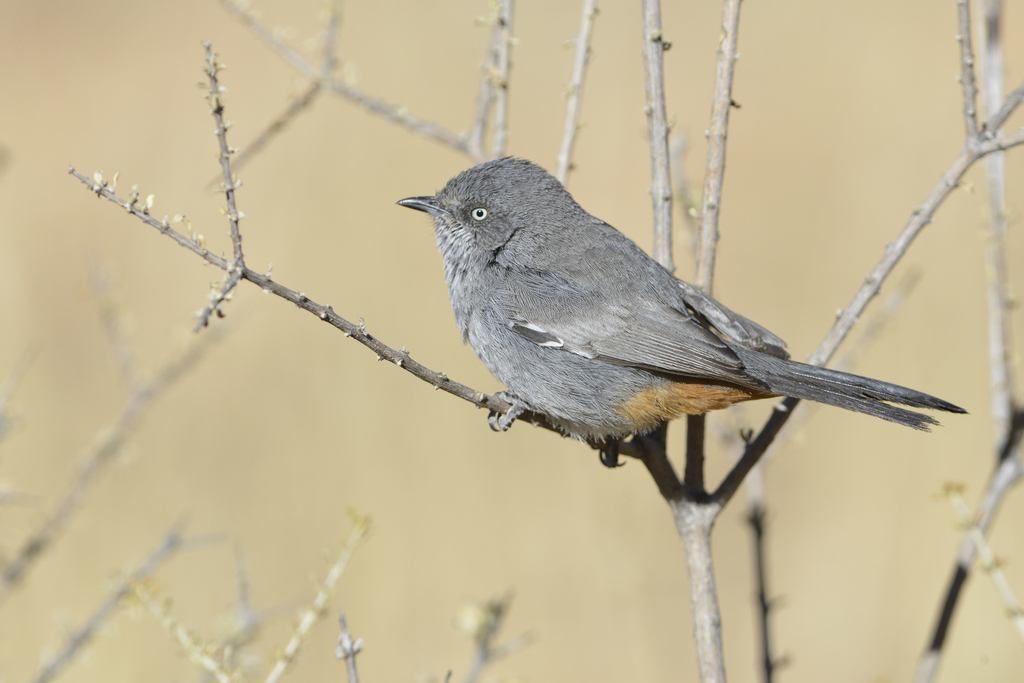
Chestnut-vented Warbler
Photo © Tom Heijnen
Photo © Tom Heijnen — CC BY 4.0 — Source: iNaturalist photo #408908637Identification
The Chestnut-vented Warbler is a small warbler measuring 14–15 cm long and weighing around 16 g. Its most distinctive feature is the bright chestnut vent area that gives the species its common name. The bird has grey-brown upperparts, a black tail with a prominent broad white band at the tip, and a white eye ring. The throat is grey with heavy dark streaking, while the breast and belly are grey. The legs are black and the eyes are grey. Juveniles differ from adults by having an unstreaked throat. The call is a loud, fluted cheerup-chee-chee. The only similar species is Layard's Warbler, which is paler, has more white in the tail, and crucially lacks the chestnut vent.
Range & Habitat
The Chestnut-vented Warbler breeds across southern Africa, with a range spanning Angola, Botswana, Zimbabwe, Zambia, Namibia, South Africa, Lesotho, Mozambique and Eswatini. This is a common species found in a diverse range of habitats including fynbos, scrub, thickets and dry riverbeds. The bird's large range covers an estimated 2,800,000 km², and it maintains a large population throughout this area.
Behaviour & Diet
The Chestnut-vented Warbler is monogamous, pairing for life with its mate. It is usually seen alone or in pairs as it moves through vegetation foraging for insects and other small invertebrates. The species builds a cup nest low in vegetation, keeping close to the dense cover that characterizes its preferred habitats.
Best Time & Places to See It
This common warbler can be found year-round throughout southern Africa wherever suitable habitat exists. Look for it in fynbos scrubland, dense thickets, and along dry riverbeds with thick vegetation. The bird's habit of foraging in low vegetation makes it relatively approachable, though it often remains partially concealed in dense cover. Its loud, distinctive call is often the first indication of its presence.
Photography Tips
Patience is essential when photographing this small warbler, as it tends to move quickly through vegetation. The bird's preference for low cover means you may need to position yourself at ground level or use a low angle to capture it effectively. The bright chestnut vent is the key field mark to capture, along with the contrasting black tail with white terminal band and the distinctive white eye ring. Early morning or late afternoon light will best showcase the subtle plumage coloration. A fast shutter speed is recommended to freeze the bird's often-rapid movements through scrub and thickets.
Addo Elephant National Park
Augrabies Falls National Park
Bontebok National Park
Bwabwata National Park
Camdeboo National Park
Chobe National Park
Dorob National Park
Etosha National Park
Garden Route National Park
Nothing matches these filters.
No community photos yet. Log in to add the first one.
No community observations of this species yet.