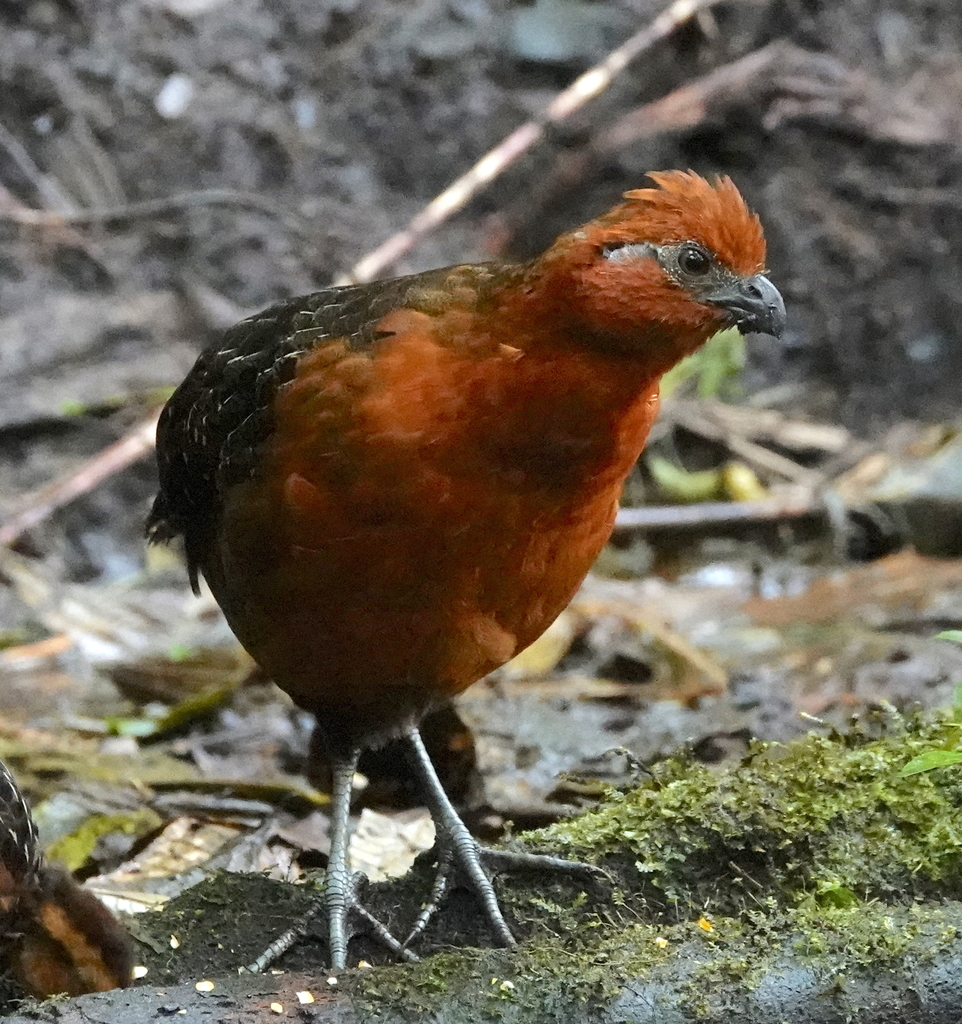
Chestnut Wood Quail
Photo © desertnaturalist
Photo © desertnaturalist — CC BY 4.0 — Source: iNaturalist #104998911Identification
The chestnut wood quail is a small Andean quail, measuring 25 to 29 centimetres in length. Males and females are distinctly different in plumage. Adult males are striking birds with a chestnut head, brown back, rump, and wings; the rump features fine black vermiculation. Both sexes share grayish-white feathers around the eye, though females have more extensive eye-rings. Males have a rufous throat and undersides, while females display a dusky brown crown with dark gray breast and belly. Juveniles resemble adult females. Males typically weigh 325 to 380 grams, while females are slightly lighter at 325 to 330 grams.
Range & Habitat
Endemic to Colombia, the chestnut wood quail inhabits the western and central Andes, with populations also found locally in the eastern Andes. This species occupies a narrow elevational band between 1,600 and 2,800 metres, preferring the interior and edges of subtropical montane forests in both primary and secondary growth. Though primarily terrestrial, foraging on the forest floor, these quails have been observed roosting as high as 10 metres above ground, suggesting some arboreal behaviour at night.
Behaviour & Diet
The chestnut wood quail is a ground-forager that scratches through leaf litter searching for roots, seeds, fallen berries, and likely insects. This species appears to have two distinct nesting seasons corresponding with the year's wettest periods: March to May and October to December. Females construct remarkable domed-globe nests on the ground using leaves and twigs, with a short tunnel entrance. Clutches contain four or five eggs, which the female incubates alone. After hatching, family groups remain together for many months.
The species is vocal, particularly during breeding season. Its distinctive advertising call is a rollicking, rapidly repeated duet rendered as "orrit-kilyit..." Males use this duet to establish territories and attract mates. When alarmed, the birds produce a lower-pitched "peetit, peetit..." call.
Best Time & Places to See It
The chestnut wood quail's restricted range in the Colombian Andes makes it a sought-after species for dedicated birdwatchers and photographers. Your best chances occur during the two nesting seasons—March to May and October to December—when birds are most vocal and active. Target subtropical montane forests in the western and central Andes at elevations between 1,600 and 2,800 metres. Early mornings offer the best opportunities to hear advertising calls, which may lead you to families foraging on the forest floor.
Photography Tips
Photography of this species presents challenges typical of forest quails: they are shy, terrestrial, and favour dense undergrowth. Position yourself quietly near suitable habitat at dawn and listen for calling males. The birds' preference for leaf litter and forest edges offers occasional opportunities for photography. The male's distinctive chestnut head and rufous undersides provide good contrast, while females blend better with their surroundings. Patience and a long lens are essential; avoid sudden movements that will send these birds scurrying into cover.
Natural Munchique National Park
El Tambo, Colombia
+194 birds
Where the Western Cordillera rises steeply from the Pacific plains of southwestern Colombia, Natural Munchique National Park sprawls across 1,078 square kilometers of montane forest that…
VIEW NATIONAL PARKNatural Farallones de Cali National Park
Buenaventura, Colombia
+733 birds+27 mammals
Where the Pacific coastal plain meets the western slopes of the Andes, Farallones de Cali National Park sprawls across nearly 3,500 square kilometers of dramatic topography…
VIEW NATIONAL PARKGuácharos Cave National Natural Park
Acevedo, Colombia
+359 birds
High in the Andean foothills of southern Huila, where mist-laden slopes rise above 1,600 metres, lies a landscape carved by underground rivers and crowned by karst…
VIEW NATIONAL PARKNatural Uramba Bahía Málaga National Park
Buenaventura, Colombia
+308 birds+15 mammals
Where the Pacific coastal rainforest descends to mangrove estuaries and rocky headlands, Uramba Bahía Málaga National Park unfolds across nearly 1,000 square kilometres of Colombia's Valle…
VIEW NATIONAL PARKNo community photos yet. Log in to add the first one.
No community observations of this species yet.