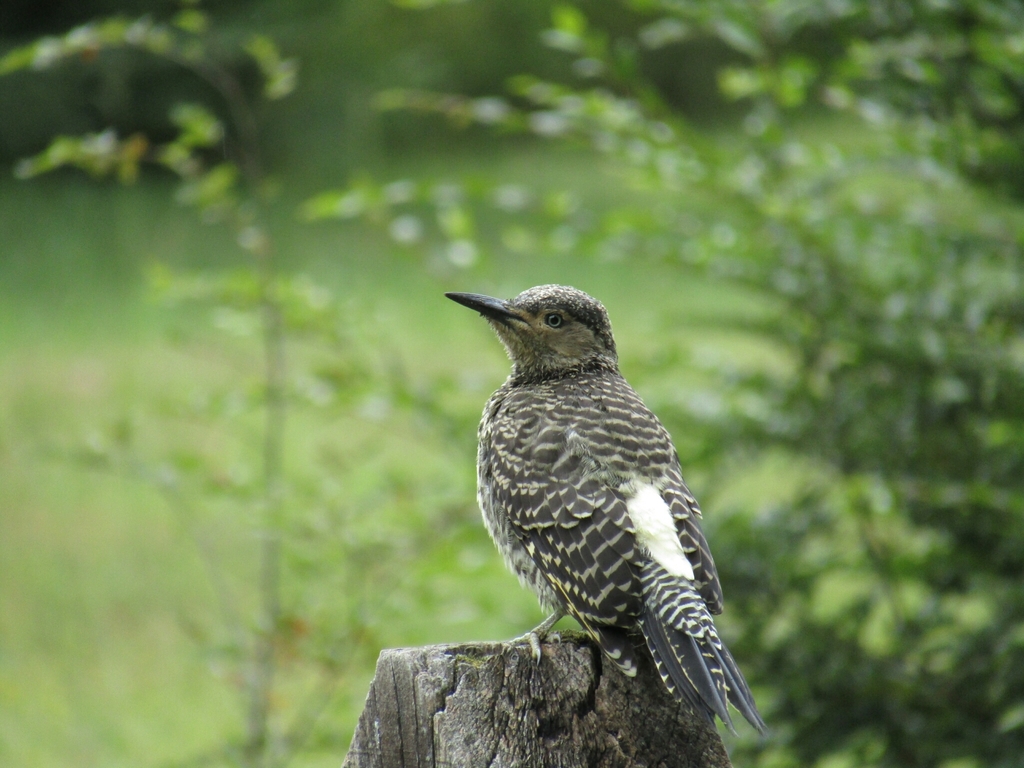
Chilean Flicker
Photo © Ezequiel Vera
Photo © Ezequiel Vera — CC BY 4.0 — Source: iNaturalist photo #13498317Identification
The Chilean flicker is a medium-sized woodpecker measuring about 30 cm (12 in) long and weighing between 100 and 163 g (3.5 to 5.7 oz). Both sexes share similar overall plumage, though males and females differ distinctly on the head. Adult males display dark slate-gray crowns and napes, with the nape occasionally showing a hint of red. Both sexes are characterized by blackish-brown upperparts with narrow white to buff-white bars, a white rump sometimes spotted with black, and whitish underparts heavily barred with blackish-brown on the breast. The belly is mostly plain. A useful field mark is the buffish coloration around the lores and eye, with fine spots on the malar area forming a diffuse patch. Their longish black bill, whitish to yellowish iris, and gray to green-gray legs are diagnostic features. Females lack spots on the malar area and never show red on the nape, making them distinguishable from males.
Range & Habitat
The Chilean flicker is found in central and southern Chile, ranging from the Coquimbo Region to central Magallanes Region, and in adjacent southwestern Argentina between Neuquén and Santa Cruz provinces. It favors semi-open to open landscapes within temperate and Mediterranean climate zones, including forest edges and openings, open woodlands, riparian woodland, tree plantations, and scrublands. The species typically inhabits elevations between 600 and 1,000 m (2,000 and 3,300 ft), though it may descend to near sea level during winter months.
Behaviour & Diet
The Chilean flicker feeds almost exclusively on adult ants, along with their larvae and pupae. It forages primarily on the ground in family groups, hopping about while poking, digging, and sweeping aside debris to locate prey. The bird will investigate fallen logs and stumps but very rarely ventures into trees to forage. It is mostly resident throughout its range, though it may show some nomadic behavior. The species is believed to be highly territorial during its breeding season, which occurs between October and December, when it excavates nest cavities in dead trees, snags, or occasionally in earthen banks. Clutches typically contain four to six eggs.
Best Time & Places to See It
The Chilean flicker is considered rather common throughout its range and occurs in several protected areas, making it a reliably observable species. Its preference for semi-open landscapes and ground foraging makes it relatively conspicuous compared to many woodpeckers. The breeding season from October to December may offer opportunities to observe territorial behavior and family groups. The temperate and Mediterranean zones of central and southern Chile and adjacent Argentina provide the best locations for encountering this species in its natural habitat.
Photography Tips
Photographing the Chilean flicker requires patience and attention to ground-level behavior. Since the species forages primarily on the ground in open to semi-open landscapes, position yourself near suitable habitat such as forest edges or open woodlands. Early morning hours often provide the best lighting for capturing the bird's characteristic barred plumage and subtle head markings. Focus on distinguishing male and female plumage patterns—the male's dark slate-gray crown and occasional red nape are key identifying features worth documenting. Watch for family groups foraging together, which may offer opportunities for behavioral shots showing the bird's characteristic hopping and debris-clearing foraging technique.
Chiloé National Park
Dalcahue, Chile
+122 birds+6 mammals
Temperate rainforest cloaks the Chiloé archipelago's northwestern reaches, where granite ridges thrust through dense, moisture-laden canopy and freshwater streams carve ravines toward the Pacific. Across approximately…
VIEW NATIONAL PARKAlerce Costero National Park
Corral, Chile
+34 birds
Where temperate rainforest descends to the Pacific coast in southern Chile, Alerce Costero National Park protects one of the continent's rarest and most ancient ecosystems across…
VIEW NATIONAL PARKCorcovado National Park
Chaitén, Chile
+39 birds+1 mammals
Where temperate rainforest meets the raw Pacific coastline of Chilean Patagonia, Corcovado National Park sprawls across 6,585 square kilometres of some of South America's most pristine…
VIEW NATIONAL PARKTorres del Paine National Park
Torres del Paine, Chile
+143 birds+10 mammals
Where granite spires pierce the Patagonian sky, Torres del Paine commands one of South America's most dramatic landscapes. Across 4,106 square kilometres of southern Chile, jagged…
VIEW NATIONAL PARKLaja National Park Lagoon
Antuco, Chile
+123 birds+1 mammals
Where the Andes descend into the Biobío Region's temperate forests, a vast lagoon fills the caldera of the extinct Antuco volcano, cradled by steep native woodland…
VIEW NATIONAL PARKPuyehue National Park
Puyehue, Chile
+110 birds+4 mammals
Across the volcanic spine of the Los Lagos Region, where the Andes descend toward temperate rainforest, Puyehue National Park encompasses nearly 2,600 square kilometers of one…
VIEW NATIONAL PARKVicente Pérez Rosales National Park
Puerto Varas, Chile
+109 birds+8 mammals
Where the Andes descend toward the temperate rainforests of Chile's Lake District, nearly 4,641 square kilometers of pristine wilderness unfolds across Vicente Pérez Rosales National Park.…
VIEW NATIONAL PARKCerro Castillo National Park
Coyhaique, Chile
+89 birds+3 mammals
Granite peaks and windswept steppe converge across this vast Patagonian landscape, where the Andes' eastern flank drops into terrain sculpted by ice age glaciers and relentless…
VIEW NATIONAL PARKPatagonia National Park
Cochrane, Chile
+133 birds+8 mammals
Where the Andes meet the Patagonian steppe, vast grasslands and shrublands sweep across rolling terrain carved by ancient glaciation, their contours softened by distance and dramatic…
VIEW NATIONAL PARKReserva Nacional Magallanes
Punta Arenas, Chile
+78 birds+2 mammals
Where windswept steppe meets sub-Antarctic forest near the southern tip of continental South America, Reserva Nacional Magallanes unfolds across roughly 352 square kilometres of profound ecological…
VIEW NATIONAL PARKParque Provincial Península de Magallanes
Argentina
+125 birds+4 mammals
Granite peaks and windswept steppe converge across this 415-square-kilometre peninsula jutting into the cold Atlantic waters of southern Patagonia, where the Magallanes landscape embodies the raw,…
VIEW NATIONAL PARKParque Municipal Llao Llao
San Carlos de Bariloche, Argentina
+73 birds+1 mammals
Where the Andes meet the Patagonian lakes, granite peaks rise above temperate rainforest in a landscape of startling contrasts. Parque Municipal Llao Llao, sprawling across 23…
VIEW NATIONAL PARKLos Glaciares National Park
Argentina
+121 birds+3 mammals
Where granite peaks and sprawling ice fields dominate the landscape, Los Glaciares National Park encompasses over ten thousand square kilometres of Patagonian wilderness in southern Argentina.…
VIEW NATIONAL PARKPerito Moreno National Park
Argentina
+78 birds
Where the Patagonian steppe descends into a landscape carved by ancient ice, Perito Moreno National Park sprawls across nearly 1,590 square kilometres of some of South…
VIEW NATIONAL PARKNahuel Huapi National Park
Argentina
+124 birds+11 mammals
Where the Andes descend toward Patagonia, vast glacial lakes cut through a landscape of southern beech forest and granite peaks, creating one of South America's most…
VIEW NATIONAL PARKLanín National Park
Argentina
+128 birds+7 mammals
Where the volcanic spine of the Andes plunges into Patagonian steppe, Lanín National Park sprawls across nearly 4,700 square kilometers of one of Argentina's most visually…
VIEW NATIONAL PARKLago Puelo National Park
Argentina
+109 birds+1 mammals
Where temperate forests descend to crystalline waters in the foothills of the Andes, Lago Puelo National Park sprawls across nearly 300 square kilometers of pristine wilderness…
VIEW NATIONAL PARKLos Alerces National Park
Argentina
+84 birds+3 mammals
Where the temperate rainforests of southern Patagonia sweep down towards crystalline lakes, Los Alerces National Park unfolds across nearly 3,000 square kilometres of one of South…
VIEW NATIONAL PARKNo community photos yet. Log in to add the first one.
No community observations of this species yet.