Chiloe Wigeon
Photo © Luciano Massa
Photo © Luciano Massa — CC BY 4.0 — Source: iNaturalist photo #149748108Identification
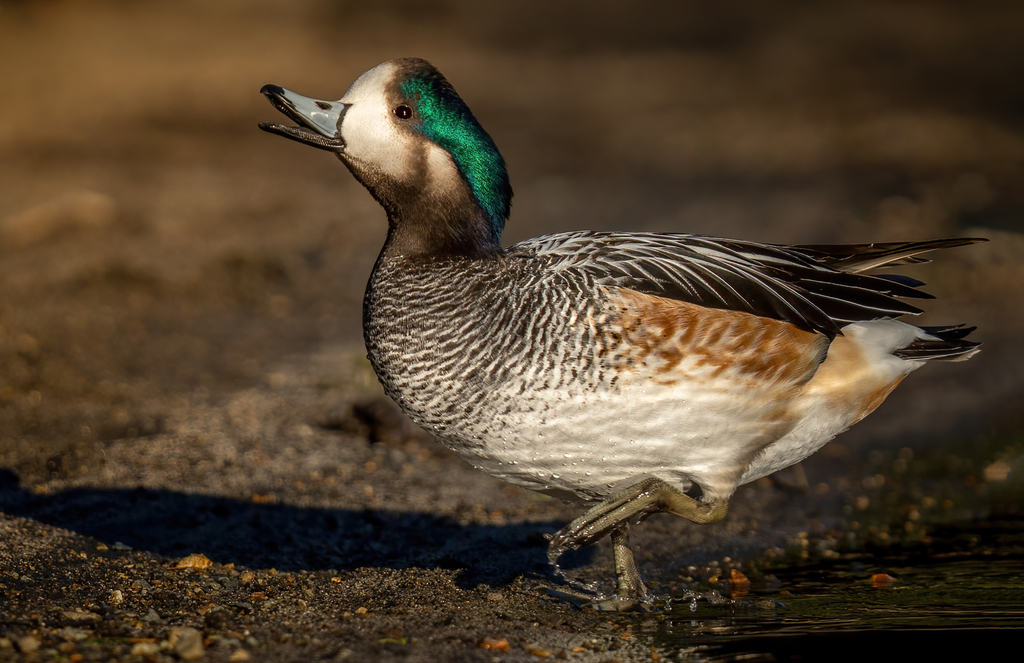
The Chiloé wigeon is a medium-sized dabbling duck with distinctive plumage and subtle sexual dimorphism. It measures 46 to 56 cm in body length with a wingspan of 75 to 86 cm, weighing approximately 800 g. The most striking feature is its iridescent green-blue cap, which is more pronounced in males. The face is predominantly white on the cheeks and forehead, with a contrasting black neck and occipital region. A white auricular patch is visible behind the eye, and the bill is bluish-gray with a black tip.
The breast displays distinctive black and white barring, while the wings are gray and white. Males have rust-colored flanks, while females show lighter brown flanking. The legs and feet are gray, and the eyes are dark brown. Sexual dimorphism is relatively subtle; males are typically somewhat larger with brighter plumage and more pronounced cap iridescence. Juveniles resemble adults but lack or have greatly diminished rust coloring on the flanks.
Range & Habitat
This species is indigenous to southern South America, with its name derived from the Chiloé Archipelago off the Chilean coast. It breeds primarily in Argentina, Uruguay, and Chile, with the northern limit of its breeding range at approximately 36° S in Argentina and 40° S in Chile. The bird also breeds sparingly in the Falkland Islands. During winter, populations migrate to southeastern Brazil. Vagrants have occasionally been recorded as far as South Georgia, the South Orkney Islands, and the South Shetland Islands.
The Chiloé wigeon favors freshwater habitats including lakes, marshes, shallow lagoons, and slow-flowing rivers. The species has a large, stable wild population and is widely distributed throughout its range, earning it a classification of least concern by the IUCN. The bird has also been established in captive collections since its introduction to Europe in 1870, where it bred readily in zoos.
Behaviour & Diet
This monogamous species is predominantly an omnivore, feeding on aquatic plants, grasses, and occasionally coastal algae. Its behavior varies according to habitat conditions. The Chiloé wigeon breeds during the austral spring between September and December, with pairs establishing very small breeding territories. Nests are constructed in grasses and under bushes, where females lay clutches of eight to ten white or cream-colored eggs.
Incubation lasts approximately 24 to 25 days. Unlike many duck species, males participate in raising the ducklings, though they abandon the family after the offspring molt. The bird's specific epithet, sibilatrix, refers to its characteristic whistling call. The species hosts various parasites including chewing lice, feather mites, nasal mites, tapeworms, nematodes, and trematodes.
Best Time & Places to See It
The austral spring breeding season between September and December offers the best opportunity to observe Chiloé wigeons at their breeding grounds in Argentina, Uruguay, and Chile. During this period, the birds are territorial and more conspicuous as they establish nesting sites. The primary freshwater habitats—lakes, marshes, shallow lagoons, and slow-flowing rivers—are the most productive locations for sightings during breeding season.
Winter observations are possible in southeastern Brazil where populations migrate seasonally. The Falkland Islands also host breeding populations, making them accessible destinations for travelers seeking this species. The wide distribution and stable population mean that dedicated birders exploring southern South American wetlands have reasonable prospects for encounters, particularly in suitable freshwater habitat.
Photography Tips
The Chiloé wigeon's striking plumage and relatively subtle sexual dimorphism present excellent photography opportunities. The iridescent green-blue cap is most vibrant in males and photographs best in good natural light that can capture the metallic sheen. Position yourself to capture the contrast between the white facial markings and the black neck and occipital region, as these distinctive features make for compelling portraits.
Photograph birds in pairs or family groups during breeding season to document breeding behavior and parental care, which is relatively unusual among ducks. Early morning light will enhance the visibility of the cap's iridescence and the subtle barring on the breast. The birds' preference for freshwater habitats often provides scenic backgrounds; use these landscape elements to create contextual images that showcase the species in its natural environment.
Danube Delta Biosphere Reserve
Tulcea, Romania
+277 birds+27 mammals
Where the Danube surrenders to the Black Sea, a vast labyrinth of channels, reed beds, and freshwater lakes sprawls across nearly 13,400 square kilometers of eastern…
VIEW NATIONAL PARKSea Lion Island
Sealion Island Settlement, Falkland Islands
+74 birds+3 mammals
Windswept tussock grasslands roll across volcanic terrain where Southern Ocean swells crash against rocky shores, creating one of the Falkland Islands' most dramatic wildlife theatres. This…
VIEW ISLAND & ARCHIPELAGOMurrell Farm
falskland islands, Falkland Islands
+54 birds
Rolling grasslands sweep across windswept plateaux where the South Atlantic exerts its relentless influence on the vegetation, sculpting tussock grassland into a tapestry of browns and…
VIEW NATURE RESERVECape Dolphin
falskland islands, Falkland Islands
+54 birds+1 mammals
Where windswept grasslands meet dramatic coastal cliffs, the Falkland Islands' northern reaches reveal one of the Southern Hemisphere's most compelling seabird sanctuaries. The terrain here is…
VIEW NATURE RESERVEVolunteer Point
Stanley, Falkland Islands
+70 birds+3 mammals
Windswept grasslands meet volcanic black sand beaches where three penguin species converge in the South Atlantic's most theatrical wildlife theatre. This remote peninsula on East Falkland…
VIEW NATURE RESERVEWest Point Island
West Point, Falkland Islands
+67 birds+3 mammals
Windswept cliffs plunge dramatically into the South Atlantic, their rust-coloured rock faces sculpted by millennia of gales and spray. This northwestern outpost of the Falkland Islands…
VIEW ISLAND & ARCHIPELAGOChiloé National Park
Dalcahue, Chile
+122 birds+6 mammals
Temperate rainforest cloaks the Chiloé archipelago's northwestern reaches, where granite ridges thrust through dense, moisture-laden canopy and freshwater streams carve ravines toward the Pacific. Across approximately…
VIEW NATIONAL PARKTorres del Paine National Park
Torres del Paine, Chile
+143 birds+10 mammals
Where granite spires pierce the Patagonian sky, Torres del Paine commands one of South America's most dramatic landscapes. Across 4,106 square kilometres of southern Chile, jagged…
VIEW NATIONAL PARKLaja National Park Lagoon
Antuco, Chile
+123 birds+1 mammals
Where the Andes descend into the Biobío Region's temperate forests, a vast lagoon fills the caldera of the extinct Antuco volcano, cradled by steep native woodland…
VIEW NATIONAL PARKPuyehue National Park
Puyehue, Chile
+110 birds+4 mammals
Across the volcanic spine of the Los Lagos Region, where the Andes descend toward temperate rainforest, Puyehue National Park encompasses nearly 2,600 square kilometers of one…
VIEW NATIONAL PARKVicente Pérez Rosales National Park
Puerto Varas, Chile
+109 birds+8 mammals
Where the Andes descend toward the temperate rainforests of Chile's Lake District, nearly 4,641 square kilometers of pristine wilderness unfolds across Vicente Pérez Rosales National Park.…
VIEW NATIONAL PARKCerro Castillo National Park
Coyhaique, Chile
+89 birds+3 mammals
Granite peaks and windswept steppe converge across this vast Patagonian landscape, where the Andes' eastern flank drops into terrain sculpted by ice age glaciers and relentless…
VIEW NATIONAL PARKPatagonia National Park
Cochrane, Chile
+133 birds+8 mammals
Where the Andes meet the Patagonian steppe, vast grasslands and shrublands sweep across rolling terrain carved by ancient glaciation, their contours softened by distance and dramatic…
VIEW NATIONAL PARKReserva Nacional Magallanes
Punta Arenas, Chile
+78 birds+2 mammals
Where windswept steppe meets sub-Antarctic forest near the southern tip of continental South America, Reserva Nacional Magallanes unfolds across roughly 352 square kilometres of profound ecological…
VIEW NATIONAL PARKParque Provincial Península de Magallanes
Argentina
+125 birds+4 mammals
Granite peaks and windswept steppe converge across this 415-square-kilometre peninsula jutting into the cold Atlantic waters of southern Patagonia, where the Magallanes landscape embodies the raw,…
VIEW NATIONAL PARKParque Municipal Llao Llao
San Carlos de Bariloche, Argentina
+73 birds+1 mammals
Where the Andes meet the Patagonian lakes, granite peaks rise above temperate rainforest in a landscape of startling contrasts. Parque Municipal Llao Llao, sprawling across 23…
VIEW NATIONAL PARKMonte León National Park
Argentina
+100 birds+4 mammals
Where the Patagonian steppe meets the Atlantic, Monte León National Park protects a landscape of windswept coastal cliffs, rocky outcrops, and semi-arid grassland spanning over 1,200…
VIEW NATIONAL PARKLos Glaciares National Park
Argentina
+121 birds+3 mammals
Where granite peaks and sprawling ice fields dominate the landscape, Los Glaciares National Park encompasses over ten thousand square kilometres of Patagonian wilderness in southern Argentina.…
VIEW NATIONAL PARKCampos del Tuyú National Park
Argentina
+169 birds+5 mammals
Subtropical forest graces the borderlands where Misiones Province meets Paraguay, a landscape shaped by the Paraná Plateau's weathered topography and the warm, humid climate of northeastern…
VIEW NATIONAL PARKPerito Moreno National Park
Argentina
+78 birds
Where the Patagonian steppe descends into a landscape carved by ancient ice, Perito Moreno National Park sprawls across nearly 1,590 square kilometres of some of South…
VIEW NATIONAL PARKNahuel Huapi National Park
Argentina
+124 birds+11 mammals
Where the Andes descend toward Patagonia, vast glacial lakes cut through a landscape of southern beech forest and granite peaks, creating one of South America's most…
VIEW NATIONAL PARKLanín National Park
Argentina
+128 birds+7 mammals
Where the volcanic spine of the Andes plunges into Patagonian steppe, Lanín National Park sprawls across nearly 4,700 square kilometers of one of Argentina's most visually…
VIEW NATIONAL PARKLago Puelo National Park
Argentina
+109 birds+1 mammals
Where temperate forests descend to crystalline waters in the foothills of the Andes, Lago Puelo National Park sprawls across nearly 300 square kilometers of pristine wilderness…
VIEW NATIONAL PARKLos Alerces National Park
Argentina
+84 birds+3 mammals
Where the temperate rainforests of southern Patagonia sweep down towards crystalline lakes, Los Alerces National Park unfolds across nearly 3,000 square kilometres of one of South…
VIEW NATIONAL PARKNo community photos yet. Log in to add the first one.
No community observations of this species yet.