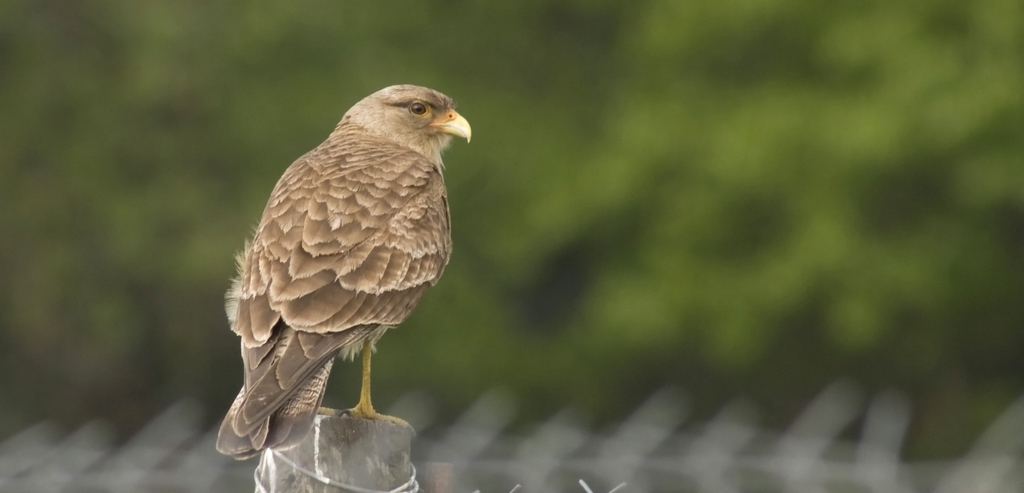
Chimango Caracara
Photo © Nicolas Olejnik
Photo © Nicolas Olejnik — CC BY 4.0 — Source: iNaturalist photo #1933158Identification
The Chimango Caracara is a medium-sized raptor measuring 32 to 43 cm in length with a wingspan of 80 to 99 cm, weighing between 170 to 260 grams. Adults are predominantly brownish with dark streaks on the side of the head and hindneck, while their undersides are mottled or barred with rufous-brown. A distinctive feature is their white uppertail coverts and grayish-white tail with a wide black band near the tip. The sexes differ slightly in bare parts: males display bright yellow skin around the eye, yellow legs, and yellow feet, while females have reddish-pink eye skin and bluish-gray legs and feet. Juvenile birds show a stronger rufous tinge overall. The southern subspecies, D. c. temucoensis, is noticeably darker and more heavily marked than its northern counterpart.
Range & Habitat
This versatile caracara is found across much of southern South America, with the nominate subspecies inhabiting northern and central Chile, central Argentina, Paraguay, southern Brazil, and Uruguay. The southern subspecies extends from southern Chile through Tierra del Fuego to Cape Horn, with occasional vagrants recorded on the Falkland Islands. The species was also introduced to Easter Island in the early 20th century.
The Chimango Caracara thrives in remarkably diverse open landscapes, from grassy Andean foothills and heathland to shrub-steppe, marshes, and coastal flats. It readily adapts to open woodlands, plantations, villages, suburbs, and urban areas. The species is particularly common in the ranching and wheat belts of the Argentinian Pampas and around Chilean fishing villages, making it the most common raptor in Argentinean Patagonia. While most abundant below 2,000 meters, it regularly occurs up to 3,000 meters and occasionally reaches 4,000 meters elevation.
Behaviour & Diet
This intelligent bird is a year-round resident throughout most of its range, though southern populations show partial migratory behavior, moving north during the austral winter. Northern populations regularly venture into Bolivia and occasionally as far north as Brazil during the non-breeding season.
The Chimango Caracara is an omnivorous opportunist, described as both a small-scale predator and general scavenger. Its diet includes insects and invertebrates, lizards, amphibians, bird eggs and nestlings, and rodents. It readily scavenges roadkill and larger carcasses abandoned by other predators, supplementing its diet with rotten fruit, fungi, and material from livestock dung. The bird typically forages on the wing, flying 10 meters above ground and dropping onto prey or food sources. Famously, it follows plowing farmers in assemblies exceeding 100 birds, congregates at grass fires, and frequents fishing villages and shellfish processing plants. It even pirates food from other raptors and occasionally catches live fish from water surfaces.
Best Time & Places to See It
The Chimango Caracara's breeding season runs from September to January, with eggs laid between mid-October and mid-November. This is an excellent period for observing the species' nesting behavior and territorial activities. The bird's year-round presence in most of its range means it can be encountered throughout the year, though populations are most concentrated in the Argentinian Pampas, southern Chile, and Patagonia.
Look for this adaptable raptor in open country near human activity—along roads, near farmland during plowing, at garbage dumps, and around coastal fishing settlements. Its association with disturbed and modified landscapes means it often appears in easily accessible areas where travelers frequent, making it a reliable sighting for those exploring temperate South America.
Photography Tips
The Chimango Caracara's brown plumage blends easily with scrubby vegetation, so search open landscapes methodically and watch for birds quartering low over grassland. The species' habit of following farmers and congregating at fires provides predictable photo opportunities, as does its frequent perching on posts, rocks, and fence lines. Early morning and late afternoon light will enhance details of the pale uppertail coverts and tail pattern against darker plumage.
When photographing, watch for the distinctive sexual differences in eye and leg coloration—males' bright yellow contrasts dramatically with females' reddish-pink and gray tones. Nesting birds in trees offer chances to capture behavioral shots during the breeding season, though ground-nesting colonies in marshes provide exceptional opportunities for documenting colonial nesting behavior and family groups.
Peixe National Park Lagoon
Brazil
+293 birds+4 mammals
Where the coastal plains of Rio Grande do Sul meet the Atlantic, Peixe National Park Lagoon sprawls across nearly 2,200 square kilometres of shallow waters, reed…
VIEW NATIONAL PARKChiloé National Park
Dalcahue, Chile
+122 birds+6 mammals
Temperate rainforest cloaks the Chiloé archipelago's northwestern reaches, where granite ridges thrust through dense, moisture-laden canopy and freshwater streams carve ravines toward the Pacific. Across approximately…
VIEW NATIONAL PARKTorres del Paine National Park
Torres del Paine, Chile
+143 birds+10 mammals
Where granite spires pierce the Patagonian sky, Torres del Paine commands one of South America's most dramatic landscapes. Across 4,106 square kilometres of southern Chile, jagged…
VIEW NATIONAL PARKVicente Pérez Rosales National Park
Puerto Varas, Chile
+109 birds+8 mammals
Where the Andes descend toward the temperate rainforests of Chile's Lake District, nearly 4,641 square kilometers of pristine wilderness unfolds across Vicente Pérez Rosales National Park.…
VIEW NATIONAL PARKReserva Nacional Magallanes
Punta Arenas, Chile
+78 birds+2 mammals
Where windswept steppe meets sub-Antarctic forest near the southern tip of continental South America, Reserva Nacional Magallanes unfolds across roughly 352 square kilometres of profound ecological…
VIEW NATIONAL PARKParque Provincial Península de Magallanes
Argentina
+125 birds+4 mammals
Granite peaks and windswept steppe converge across this 415-square-kilometre peninsula jutting into the cold Atlantic waters of southern Patagonia, where the Magallanes landscape embodies the raw,…
VIEW NATIONAL PARKParque Municipal Llao Llao
San Carlos de Bariloche, Argentina
+73 birds+1 mammals
Where the Andes meet the Patagonian lakes, granite peaks rise above temperate rainforest in a landscape of startling contrasts. Parque Municipal Llao Llao, sprawling across 23…
VIEW NATIONAL PARKNo community photos yet. Log in to add the first one.
No community observations of this species yet.