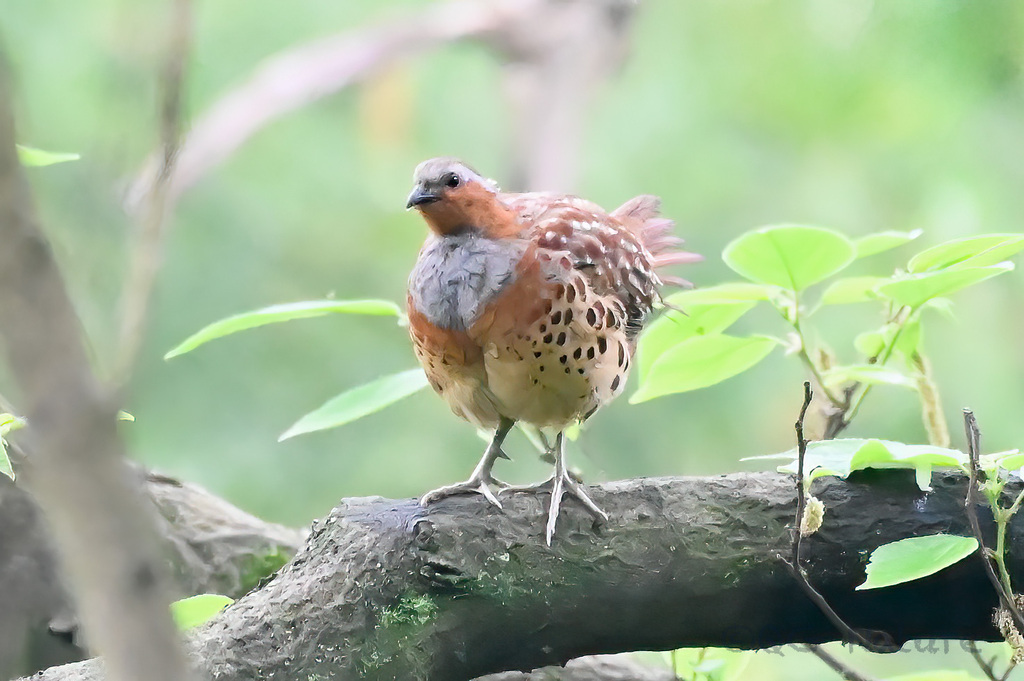
Chinese Bamboo Partridge
Photo © Wang.QG
Photo © Wang.QG — CC BY 4.0 — Source: iNaturalist photo #244052836Identification
The Chinese bamboo partridge is a small galliform bird measuring 31 centimetres, intermediate in size between Coturnix and Perdix species, with males slightly larger than females. The species is richly patterned: the breast and back are mottled in black, chestnut, and cream, with black spots decorating the flanks and upper parts. The face and throat display warm fulvous and rufous tones, while the breast is yellow-ochre. A pale greyish-blue and taupe colouration extends above the eye and down the neck. The birds possess well-developed flight feathers, broad squared tails, and long narrow wings—adaptations that enable sustained flight and remarkable agility in their forest habitat.
Range & Habitat
Native to eastern mainland China, the Chinese bamboo partridge has been intentionally introduced to Japan (first in 1919), Hawaii, Argentina, and the remote island of Iwo Jima. Despite its name, the species is not entirely dependent on bamboo and inhabits warm forests and grasslands across its native range. Notably, the species has been extirpated from Hong Kong, and a reintroduction attempt there in 1961 failed to establish a viable breeding population.
Behaviour & Diet
Like many galliform birds, Chinese bamboo partridges prefer concealment to flight, yet readily flush when approached, startling pursuers with loud, explosive wingbeats. An unusual behaviour—flying uphill while weaving through timber—has been recorded in this species and the unrelated koklass, setting them apart from related gamebirds. Males broadcast loud, multi-syllabic calls throughout the day and year, serving as territorial challenges, location signals, and anti-predator alarms. The distinctive loud contact call is typically rendered as "ki-ko-kuai" or "kojukei" (the latter adopted as its Japanese name) and is repeated several times before gradually slowing. Though common within its limited range, the species remains elusive and secretive, heard far more often than seen.
Best Time & Places to See It
The Chinese bamboo partridge's loud vocalisations are heard throughout the day and year, making calls an excellent means of locating birds even when they remain visually elusive. Within its native range in eastern mainland China, the species is common in warm forests and grasslands, though its secretive nature requires patience and careful stalking. Birders should listen for the distinctive multi-syllabic call as their best chance of detection.
Photography Tips
Photographing this species presents a challenge due to its elusive, secretive behaviour and preference for dense forest cover. Use the bird's vocalisations to locate individuals, then approach slowly and cautiously to avoid flushing. The partridge's preference for moving between the sub-canopy and forest floor multiple times daily suggests that patience near suitable habitat will yield opportunities. Early morning and late afternoon, when vocalisations are most frequent, offer the best chances for observation and photography.
Wulingyuan
Jundiping, China
+97 birds+3 mammals
Sandstone peaks erupting from forested valleys define this sprawling 993-square-kilometre national park in Hunan Province, where vertical cliffs rise dramatically above lush subtropical woodland. The landscape—a…
VIEW NATURAL MONUMENTGiant Panda National Park
Mianyang, China
+447 birds+47 mammals
Where the eastern slopes of China's Sichuan plateau descend into cloud-wrapped valleys, one of Asia's most biodiverse landscapes unfolds across more than 350,000 square kilometres. This…
VIEW NATIONAL PARKMount Nanling Forest Park
Ruyang Forest Farm, China
+179 birds+3 mammals
Granite ridges and weathered peaks rise through a canopy of subtropical montane forest where Ruyang Forest Farm anchors one of southern China's most biodiverse landscapes. Across…
VIEW FOREST & JUNGLEWuyishan National Park
Yanshan County, China
+141 birds+2 mammals
Where subtropical monsoon rains sustain a perpetually humid landscape, Wuyishan National Park rises from Fujian's eastern plateau as a realm of forested ridges, cascading streams, and…
VIEW NATIONAL PARKWolong National Nature Reserve
Wenchuan County, China
+333 birds+17 mammals
Where the Qingyi River cuts through the eastern flanks of the Minshan Range, a temperate montane forest cloaks steep valleys in dense canopy that thins dramatically…
VIEW NATURE RESERVEPoyang Lake National Nature Reserve
Shangrao, China
+270 birds+7 mammals
Where the Yangtze River's massive floodplain spreads across central China, Poyang Lake National Nature Reserve encompasses one of the continent's most dynamic and water-rich wetland systems.…
VIEW NATURE RESERVENo community photos yet. Log in to add the first one.
No community observations of this species yet.