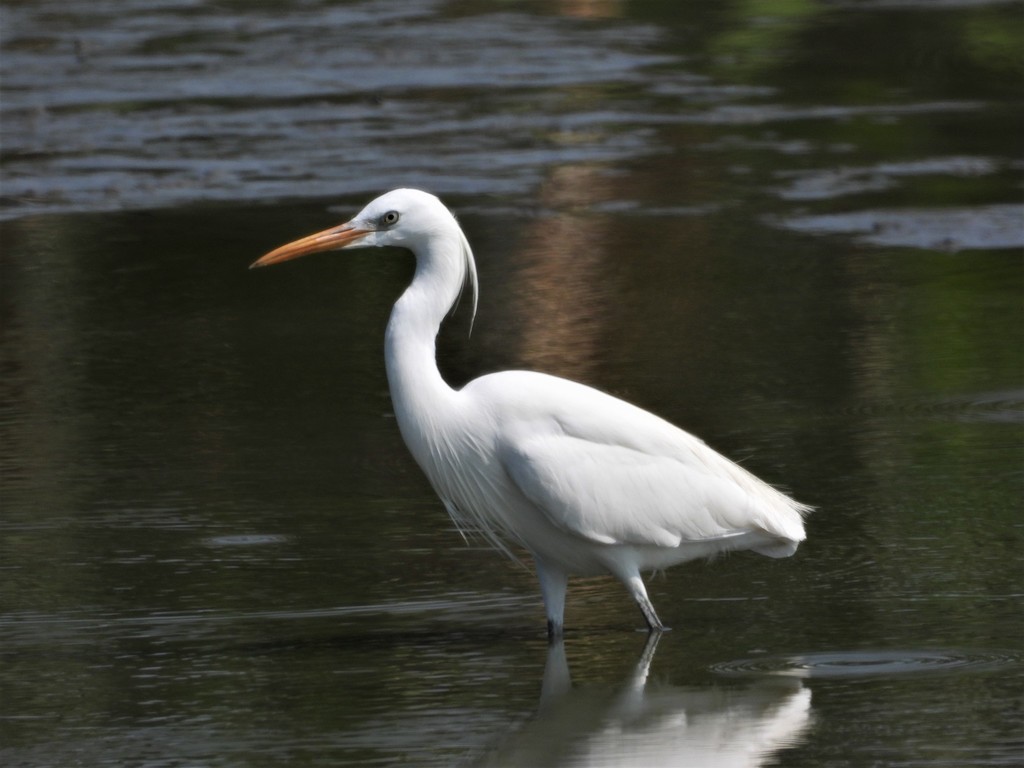
Chinese Egret
Photo © Stephen Matthews
Photo © Stephen Matthews — CC0 1.0 — Source: iNaturalist #115315952Identification
The Chinese egret, also known as Swinhoe's egret, is a medium-sized heron averaging 68 cm in height with pure white plumage throughout its life. At first glance, it closely resembles the little egret, making field identification challenging. However, subtle differences in bare-part coloration help distinguish the two species across seasons.
Outside the breeding season, the Chinese egret displays a dusky bill with a tannish-peach basal portion, yellow-green lores and legs, and a yellow iris. The breeding season transforms the bird dramatically: adults develop a luxuriant crest exceeding 11 cm in length, along with long lanceolate plumes on the breast and dorsal feathers that extend beyond the tail—ornamental feathers called aigrettes. Simultaneously, the bill brightens to an almost orange-yellow, the lores turn bright blue, and the legs become black with yellow feet, creating a striking appearance.
Range & Habitat
The Chinese egret breeds on small islands off the coasts of far eastern Russia, North Korea, South Korea, and mainland China. Historically, it nested in Taiwan and Hong Kong's New Territories, but these regions now host only non-breeding visitors or passage migrants. During migration and winter, the species occurs throughout much of Southeast Asia, including Japan, the Philippines, Vietnam, Thailand, Peninsular Malaysia, Sarawak, Singapore, Indonesia, and Brunei.
The most significant wintering grounds are in the Philippines—particularly the Eastern Visayas islands of Leyte, Bohol, and Cebu—and in Malaysian Sarawak and Selangor, where between one-third and one-half of the global population winters. Outside breeding season, Chinese egrets favour shallow tidal estuaries, mudflats, and bays, occasionally venturing into rice fields and fish ponds. The global population is estimated at 2,600–3,400 individuals and is classified as vulnerable, primarily due to habitat loss.
Behaviour & Diet
In South Korea, Chinese egrets typically return to breeding colonies in mid-April, already displaying full breeding plumage. Their arrival follows a rapid spring migration with minimal staging along the coast, concentrated between mid-April and mid-May. Birds appear first on offshore islands, particularly during stormy weather. The autumn migration is more leisurely, with egrets moving southward along Korea's west coast during August and September before departing across the Yellow Sea.
Survey data from South Korea suggests two primary migration routes: some birds move westward across Gyeonggi Bay toward the Shandong Peninsula and down the Chinese coast, while others take more southerly pathways. Counts during late August and September 2002 documented between 475 and 615 egrets along South Korea's coasts, with concentrations in northwestern Gyeonggi Bay and southern coastal sites.
Best Time & Places to See It
For observing breeding birds, South Korea offers excellent opportunities from mid-April through summer, particularly around offshore islands in Gyeonggi Bay and other northwestern coastal areas. Spring migrants occasionally appear on Korean shores during stormy weather, providing unexpected viewing opportunities.
Winter birdwatchers should focus on the Philippines' Eastern Visayas islands and Malaysian Sarawak and Selangor, where significant populations congregate. August and September along South Korea's west and south coasts present good chances to encounter migrating birds, especially in northwestern Gyeonggi Bay and southern coastal estuaries.
Photography Tips
Breeding plumage offers the most photographic drama, with the extended aigrettes and striking bare-part colours creating compelling compositions. Photograph birds during breeding season (April–early summer) to capture the full crest and elaborate plumes. Early morning and late afternoon light beautifully highlights the white plumage and iridescent lore colours.
Shallow estuarine habitats and mudflats provide natural settings that complement the egret's elegant form. Winter birds, though less ornate, remain visually striking in their pure white plumage against mudflats and water. Patient observation in traditional wintering areas during August–September migration may reward photographers with active feeding behaviour in natural wetland settings.
Hat Noppharat Thara-Mu Ko Phi Phi National Park
Ao Nang, Thailand
+253 birds+9 mammals
Where limestone karsts rise dramatically from turquoise waters, Hat Noppharat Thara-Mu Ko Phi Phi National Park unfolds across a mosaic of beach, mangrove forest, and island…
VIEW NATIONAL PARKBako National Park
Kuching, Malaysia
+210 birds+17 mammals
Weathered sandstone cliffs rise dramatically from the South China Sea, their ochre faces sculpted by millennia of wind and tide into a landscape of extraordinary geological…
VIEW NATIONAL PARKKuching Wetlands National Park
Kuching, Malaysia
+103 birds+4 mammals
Where brackish waters meet mangrove stilts and freshwater swamps blend into coastal mudflats, one of Southeast Asia's most dynamic wetland ecosystems unfolds across Sarawak's northwestern coast.…
VIEW NATIONAL PARKSembilang National Park
Banyuasin, Indonesia
+56 birds+3 mammals
Where tidal mangroves grade into freshwater swamp forest and the Musi River delta spreads across more than 7,000 square kilometres, Sembilang National Park represents one of…
VIEW NATIONAL PARKLand of the Leopard National Park
Khasansky District, Russia
+83 birds+11 mammals
Where coniferous and mixed forests sweep across the rolling terrain of Russia's Far East, Land of the Leopard National Park embraces a landscape shaped by the…
VIEW NATIONAL PARKNo community photos yet. Log in to add the first one.
No community observations of this species yet.