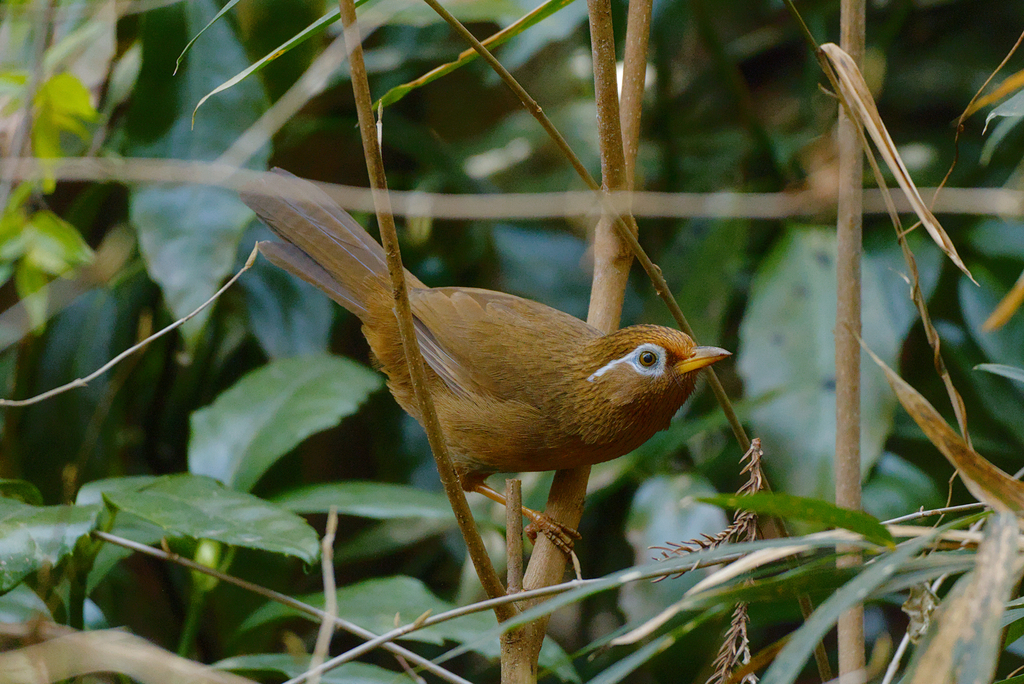
Chinese Hwamei
Photo © Liem Malarney
Photo © Liem Malarney — CC BY 4.0 — Source: iNaturalist photo #690796943Identification
The Chinese hwamei is a medium-sized passerine measuring 21–25 cm in length, named for its distinctive "painted eyebrow" markings—white rings around the eyes extending backward as white stripes. The plumage is predominantly reddish-brown with dark streaking on the crown, back, and throat. Broad, rounded wings and a fan-shaped tail complete its stocky profile, while the bill and feet are yellowish. The Hainan Island subspecies (G. c. owstoni) appears paler below and more olive above, while the closely related Taiwan hwamei is greyer, more heavily streaked, and lacks the characteristic white head markings.
The hwamei's loud, clear, varied whistling song is one of its most conspicuous features—a series of melodious notes with regular repetition and imitations of other bird calls. Its call is a distinctive rasping whistle or rattle, making it more often heard than seen in dense cover.
Range & Habitat
The nominate subspecies occurs across southeastern and central China, extending into northern and central Vietnam and Laos. The Hainan Island subspecies inhabits that location exclusively. The species favours scrubland, open woodland, secondary forest, parks, and gardens, typically below 1,800 metres elevation. It is common throughout much of its native range and faces no conservation threats.
The species has also been introduced to Taiwan (since the 1980s), Singapore, Japan, and Hawaii, where it was established in the early 20th century and now thrives in both native forest and cultivated habitats across Kauai, Maui, and Hawaii Island.
Behaviour & Diet
The hwamei is a skulking, elusive bird that often proves difficult to observe despite its vocal nature. It typically forages on the ground among leaf litter, searching for insects and fruit. This species usually travels in pairs or small groups rather than large flocks.
Breeding occurs from May to July, with pairs constructing large cup-shaped nests positioned up to two metres above ground in trees, bushes, or dense undergrowth. Clutches consist of two to five blue or blue-green eggs.
Best Time & Places to See It
The breeding season (May–July) offers the best opportunity to locate this bird through its constant singing, particularly during early morning hours. Listen for its loud, variable whistling in scrubland and secondary forest edges. Though present year-round in most of its range, patient observers will have greater success in open woodland and gardens where vegetation is less dense.
In its native range, southeastern China, Vietnam, and Laos offer reliable sightings. In introduced populations, Hawaii's Kauai and Maui support healthy populations, making these islands accessible alternatives for nature travellers.
Photography Tips
The hwamei's skulking habits demand patience and strategic positioning. Early morning visits to scrubland edges and secondary forest margins yield the best results, as birds are most vocal and active at dawn. Position yourself quietly near dense cover and wait for birds to emerge while foraging on the ground or in low vegetation.
The white eye-ring and facial markings are key identification features—frame shots to highlight these distinctive features. Use a telephoto lens (400mm or longer) to maintain distance without disturbing this wary bird. Overcast conditions work well for capturing the subtle plumage details, while the bird's loud song will alert you to nearby individuals before you spot them visually.
Hawaiʻi Volcanoes National Park
Hawaiʻi County, United States
+84 birds+2 mammals
Where volcanic slopes descend toward the Pacific across more than five thousand square kilometers, Hawaiʻi Volcanoes National Park presents one of Earth's most dynamic laboratories of…
VIEW NATIONAL PARKWulingyuan
Jundiping, China
+97 birds+3 mammals
Sandstone peaks erupting from forested valleys define this sprawling 993-square-kilometre national park in Hunan Province, where vertical cliffs rise dramatically above lush subtropical woodland. The landscape—a…
VIEW NATURAL MONUMENTGiant Panda National Park
Mianyang, China
+447 birds+47 mammals
Where the eastern slopes of China's Sichuan plateau descend into cloud-wrapped valleys, one of Asia's most biodiverse landscapes unfolds across more than 350,000 square kilometres. This…
VIEW NATIONAL PARKHaleakalā National Park
Maui County, United States
+66 birds+4 mammals
Ascending from sea level to over 10,000 feet across a mere thirty miles, Haleakalā National Park commands one of the Pacific's most dramatic elevation gradients, where…
VIEW NATIONAL PARKKīlauea Point National Wildlife Refuge
Kilauea, United States
+79 birds+1 mammals
At the northernmost tip of Kauai, where the Pacific trades collide with volcanic rock, Kīlauea Point National Wildlife Sanctuary crowns a dramatic headland overlooking one of…
VIEW WILDLIFE SANCTUARYNo community photos yet. Log in to add the first one.
No community observations of this species yet.