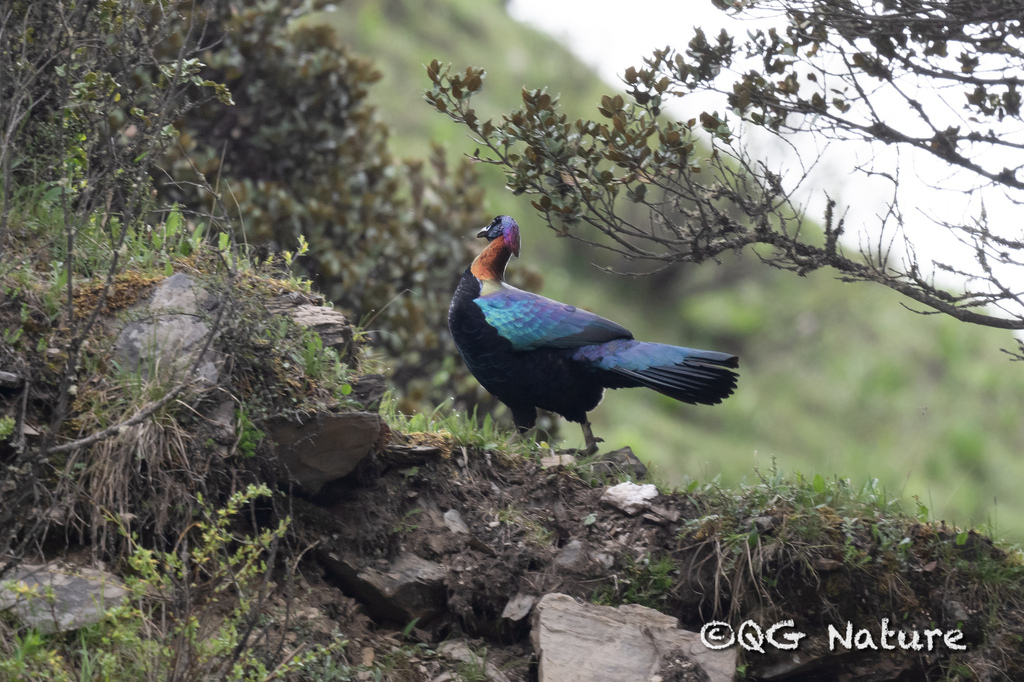
Chinese Monal
Photo © Wang.QG
Photo © Wang.QG — CC BY 4.0 — Source: iNaturalist photo #382012593Identification
The Chinese monal is the largest of the three monal species and ranks among the heaviest pheasants, with males measuring 76–80 cm in length and females slightly smaller at 72–75 cm. Males are extraordinarily striking, displaying a large drooping purple crest that crowns their metallic green head. The face features distinctive blue bare skin around the eyes, while the mantle glows with reddish-gold tones. The body combines bluish-green feathers with contrasting black underparts and a brilliant white rump, creating a highly iridescent overall effect that shimmers in changing light. Females are considerably more subdued, appearing dark brown with white markings on the throat, providing effective camouflage in their mountain habitat.
Range & Habitat
The Chinese monal is endemic to west-central China, with a highly restricted range confined to the mountains of western Sichuan and southern Gansu provinces. This limited distribution makes the species particularly vulnerable to environmental pressures and human disturbance. The bird inhabits mountainous terrain where specific ecological conditions support its survival, though habitat loss and degradation continue to threaten its populations across this already narrow range.
Behaviour & Diet
Like other monals and pheasants, the Chinese monal is a ground-dwelling bird adapted to life in steep mountain terrain. While detailed behavioral observations remain limited in published sources, the species is known to inhabit high-altitude environments where it forages and nests among rocky slopes and alpine vegetation. The species' vulnerability to hunting pressure, combined with its restricted range, suggests it may be less abundant and more wary than some related pheasant species, making field observations challenging.
Best Time & Places to See It
Finding wild Chinese monals requires visits to the remote mountain ranges of western Sichuan and southern Gansu in China. The species' restricted range and vulnerability make sightings unpredictable for travelers. Early morning hours, when pheasants are typically most active, would offer the best opportunity for observation. However, the species' endangered status and limited distribution mean that dedicated birders seeking this species should engage local guides familiar with remaining populations and obtain necessary permits for travel in these mountainous regions.
Photography Tips
The male's iridescent plumage—particularly the metallic green head, purple crest, and white rump—demands careful attention to lighting. Soft morning or late afternoon light will best reveal the subtle color shifts and iridescence that make this species so visually spectacular. The bird's size and striking male plumage offer excellent photographic potential when encountered, though the female's cryptic brown coloration requires patience and careful positioning to capture effectively. Given the species' scarcity and wariness, a telephoto lens will be essential, and approaching birds slowly and quietly will maximize photography opportunities without causing disturbance to this vulnerable species.
Giant Panda National Park
Mianyang, China
+447 birds+47 mammals
Where the eastern slopes of China's Sichuan plateau descend into cloud-wrapped valleys, one of Asia's most biodiverse landscapes unfolds across more than 350,000 square kilometres. This…
VIEW NATIONAL PARKJiuzhai Valley
Jiuzhaigou County, China
+226 birds+7 mammals
Where crystalline alpine streams cascade through limestone gorges and karst terrain rises in dramatic vertical walls, Jiuzhai Valley unfolds across nearly 1,300 square kilometers of southwestern…
VIEW NATURAL MONUMENTWolong National Nature Reserve
Wenchuan County, China
+333 birds+17 mammals
Where the Qingyi River cuts through the eastern flanks of the Minshan Range, a temperate montane forest cloaks steep valleys in dense canopy that thins dramatically…
VIEW NATURE RESERVENo community photos yet. Log in to add the first one.
No community observations of this species yet.