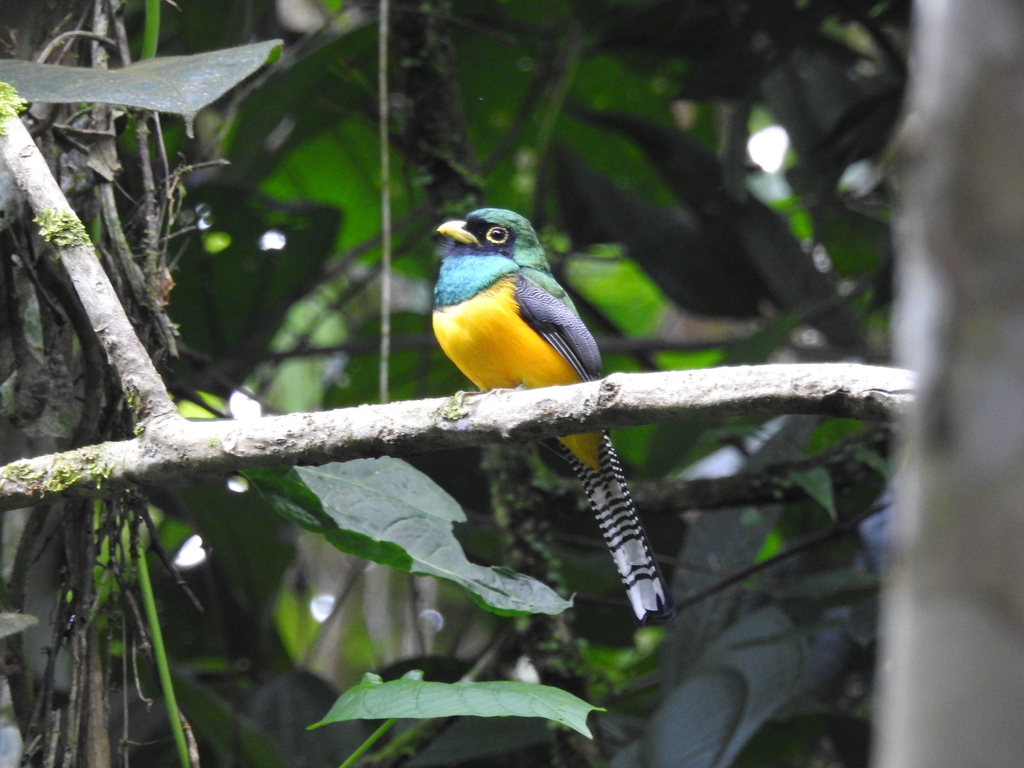
Choco Black-throated Trogon
Photo © Tristan Jobin
Photo © Tristan Jobin — CC BY 4.0 — Source: iNaturalist #83191261The Choco black-throated trogon (Trogon cupreicauda), also known as Kerr's black-throated trogon, is a bird in the family Trogonidae, the trogons and quetzals. It is found in Colombia and Ecuador. == Taxonomy and systematics == What is now the Choco black-throated trogon was long treated as one of six subspecies of the then "black-throated trogon" (Trogon rufus sensu lato). Starting in 2022, the South American Classification Committee of the American Ornithological Society (AOS), the International Ornithological Congress, and the Clements taxonomy split the black-throated trogon into four species, one of them being the Choco black-throated trogon. In this split Trogon rufus was renamed the Amazonian black-throated trogon. However, as of 2024 the North American Classification Committee of the AOS and BirdLife International's Handbook of the Birds of the World (HBW) have not recognized the split, retaining the six-subspecies black-throated trogon. The Choco black-throated trogon is monotypic. == Description == Like most trogons, the Choco black-throated has distinctive male and female plumages with soft colorful feathers. This relatively small species is about 25 to 26 cm (9.8 to 10 in) long. Adult males have a black face and throat with a pale blue ring of bare skin around their eye. They…
Natural Utría National Park
Alto Baudó (Pie de Pató), Colombia
+372 birds+11 mammals
Where the Chocó's coastal mountains plunge toward the Pacific, Utría National Park preserves one of Colombia's most biodiverse and least-visited wilderness expanses. Sprawling across 1,287 square…
VIEW NATIONAL PARKNatural Farallones de Cali National Park
Buenaventura, Colombia
+733 birds+27 mammals
Where the Pacific coastal plain meets the western slopes of the Andes, Farallones de Cali National Park sprawls across nearly 3,500 square kilometers of dramatic topography…
VIEW NATIONAL PARKNo community photos yet. Log in to add the first one.
No community observations of this species yet.