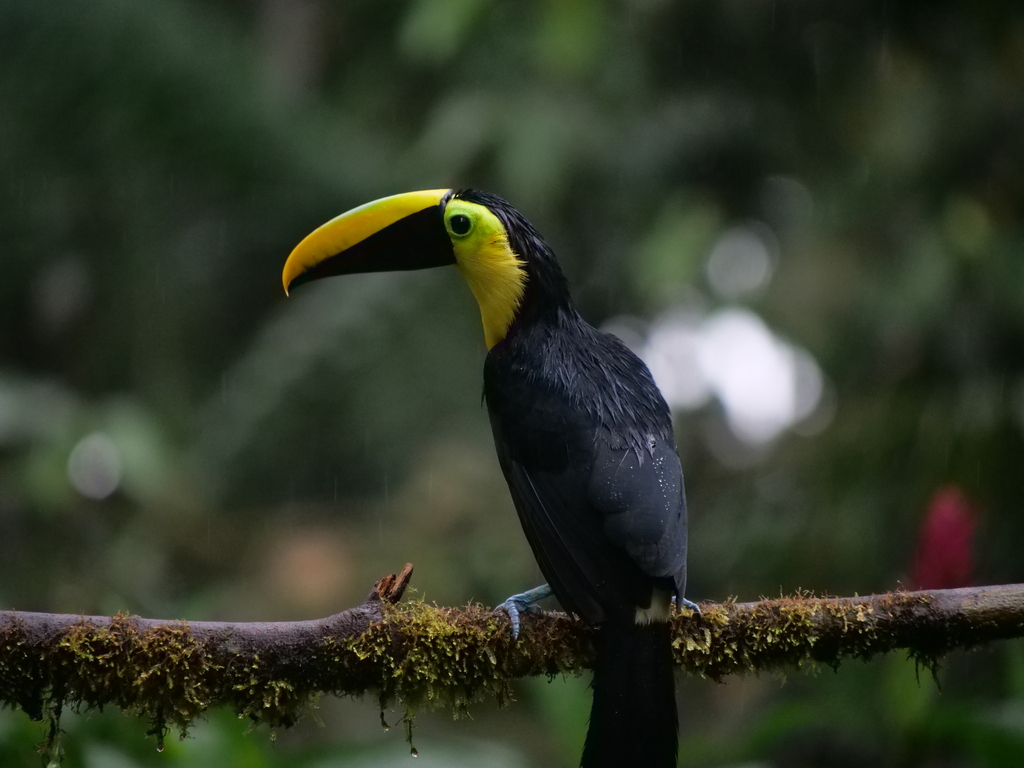
Choco Toucan
Photo © Nico
Photo © Nico — CC0 1.0 — Source: iNaturalist photo #630981144Identification
The Choco toucan is a striking medium-sized toucan measuring 46 to 48.5 cm in length and weighing 365 to 482 grams. Both sexes are similar in appearance, though females have slightly shorter bills than males. The bird's most distinctive feature is its impressive bill: the upper mandible is predominantly yellow with green shading on the culmen and a black triangle at its base, while the lower mandible is black, sometimes with a yellow tip.
The plumage is predominantly black on the crown, nape, upperparts, and tail, with a distinctive maroon tinge on the head. The uppertail coverts are white, providing striking contrast. The throat and breast are bright yellow, separated from the black belly by a narrow red band. Red undertail coverts complete the coloring, while bare yellow-green to olive-green skin surrounds each eye. Visually very similar to a subspecies of the yellow-throated toucan within its range overlap, the Choco toucan is reliably distinguished by its unique vocalizations.
Range & Habitat
As its name suggests, the Choco toucan is restricted to the humid Chocó region, a narrow strip of rainforest running from northwestern Colombia through southwestern Ecuador. This specialized range makes it a sought-after species for dedicated birdwatchers exploring this biodiverse corner of northwestern South America.
The species predominantly inhabits lowland and foothill forests, though it also ventures into pastures and plantations where fruiting trees grow adjacent to forest. Elevations range from the lowlands up to approximately 1,550 meters, allowing birders to search across a range of forest zones. The bird occurs in at least one protected area in both Colombia and Ecuador, offering legitimate opportunities for observation.
Behaviour & Diet
The Choco toucan is non-migratory but maintains a restless lifestyle, with pairs and groups moving up and downslope as they forage. The species spends most of its time in the forest canopy searching for food. While its diet is not fully documented, it is primarily frugivorous, supplemented with insects and small vertebrates. Notably, the species has been observed following army ant swarms, likely exploiting prey disturbed by the ants' passage.
Vocalally distinctive, the Choco toucan belongs to the "croaker" group of toucans. Its primary call is a steadily repeated series of croaking "kreeork" notes, which sometimes speed up into a rapid "kriik." The bird also produces bill-clacking sounds and grating vocalizations with a closed bill. During breeding season, which appears to run mostly from June through August (though potentially earlier in Colombia), pairs engage in displays involving synchronized head-swinging while vocalizing.
Best Time & Places to See It
The Choco toucan is considered uncommon to locally common in Ecuador and occurs at various densities throughout its Colombian range. The breeding season from June through August offers good opportunities to locate calling birds, as their vocal activity increases during this period. However, the species can be encountered year-round within its limited range.
Protected areas in both Colombia and Ecuador provide legitimate access to Choco toucan habitat. The humid lowland and foothill forests of the Chocó region offer the best chances of observation. Hiring experienced local guides familiar with toucan behavior and vocalizations will significantly increase your chances of locating this canopy-dwelling species.
Photography Tips
The Choco toucan's striking plumage—with its yellow throat and breast contrasting sharply against black upperparts and its impressive colorful bill—makes it a rewarding photographic subject. Early morning hours when the bird is most active in the canopy offer the best lighting and behavior opportunities. Position yourself to capture the distinctive eye-ring and bill coloration, as these are key identification features.
Since the bird forages primarily high in the forest canopy, patience and a sturdy telephoto lens (400mm or longer) are essential. Listen for its distinctive croaking calls to locate individuals, then wait for canopy gaps that allow better visibility and photography angles. Capturing the bird's characteristic head-swinging display during breeding season would represent exceptional documentation of this poorly-studied species.
Cerros de Amotape National Park
District of San Jacinto, Ecuador
+246 birds+1 mammals
Arid mountains rise abruptly from Peru's northwestern frontier, their slopes clothed in xerophytic scrubland and seasonal deciduous forest that transforms these Andean foothills into one of…
VIEW NATIONAL PARKNatural Utría National Park
Alto Baudó (Pie de Pató), Colombia
+372 birds+11 mammals
Where the Chocó's coastal mountains plunge toward the Pacific, Utría National Park preserves one of Colombia's most biodiverse and least-visited wilderness expanses. Sprawling across 1,287 square…
VIEW NATIONAL PARKNatural Farallones de Cali National Park
Buenaventura, Colombia
+733 birds+27 mammals
Where the Pacific coastal plain meets the western slopes of the Andes, Farallones de Cali National Park sprawls across nearly 3,500 square kilometers of dramatic topography…
VIEW NATIONAL PARKNatural Uramba Bahía Málaga National Park
Buenaventura, Colombia
+308 birds+15 mammals
Where the Pacific coastal rainforest descends to mangrove estuaries and rocky headlands, Uramba Bahía Málaga National Park unfolds across nearly 1,000 square kilometres of Colombia's Valle…
VIEW NATIONAL PARKDarién National Park
Tucutí, Panama
+534 birds+13 mammals
Where the spine of Central America crumbles into wetland and rainforest, Darién National Park sprawls across more than 20,000 square kilometres of some of the tropics'…
VIEW NATIONAL PARKNo community photos yet. Log in to add the first one.
No community observations of this species yet.