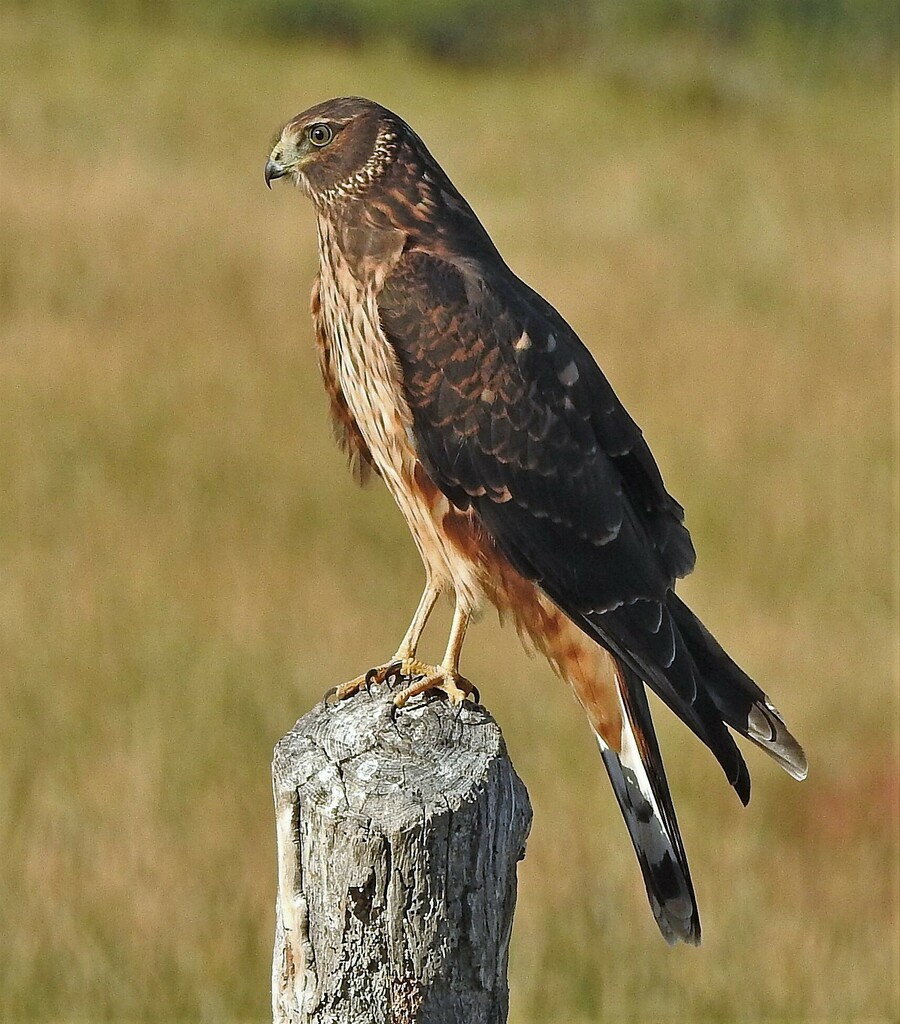
Cinereous Harrier
Photo © Hugo Hulsberg
Photo © Hugo Hulsberg — CC0 1.0 — Source: iNaturalist photo #288885587Identification
The cinereous harrier is a slender raptor with striking sexual dimorphism. Males display dark grey plumage above with black wingtips, a distinctive white rump, and pale grey underparts streaked with rufous on the belly. Females are brown above with the same white rump patch, but feature cream-coloured underparts with similar belly streaking. The female is noticeably larger, averaging 46 cm compared to the male's 40 cm, though both sexes share a remarkable wingspan of 90–115 cm. The most distinctive feature is the exceptionally long tail, comprising about 56% of the bird's total length—a proportion that ties this species with the long-tailed hawk for the longest tail relative to body size among all raptors.
Range & Habitat
This South American harrier breeds across a vast range extending from Tierra del Fuego northward through Argentina, Chile, Bolivia, Paraguay, and Peru, into southern Brazil and across the Andes to Colombia. The species is highly adaptable, inhabiting open landscapes from lowland marshes to high-altitude Andean grasslands, with records from elevations up to 4,000 metres. Like other harriers, it nests on the ground in vegetation. Though generally considered sedentary, populations show seasonal movements, typically migrating during April and May and returning to breeding grounds between September and October.
Behaviour & Diet
During breeding season, cinereous harriers engage in spectacular aerial courtship displays accompanied by loud chattering—a dramatic performance visible across open terrain. Eggs are laid in November and young fledge by January, with nest structures measuring up to 40 centimetres across and 30 centimetres deep. The harrier's diet reflects its broad habitat range and is opportunistic in nature. Small rodents and birds form the dietary staple, with particular preference for chicks of coots and waders. The species also readily takes reptiles, amphibians, and insects, making it a generalist predator well-adapted to diverse prey availability across its range.
Best Time & Places to See It
To observe cinereous harriers, visit open grasslands, marshes, or Andean altiplano habitats within their range during breeding season (September to January), when birds are most active and visible. The species' large geographic range across South America—from southern cone countries to Colombia—offers multiple opportunities for observation. Look for characteristic low, quartering flights over open ground, a hunting technique typical of harriers. The loud vocalizations and aerial displays during breeding season make this an ideal period for both sightings and audio recording.
Photography Tips
Photograph cinereous harriers in open terrain where they hunt in low, predictable flight patterns, allowing for anticipatory positioning. The striking white rump is a key identifying feature—capture this distinctive marker in flight shots to document sexual dimorphism and aid species confirmation. Early morning and late afternoon light will enhance the subtle grey and brown plumage tones. During breeding season, position yourself with a clear view of open sky to capture the dramatic aerial courtship displays that define this species' behaviour. A telephoto lens is essential for capturing details of the remarkably long tail and facial markings without disturbance.
Antisana National Park
Cajas National Park
Campos del Tuyú National Park
Cerro Castillo National Park
Chiloé National Park
Cotopaxi National Park
El Palmar National Park
Huascarán National Park
Laja National Park Lagoon
Nothing matches these filters.
No community photos yet. Log in to add the first one.
No community observations of this species yet.