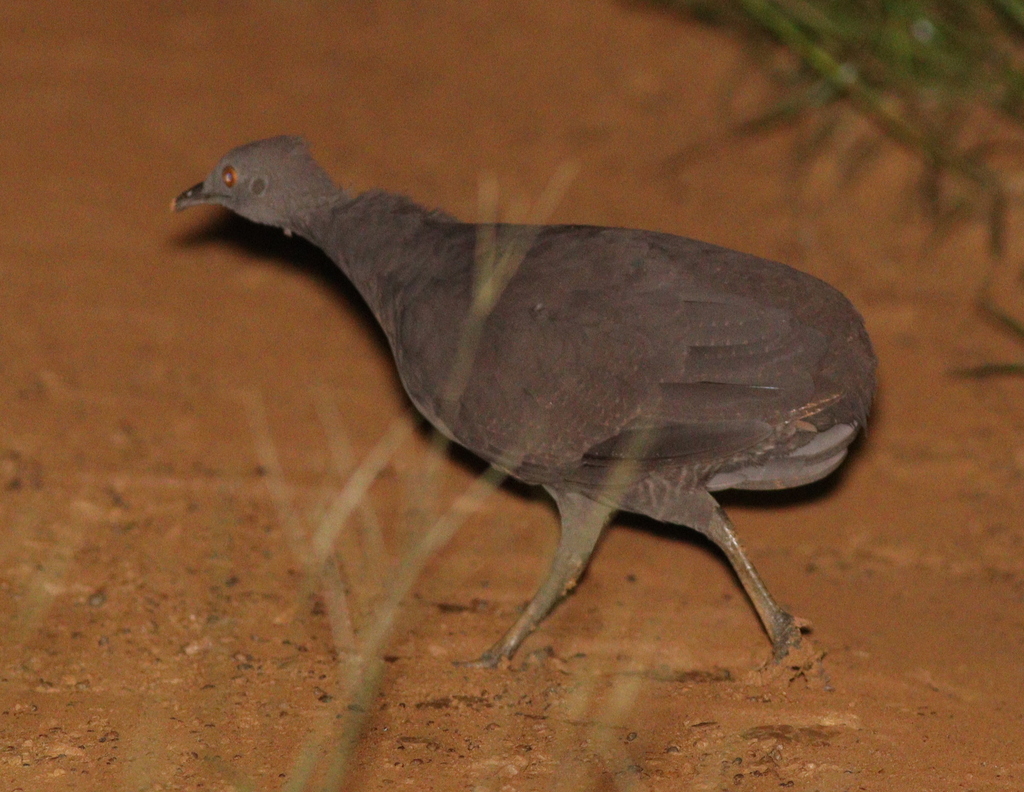
Cinereous Tinamou
Photo © Jan Ebr & Ivana Ebrová
Photo © Jan Ebr & Ivana Ebrová — CC BY 4.0 — Source: iNaturalist photo #463612340Identification
The cinereous tinamou is a small, ground-dwelling bird measuring 29–32 cm in length, with females noticeably larger than males. Its plumage is dark brown to sooty brown or brownish black, slightly more brown-toned than its close relative, Berlepsch's tinamou. The bird is distinctively marked by a smoky-grey crown and nape with reddish-brown tones, and white feather shafts on the sides of the head that occasionally show through. The underparts are only slightly paler than the body, and the dull orange to yellow legs are visible against darker plumage. A light-colored eye ring frames the face, while the bill features a dark upper mandible and yellow lower mandible. This subtle coloration serves an important survival function—it blends seamlessly with the forest environment, making the bird difficult to spot despite its prominent voice.
The cinereous tinamou is famously easy to hear but extraordinarily difficult to see. It produces a loud, distinctive whistle lasting almost two seconds, heard primarily at dawn and dusk. The monosyllabic call is remarkable for its unique pitch and the bird's uncanny ability to project its voice to seem as though it originates from another direction entirely, making precise location nearly impossible. The calls between males and females are similar but distinguishable to the trained ear, and the interval between whistles gradually shortens, creating an accelerating effect.
Range & Habitat
The cinereous tinamou is a sedentary species native to a broad range across northern South America, including southern Colombia, southern Venezuela, Suriname, Guyana, French Guiana, northern and western Brazil, eastern Ecuador, eastern Peru, and northern Bolivia. Within Brazil, its distribution extends across the Amazon Basin south to Mato Grosso and east to Pará, where local inhabitants know it by various indigenous names including inambu-pixuna in Amazonas and nambu-sujo in Pará.
This bird inhabits lowland rainforests and swamp forests at elevations up to 700 meters, showing a strong preference for thick, dark, and dense vegetation. It frequents second-growth forests, bushy areas with scattered trees, and has adapted to human-modified landscapes including coffee and cocoa plantations. The species shows a marked preference for areas near streams and thick swamp woods, where it is particularly abundant in varzea habitat within the upper Amazon region. Occasionally, it may venture into savanna areas, though dense forest remains its preferred domain.
Behaviour & Diet
The cinereous tinamou is a diurnal species that spends its life primarily on the forest floor. When frightened or surprised, it exhibits remarkable reflexes and typically flees by running rather than flying. Though capable of flight, the bird employs this ability rarely, preferring rapid ground movement to escape predators. When it does take to the air, its flight is notably strong and direct despite being brief in duration. These tinamous are solitary or found in pairs and do not congregate in groups, making encounters with humans particularly rare.
Breeding occurs year-round due to the tropical climate, though a preferred mating season occurs from August through October, shifting to June in Colombia. Like other tinamous, males practice simultaneous polygyny while females practice successive polyandry. Courtship is initiated when males call to attract females, with the ritual involving the male lowering its chest to the ground, stretching its neck forward, and raising its posterior—a posture that simultaneously makes the bird appear larger and more attractive to potential mates while signaling dominance to rival males.
Best Time & Places to See It
The best opportunities to encounter the cinereous tinamou come during dawn and dusk hours when the bird is most vocal. Early morning expeditions into the upper Amazon basin, particularly in varzea habitat or near streams within dense rainforest or swamp forest, offer the highest probability of locating this elusive species. The bird's year-round presence makes timing flexible, though August through October may offer slightly better chances during the preferred breeding season. Listening carefully for the distinctive loud whistle is essential, as visual sightings remain challenging despite the bird's vocal prominence.
Throughout its range in Colombia, Venezuela, Guyana, Suriname, French Guiana, Brazil, Ecuador, Peru, and Bolivia, this sedentary species remains in the same territories year-round. Focusing efforts on lowland areas below 700 meters elevation, particularly near water sources and within second-growth or mature rainforest with dense understory vegetation, maximizes encounter chances.
Photography Tips
Photographing the cinereous tinamou presents significant challenges due to the bird's cryptic nature and preference for dense, dark forest habitat. Early morning or late afternoon light during the bird's most vocal periods offers the best window for attempts. Position yourself quietly near areas where calls are heard, remaining patient and still, as sudden movement will trigger the bird's rapid escape response. The bird's dark coloration means that adequate lighting is crucial—fast lenses and high ISO settings will be necessary in the shadowy understory environment where it dwells.
Because the cinereous tinamou's ventriloquial abilities make pinpointing its exact location difficult, approach potential sighting areas slowly and cautiously. Focus on ground level and lower vegetation where this terrestrial species moves and feeds. The bird's tendency to run rather than fly means it may move considerable distances while remaining hidden. Wide-angle shots capturing the dense forest habitat alongside detailed portraits will document both the bird and the challenging environment that makes it one of the most elusive species in the Amazon Basin.
Yasuní National Park
Aguarico, Ecuador
+601 birds+43 mammals
Where the western Amazon basin converges with Ecuador's Orellana Province, lowland rainforest reaches toward the horizon in an unbroken canopy of staggering botanical density. Yasuní National…
VIEW NATIONAL PARKSumaco Napo-Galeras National Park
Loreto, Ecuador
+563 birds+4 mammals
Where Ecuador's Amazon transitions into cloud forest, a massive shield volcano rises from the emerald lowlands of Orellana Province, anchoring one of the continent's most biodiverse…
VIEW NATIONAL PARKNatural Sierra de Chiribiquete National Park
Solano, Colombia
+359 birds+27 mammals
Massive table-top mountains rise abruptly from the lowland rainforest of southeastern Colombia, their sheer sandstone cliffs and isolated summits creating some of the most dramatic topography…
VIEW NATIONAL PARKNatural la Paya National Park
Puerto Leguízamo, Colombia
+262 birds+4 mammals
Where the Amazon's western reaches fold into the Andes foothills, La Paya National Park sprawls across more than 8,500 square kilometers of pristine Amazonian rainforest in…
VIEW NATIONAL PARKNatural el Cocuy National Park
Güicán, Colombia
+313 birds+3 mammals
Where the Andes rise to their highest peaks in Colombia's eastern cordillera, El Cocuy National Park sprawls across more than 6,600 square kilometers of some of…
VIEW NATIONAL PARKNatural Sumapaz National Park
Cubarral, Colombia
+368 birds+1 mammals
Where the Andes descend toward the Amazon basin, the high páramo grasslands of Sumapaz National Park sprawl across more than five thousand square kilometers of Meta…
VIEW NATIONAL PARKNatural Sierra de la Macarena National Park
Vista Hermosa, Colombia
+566 birds+15 mammals
Across nearly 20,000 square kilometres of Colombia's Meta Department, the terrain rises from lowland savanna into Andean foothills through a mosaic of gallery forests, palm-fringed wetlands,…
VIEW NATIONAL PARKAmacayacu National Park
Leticia, Colombia
+567 birds+25 mammals
Where the Rio Amazonas curves through the tri-border region where Colombia, Peru, and Brazil converge, Amacayacu National Park sprawls across more than 5,250 square kilometres of…
VIEW NATIONAL PARKViruá National Park
Brazil
+389 birds+6 mammals
Across the northern frontier of Roraima, where the forest canopy rises from ancient Amazonian lowlands, Viruá National Park protects nearly 3,700 square kilometres of terra firme…
VIEW NATIONAL PARKSerra do Pardo National Park
Brazil
+153 birds
Vast upland forests and weathered plateaus define this 7,129-square-kilometre protected expanse in the heart of Pará's remote interior, where ancient bedrock and swollen rivers have carved…
VIEW NATIONAL PARKChapada dos Guimarães National Park
Brazil
+450 birds+1 mammals
Where weathered sandstone plateaus rise above the cerrado grasslands of central Brazil, Chapada dos Guimarães National Park protects 624 square kilometres of ecological transition zone that…
VIEW NATIONAL PARKAmazônia National Park
Brazil
+439 birds+6 mammals
Where the Rio Amazonas and its tributaries weave through the heart of Pará state, a vast tapestry of rainforest stretches across 23,611 square kilometers of unbroken…
VIEW NATIONAL PARKMapinguari National Park
Brazil
+354 birds
Vast tracts of western Amazonian rainforest blanket the remote terrain of this 56,827 square kilometre national park in Amazonas state, where seasonal rivers wind through dense…
VIEW NATIONAL PARKPacaás Novos National Park
Brazil
+279 birds+1 mammals
Across the border between Rondônia and Amazonas, vast tracts of humid tropical forest rise and fall in gentle undulations, carved by clear-flowing rivers that feed into…
VIEW NATIONAL PARKAnavilhanas National Park
Brazil
+468 birds+8 mammals
Across the Rio Negro in central Amazonas, an archipelago of over a thousand islands rises from the world's largest rainforest river system, creating a labyrinth of…
VIEW NATIONAL PARKCampos Amazónicos National Park
Amazonas, Brazil
+434 birds+7 mammals
Sprawling across the southwestern Amazon basin in Amazonas state, this 27,263-square-kilometre national park encompasses some of the region's most pristine lowland rainforest, where terra firme forest…
VIEW NATIONAL PARKSerra do Divisor National Park
Brazil
+448 birds+10 mammals
Where the western Amazon meets the Andes foothills, Serra do Divisor National Park sprawls across one of South America's most biodiverse and least accessible frontiers. Spanning…
VIEW NATIONAL PARKOtishi National Park
Río Tambo, Peru
+108 birds
Where the Andes descend toward the Amazon basin, vast cloud forests cloak the ridges and valleys of Peru's Río Tambo watershed, and this is where Otishi…
VIEW NATIONAL PARKYanachaga–chemillén National Park
Palcazu, Peru
+639 birds+6 mammals
Where the eastern slopes of Peru's central cordillera plunge into cloud forest, Yanachaga–Chemillén National Park protects nearly three thousand square kilometres of montane wilderness that few…
VIEW NATIONAL PARKManu National Park
Manu, Peru
+892 birds+26 mammals
Across the eastern slopes of the Peruvian Andes, tropical rainforest descends into the Amazon basin with a complexity that few terrestrial ecosystems match. Manu National Park…
VIEW NATIONAL PARKYaguas National Park
Yaguas, Peru
+18 birds
Where the western Amazon transitions into terra firme uplands, Yaguas National Park sprawls across more than 16,000 square kilometres of northwestern Peru, a vast tract of…
VIEW NATIONAL PARKSierra del Divisor National Park
Alto Tapiche, Peru
+298 birds+2 mammals
Where the western Amazon meets the Andes foothills, nearly 41,000 square kilometres of pristine rainforest rise across Peru's Alto Tapiche region in a landscape of extraordinary…
VIEW NATIONAL PARKBahuaja Sonene National Park
San Pedro de Putina Punco, Peru
+602 birds+8 mammals
Where the Madre de Dios and Heath rivers converge in southeastern Peru rises one of South America's most biodiverse wilderness regions: a vast protected realm of…
VIEW NATIONAL PARKIchigkat Muja – Cordillera del Cóndor National Park
Río Santiago, Peru
+101 birds
Where the Andes descend into the western Amazon, the Río Santiago carves through a landscape of profound biological complexity. Ichigkat Muja – Cordillera del Cóndor National…
VIEW NATIONAL PARKTingo Maria National Park
Mariano Dámaso Beraún, Peru
+423 birds
Where the eastern slopes of the Peruvian Andes descend toward the Amazon basin, the landscape fractures into a maze of limestone ridges, humid gorges, and cloud-wrapped…
VIEW NATIONAL PARKCordillera Azul National Park
Pampa Hermosa, Peru
+322 birds+1 mammals
Where the eastern Andes descend into the western Amazon basin, Cordillera Azul National Park sprawls across nearly 38,000 square kilometres of some of Peru's most pristine…
VIEW NATIONAL PARKNo community photos yet. Log in to add the first one.
No community observations of this species yet.