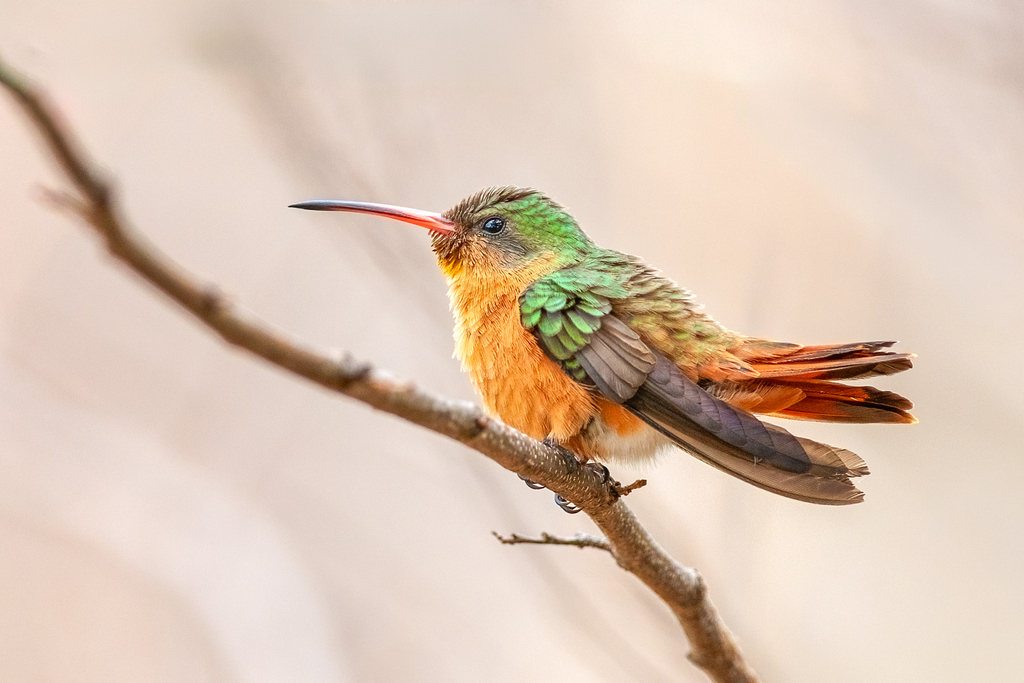
Cinnamon Hummingbird
Photo © egorbirder
Photo © egorbirder — CC BY 4.0 — Source: iNaturalist photo #595173418Identification
The cinnamon hummingbird is a small species, measuring 9.5 to 11.5 centimetres long and weighing just 5 to 5.5 grams—a delicate jewel among the hummingbird world. Its name perfectly describes its most distinctive feature: the brilliant cinnamon to cinnamon-rufous underparts that contrast strikingly with metallic bronze-green upperparts. The tail displays deep cinnamon-rufous tones with dark metallic bronze tips, while the wings are dark brownish-slate. Males sport a red bill with a black tip, while females have mostly black bills with red at the base. Juveniles resemble adults but display rufous edges on the face, crown, and rump feathers, and carry an all-black bill. The bird's voice is equally distinctive, featuring varied, high, thin, slightly squeaky chips described as "si ch chi-chit" or similar rapid sequences.
Range & Habitat
This resident species is found throughout the Pacific coast of Mexico and Central America, from the northwestern Mexican states down through Guatemala, El Salvador, Honduras, Nicaragua, and Costa Rica, with populations also in Belize and Mexico's Yucatán Peninsula. Four recognized subspecies occupy different regions, with subtle variations in plumage intensity and size. The cinnamon hummingbird typically inhabits coastal and lowland areas, though it ranges further inland in warmer locations within the southern parts of its range. It prefers primary and secondary deciduous and semi-deciduous forests, as well as thorn forest, from sea level up to approximately 1,600 metres elevation.
Behaviour & Diet
The cinnamon hummingbird is an active forager, typically hunting for nectar from the understory to mid-storey levels but also visiting taller flowering trees. Its diet consists primarily of nectar from a wide variety of flowering plants, supplemented by insects. The species is notably territorial, vigorously defending its feeding sites from intrusion by other hummingbirds, bees, and butterflies. Breeding occurs throughout the year, with different populations nesting in different months. Females construct tiny cup-shaped nests from plant material and spider silk, placed on horizontal branches. These nests, documented in western Mexico, sometimes feature small platforms of wood pieces beneath the cup, constructed from kapok seed fibres with grass, wood bits, and lichens on the exterior. Clutches typically contain two eggs.
Best Time & Places to See It
Since the cinnamon hummingbird is resident throughout its range, it can be encountered year-round, though breeding activity occurs continuously across different regions and seasons. Coastal and lowland areas of the Pacific slope offer the best opportunities for sightings. Look for them in deciduous and semi-deciduous forests, particularly where flowering plants are abundant. The species' territories and preference for foraging in mid-storey vegetation mean careful observation is rewarded with regular sightings in suitable habitat.
Photography Tips
The cinnamon hummingbird's small size and active foraging behaviour present a rewarding but challenging photography subject. Focus on areas where flowering plants attract the birds, and position yourself with soft, directional light that showcases the metallic bronze-green upperparts and warm cinnamon tones. The contrasting plumage—particularly the interplay between the dark wings and cinnamon underparts—photographs beautifully with proper lighting. Since the bird is territorial, returning to productive feeding sites increases your chances of consistent encounters and multiple photo opportunities. Fast shutter speeds are essential to freeze the rapid wing beats and intricate flight patterns typical of hummingbirds.
Arenal Volcano National Park
Peñas Blancas, Costa Rica
+551 birds+21 mammals
Straddling the border between Alajuela and Guanacaste in northwestern Costa Rica, this national park rises dramatically around one of Central America's most active volcanic systems. The…
VIEW NATIONAL PARKSanta Rosa National Park
Santa Elena, Costa Rica
+359 birds+30 mammals
Where Pacific-facing slopes descend from volcanic uplands toward the Guanacaste lowlands, Santa Rosa National Park unfolds across a mosaic of tropical dry forest, gallery woodland, and…
VIEW NATIONAL PARKGuanacaste National Park
Santa Elena, Costa Rica
+461 birds+17 mammals
Where the Pacific slopes of northwestern Costa Rica rise toward the Continental Divide, dry tropical forest gives way to cloud-laden peaks and misty ridges—a landscape that…
VIEW NATIONAL PARKDzibilchantún National Park
Barcelona, Mexico
+144 birds+2 mammals
Across the limestone plains of Yucatán, where cenotes pierce the bedrock and tropical forest clings to shallow soils, lies Dzibilchantún—a modest yet ecologically vital national park…
VIEW NATIONAL PARKSian Ka’an
Chunyaxché, Mexico
+350 birds+16 mammals
Where the Yucatán Peninsula dissolves into wetland and mangrove, a vast mosaic of forest, lagoon, and coastal margin creates one of Mexico's most biodiverse strongholds. Across…
VIEW BIOSPHERE RESERVECarara National Park
Tárcoles, Costa Rica
+397 birds+19 mammals
Where the Pacific coastal plain meets transitional forest, Carara National Park straddles one of Central America's most dynamic ecological boundaries. The park's landscape encompasses lowland deciduous…
VIEW NATIONAL PARKPalo Verde National Park
Bagaces, Costa Rica
+318 birds+24 mammals
Dry forest spreads across Palo Verde's low-lying terrain in northwestern Guanacaste, where seasonal rivers and lagoons etch through deciduous woodland that sheds its canopy each winter.…
VIEW NATIONAL PARKRincón de la Vieja National Park
Liberia, Costa Rica
+451 birds+30 mammals
Where volcanic slopes rise abruptly from the Guanacaste lowlands, Rincón de la Vieja National Park sprawls across a landscape shaped by geothermal drama and seasonal extremes.…
VIEW NATIONAL PARKTapantí Macizo de la Muerte National Park
Orosi, Costa Rica
+503 birds+18 mammals
Where montane cloud forest rises steeply from the Orosi Valley, Tapantí Macizo de la Muerte National Park enfolds a landscape of perpetual moisture and emerald complexity.…
VIEW NATIONAL PARKVolcán Tenorio National Park
Guatuso, Costa Rica
+480 birds+12 mammals
Where volcanic slopes rise through Costa Rica's northwestern borderlands, Volcán Tenorio National Park sprawls across terrain shaped by ancient lava flows and mineral-rich springs. The park's…
VIEW NATIONAL PARKMarino Las Baulas National Park
Santa Cruz, Costa Rica
+246 birds+9 mammals
Where the Pacific meets a mosaic of dry forest and mangrove estuary, this coastal national park protects one of Central America's most dynamic wildlife theatres. The…
VIEW NATIONAL PARKCaño Negro National Wildlife Refuge
Caño Negro District, Costa Rica
+486 birds+16 mammals
Where the San Juan River's seasonal floodplain opens into expansive wetlands, Caño Negro Wildlife Sanctuary sprawls across one of Central America's most productive freshwater ecosystems. This…
VIEW WILDLIFE SANCTUARYCurú National Wildlife Refuge
Paquera, Costa Rica
+249 birds+8 mammals
Where the Pacific coast of Puntarenas dissolves into dry deciduous forest and mangrove fringe, Curú Wildlife Sanctuary holds one of Costa Rica's most ecologically vital yet…
VIEW WILDLIFE SANCTUARYNo community photos yet. Log in to add the first one.
No community observations of this species yet.