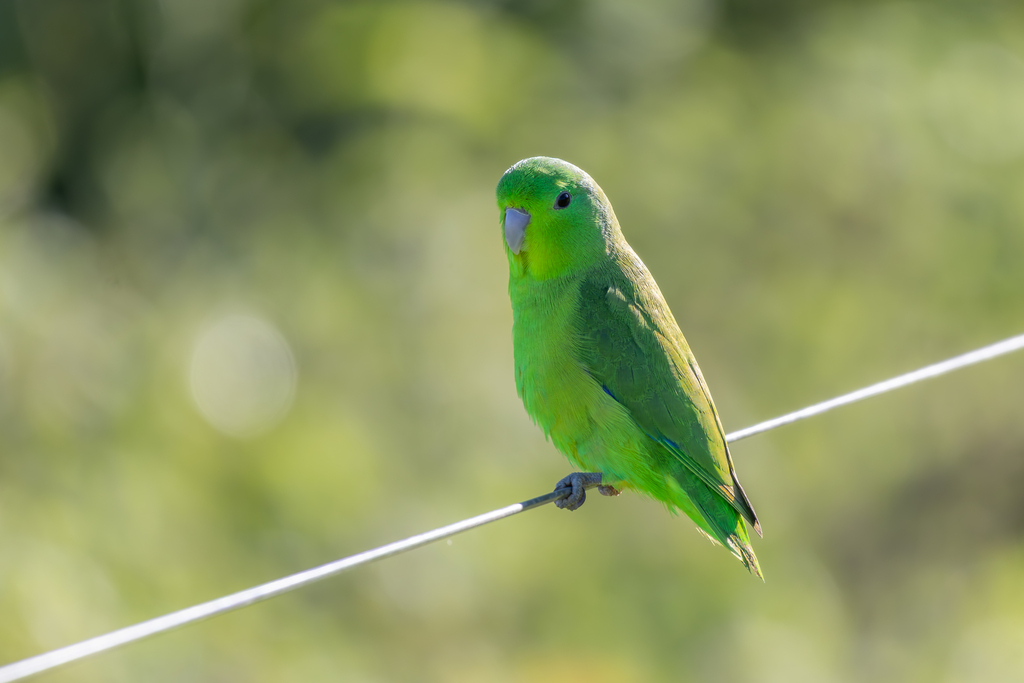
Cobalt-rumped Parrotlet
Photo © Francisco V. Bezerra Neto
Photo © Francisco V. Bezerra Neto — CC BY-SA 4.0 — Source: iNaturalist photo #654932970Identification
The cobalt-rumped parrotlet, also known as the blue-winged parrotlet, is a small parrot species within the genus Forpus. Two subspecies are recognized: Salvadori's cobalt-rumped parrotlet (F. x. flavescens) and Hellmayr's cobalt-rumped parrotlet (F. x. flavissimus). The species is distinguished by its characteristic cobalt-blue coloring on the rump, which gives it its common name.
Range & Habitat
Cobalt-rumped parrotlets inhabit much of central and northern South America, with their range divided between the two subspecies. They are generally common and widespread, though more localized in the Amazon Basin. These birds are lowland specialists, never occurring above 1,200 metres elevation. They favor open and semi-open habitats, including dry and riparian woodlands, cerrado, caatinga, palm groves, semi-arid scrubland, savanna, and pastures, actively avoiding densely forested areas.
While generally non-migratory, populations show interesting movement patterns: Argentine birds move locally according to the flowering seasons of key food plants, and Brazilian Atlantic Forest populations undertake altitudinal migrations.
Behaviour & Diet
These highly social and gregarious birds form flocks typically numbering around 20 individuals, though gatherings can exceed 50 birds at productive fruiting trees or seeding grasses. Feeding groups are usually smaller, comprising 2 to 12 birds. Their vocalizations are distinctive: high-pitched "sheet" or "zeet" screeches while flying or perched, with additional twittering and chattering sounds when feeding and socializing in larger assemblies.
The cobalt-rumped parrotlet feeds primarily on fruits from Cecropia and Ficus species, seeds from Mikania and Trema micrantha, and flowers from Ambrosia, Handroanthus serratifolius, and Marcgravia species. Breeding occurs mainly between May and August, with females laying 3–7 small white eggs. Intriguingly, birds have been observed scraping clay nests built by rufous horneros, possibly to assess mineral content or nest suitability, and subsequently using these nests for raising broods.
Best Time & Places to See It
Cobalt-rumped parrotlets are best observed in open lowland habitats across central and northern South America, particularly in areas with scattered woodlands, palm groves, and savanna. Their stable population and lack of serious threats from deforestation or the pet trade mean many populations occur within protected areas. Timing visits to coincide with flowering and fruiting seasons of key food plants increases the likelihood of encountering larger, more active flocks.
Photography Tips
Photograph these small, active parrots in open habitat where they can be observed in flight or perched on fruiting trees and flowering plants. Early morning visits when birds are most active offer the best opportunities. Their gregarious nature means patient observation of feeding flocks can yield dynamic shots of multiple individuals. The distinctive cobalt-blue rump coloring is best captured in good natural light; position yourself to photograph birds in silhouette against bright sky or with side-lighting to emphasize their coloration. Their high-pitched calls often alert photographers to their presence before visual contact.
Tijuca National Park
Brazil
+317 birds+13 mammals
Where the Atlantic forest rises steeply from Rio de Janeiro's urban edge, Tijuca National Park encompasses a landscape of dramatic granite peaks, cascading waterfalls, and closed-canopy…
VIEW NATIONAL PARKEmas National Park
Brazil
+333 birds+23 mammals
Across the high plateaux of central Brazil, where the cerrado grasslands roll toward distant horizons under an immense sky, Emas National Park anchors one of South…
VIEW NATIONAL PARKSerra do Cipó National Park
Brazil
+379 birds+5 mammals
Where granite escarpments rise above the Atlantic Forest transition zone in southeastern Brazil, Serra do Cipó National Park unfolds across a landscape of dramatic ridges, cascading…
VIEW NATIONAL PARKItatiaia National Park
Brazil
+519 birds+12 mammals
Where granite peaks pierce the Atlantic rainforest canopy in southeastern Brazil, Itatiaia National Park rises as one of the country's oldest and most ecologically vital protected…
VIEW NATIONAL PARKUbajara National Park
Brazil
+122 birds+1 mammals
Granite peaks rise sharply from the humid tropical forests of northeastern Brazil, where Ubajara's 234 square kilometres straddle the transition between Atlantic rainforest and drier cerrado…
VIEW NATIONAL PARKSuperagui National Park
Brazil
+246 birds+2 mammals
Where the Atlantic rainforest meets the subtropical coast of Paraná, Superagui National Park sprawls across more than 1,000 square kilometres of one of Brazil's most biodiverse…
VIEW NATIONAL PARKSaint-Hilaire/Lange National Park
Brazil
+225 birds
Subtropical Atlantic forests rise and fall across the plateaus of inland Paraná, where Saint-Hilaire/Lange National Park protects nearly 578 square kilometres of Brazil's most biodiverse woodland…
VIEW NATIONAL PARKSerra do Itajaí National Park
Brazil
+227 birds+2 mammals
Where the Atlantic rainforest rises steeply from the coastal plains of Santa Catarina, Serra do Itajaí National Park spreads across 1,136 square kilometres of montane wilderness…
VIEW NATIONAL PARKSerra da Bocaina National Park
Brazil
+441 birds+5 mammals
Where the escarpment of the Serra da Bocaina rises sharply from the Atlantic coastal plain, tropical rainforest cloaks steep mountainsides that climb toward peaks exceeding 2,000…
VIEW NATIONAL PARKIguaçu National Park
Brazil
+387 birds+17 mammals
Where the Paraná Plateau plunges toward the Atlantic watershed, six thousand square kilometers of subtropical rainforest cling to steep gorges and river valleys in this corner…
VIEW NATIONAL PARKIlha Grande National Park
Brazil
+233 birds
Across the subtropical plateaus and Atlantic forest remnants of southern Brazil, a vast protected landscape spanning nearly 4,600 square kilometers safeguards one of the continent's most…
VIEW NATIONAL PARKSerra do Teixeira National Park
Brazil
+160 birds+5 mammals
Rugged plateaus and deep escarpments define this 3,112-square-kilometre sweep of the Brazilian Northeast, where the crystalline bedrock of the Borborema Plateau rises abruptly from the surrounding…
VIEW NATIONAL PARKSerra da Capivara National Park
Brazil
+156 birds+6 mammals
Across the semi-arid plateaus and deeply incised canyons of northeastern Brazil, where Piauí's ancient sandstone formations rise and fall in weathered waves, Serra da Capivara National…
VIEW NATIONAL PARKPau Brasil National Park
Brazil
+211 birds
Tropical Atlantic forest cloaks the rolling terrain of northeastern Bahia, where Pau Brasil National Park protects nearly 390 square kilometers of one of Brazil's most biodiverse…
VIEW NATIONAL PARKSerra dos Órgãos National Park
Brazil
+446 birds+13 mammals
Granite peaks thrust skyward through the Atlantic Forest canopy in the mountains immediately north of Rio de Janeiro, their bare rock faces rising above a landscape…
VIEW NATIONAL PARKSete Cidades National Park
Brazil
+125 birds+1 mammals
Sete Cidades sprawls across 113 square kilometres of northeastern Brazil's interior plateau, where weathered sandstone formations rise dramatically from the cerrado landscape. The park's geology tells…
VIEW NATIONAL PARKChapada dos Guimarães National Park
Brazil
+450 birds+1 mammals
Where weathered sandstone plateaus rise above the cerrado grasslands of central Brazil, Chapada dos Guimarães National Park protects 624 square kilometres of ecological transition zone that…
VIEW NATIONAL PARKChapada dos Veadeiros National Park
Brazil
+324 birds+6 mammals
Where granite plateaus rise above the cerrado savanna in central Brazil, Chapada dos Veadeiros National Park unfolds across 6,665 square kilometres of some of the world's…
VIEW NATIONAL PARKChapada Diamantina National Park
Brazil
+346 birds+5 mammals
Where granite peaks and sandstone cliffs rise abruptly from the Brazilian interior, Chapada Diamantina National Park sprawls across 4,215 square kilometers of some of Brazil's most…
VIEW NATIONAL PARKSerra do Gandarela National Park
Brazil
+333 birds+3 mammals
Where granite massifs rise through Atlantic Forest in southeastern Brazil's highlands, Serra do Gandarela National Park protects nearly 1,000 square kilometres of montane terrain that few…
VIEW NATIONAL PARKCatimbau National Park
Brazil
+118 birds+6 mammals
Where sandstone plateaus rise from the semi-arid scrublands of northeastern Brazil, Catimbau National Park unfolds across more than 1,000 square kilometres of geological drama and surprising…
VIEW NATIONAL PARKBrasília National Park
Plano Piloto, Brazil
+338 birds+15 mammals
Cerrado grassland and scattered woodland sweep across the central Brazilian plateau where this national park sprawls across more than a thousand square kilometres of the Federal…
VIEW NATIONAL PARKRío Pilcomayo National Park
Argentina
+271 birds+13 mammals
Where the Río Pilcomayo cuts through northeastern Argentina's subtropical lowlands, a sprawling mosaic of wetlands, grasslands, and seasonally flooded forests creates one of South America's most…
VIEW NATIONAL PARKIguazú National Park
Puerto Iguazú, Argentina
+346 birds+15 mammals
Where the Paraná Plateau plunges toward the Atlantic watershed, nearly 800 square kilometers of subtropical rainforest drape across Misiones Province in a landscape carved by millennia…
VIEW NATIONAL PARKChaco National Park
Municipio de Presidencia de la Plaza, Argentina
+258 birds+7 mammals
Across the humid subtropical lowlands of northeastern Argentina, where the Paraná River basin feeds vast seasonal wetlands and gallery forests, Chaco National Park protects one of…
VIEW NATIONAL PARKNo community photos yet. Log in to add the first one.
No community observations of this species yet.