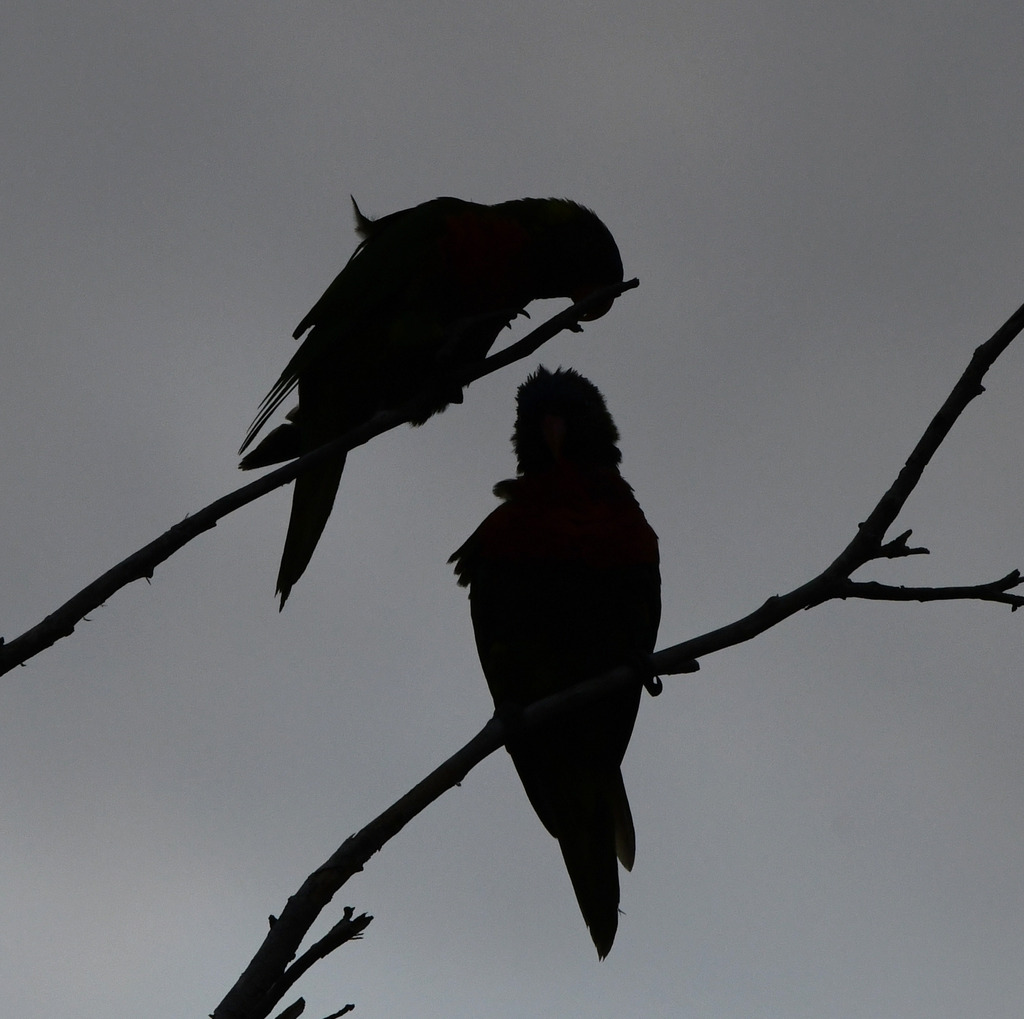
Coconut Lorikeet
Photo © Ben Keen
Photo © Ben Keen — CC0 1.0 — Source: iNaturalist #323768366Identification
The coconut lorikeet is a compact parrot measuring 25–30 cm in length, weighing around 109–137 g. It displays striking plumage that makes it unmistakable in its range. The head is clear blue, fading to brown at the neck, with a more or less extensive yellow collar. The upperparts are predominantly green, while the breast is red—in some subspecies marked with blue-black barring—and the belly ranges from yellowish-green to lighter or darker bluish tones depending on the population. The tail is green above with green and yellow barring below, and the bill is orange-red.
Sexing is challenging in the field, as males and females are virtually identical except for subtle iris coloration: males have bright red irises while females have orange-red irises, though this difference is unreliable and health-dependent. Young birds are noticeably duller and smaller, lacking the bright coloration of adults in the neck, breast, and belly regions.
Range & Habitat
The coconut lorikeet is found across Melanesia and nearby regions, distributed from Maluku province in easternmost Indonesia across the lowlands of New Guinea, the Bismarck Archipelago, the Solomon Islands and Vanuatu to New Caledonia. Depending on how species boundaries within the "rainbow lorikeet" complex are defined, the species may barely reach Australian territory in the Torres Strait. Eight subspecies are tentatively recognized, with geographic variation across this wide range.
Behaviour & Diet
Like other lorikeets, the coconut lorikeet is an active and social parrot, though detailed behavioral and dietary information specific to this species is limited. As a member of the brush-tongued lorikeet group, it is adapted for feeding on nectar and pollen from flowering trees, supplemented by fruits and seeds. Its small size and agility allow it to exploit food sources inaccessible to larger parrots, particularly in lowland forests where flowering occurs seasonally.
Best Time & Places to See It
The coconut lorikeet is best observed in lowland forest habitats throughout its range in Melanesia. Travelers visiting New Guinea, the Solomon Islands, Vanuatu, or New Caledonia have good opportunities to encounter this species. The best viewing periods coincide with fruiting and flowering cycles in local vegetation, though the species may be seen year-round. Early morning hours are typically most productive, when lorikeets are most active and vocal.
Photography Tips
The coconut lorikeet's vibrant blue head, red breast, and contrasting green upperparts make it highly photogenic. To capture its colors effectively, photograph birds in bright morning light when plumage details are most vivid. The species' small size and active behavior demand a fast shutter speed and telephoto lens. Patient observation of flowering and fruiting trees will reward photographers with natural feeding behavior shots. Pay attention to individual variation between subspecies across different geographic regions for documentary photography.
Annan River (Yuku Baja-Muliku) National Park
Ben Boyd National Park
Blue Mountains National Park
Bouddi National Park
Bribie Island National Park
Carnarvon National Park
Cleland National Park
Coffin Bay National Park
Daintree National Park
Nothing matches these filters.
No community photos yet. Log in to add the first one.
No community observations of this species yet.