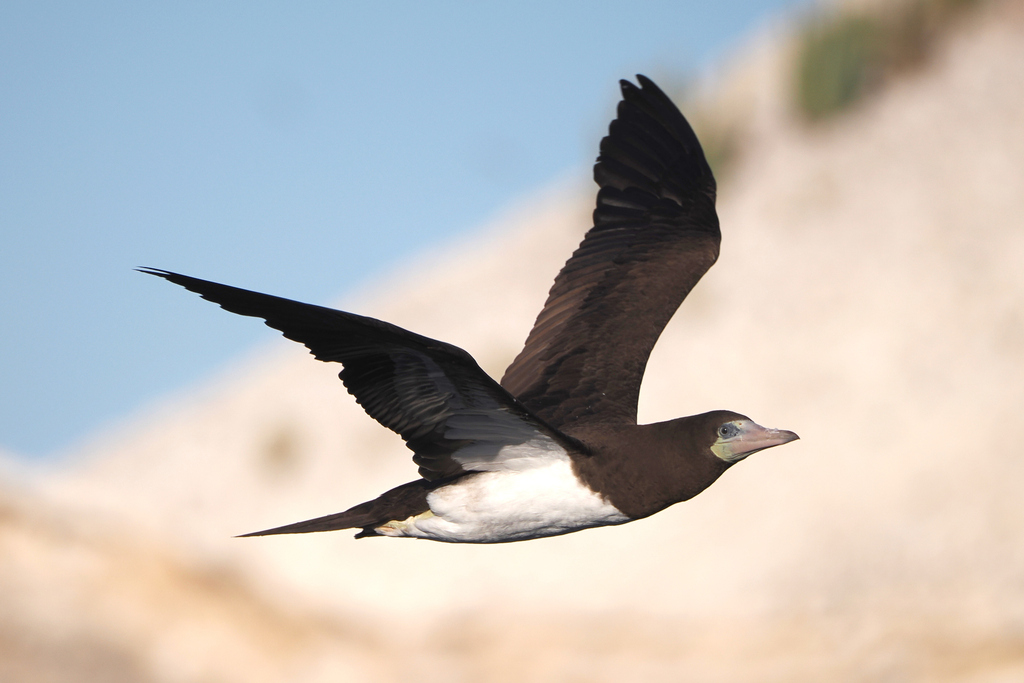
Cocos Booby
Photo © steve b
Photo © steve b — CC0 1.0 — Source: iNaturalist photo #268670320Identification
The Cocos booby is a seabird most easily distinguished from its close relative, the brown booby, by the striking white markings on the male's face and head. The extent of white varies by subspecies: males of the nominate subspecies have a white face with pale brown neck, while the nesiotes subspecies males display a fully white head and neck. Females of all subspecies possess a distinctive white forehead. Another reliable field mark is the bill colour—males have a grey bill rather than the yellow bill of male brown boobies, while females display a noticeably pinker bill than their brown booby counterparts. Like other boobies, this is a large, stocky seabird built for plunge-diving.
Range & Habitat
The Cocos booby is found throughout the East Pacific Ocean, with breeding populations established across Central America and Mexico, including Costa Rica, Nicaragua, Colombia, and Guatemala. The species nests on islands, with major colonies on Clipperton Island, San Pedro Mártir Island, Isla Espíritu Santo, Isla Isabel, Socorro Island, and Cocos Island—the namesake location off Costa Rica. In recent decades, the species has expanded its range considerably, now breeding in Hawaii, the Channel Islands of California (first recorded in 2017), and regularly occurring as far north as Vancouver on the Pacific coast. Additional breeding has recently occurred on Palmyra Atoll, Wake Island, and Midway Atoll, indicating ongoing range expansion into the central Pacific.
Behaviour & Diet
Like other boobies, the Cocos booby is a colonial breeder that nests exclusively on islands. The species shows strong reproductive isolation from the closely related brown booby despite overlapping ranges. Observations on Wake Island documented that male and female Cocos boobies consistently paired together even within large brown booby colonies. Female Cocos boobies surrounded only by brown boobies typically do not form pairs, while hybridization has only been recorded in instances where male Cocos boobies were present without female counterparts. Just two hybrid breeding events are known: one at Midway Atoll in 2020 and another at Nakanokamishima Island between 2012 and 2014, where a chick was successfully fledged.
Best Time & Places to See It
Cocos Island off Costa Rica offers the most reliable encounters, as the species breeds there year-round in established colonies. The Gulf of California islands, particularly San Pedro Mártir Island and Isla Espíritu Santo, host substantial populations. For North American observers, the Channel Islands of California provide increasingly accessible viewing opportunities since breeding began there in 2017. Palmyra Atoll and other central Pacific locations now support growing populations. As a colonial breeder, the species aggregates predictably on specific islands, making these breeding sites the best locations for observation and photography.
Photography Tips
The distinctive white facial markings of male Cocos boobies make them highly photogenic subjects. When photographing at breeding colonies, capture the contrast between the white face and darker plumage, along with the characteristic grey bill. Include nesting behavior and interactions between males and females, which show strong pair-bonding. Females with their white foreheads also make compelling subjects. The species' recent establishment in new locations like the Channel Islands means photographers can document range expansion and colonization behavior. Early morning light on island breeding sites will best reveal the subtle differences in plumage coloration that distinguish this species from the brown booby.
Corcovado National Park
Puerto Jiménez, Costa Rica
+444 birds+48 mammals
Where the Osa Peninsula juts into the Pacific, rainforest descends almost to the tide line, and Corcovado National Park protects one of Central America's most intact…
VIEW NATIONAL PARKManuel Antonio National Park
Quepos, Costa Rica
+426 birds+22 mammals
Where tropical rainforest descends steeply to a rocky Pacific coastline, Manuel Antonio National Park distills Central American biodiversity into one of Costa Rica's most compressed and…
VIEW NATIONAL PARKSanta Rosa National Park
Santa Elena, Costa Rica
+359 birds+30 mammals
Where Pacific-facing slopes descend from volcanic uplands toward the Guanacaste lowlands, Santa Rosa National Park unfolds across a mosaic of tropical dry forest, gallery woodland, and…
VIEW NATIONAL PARKNatural Utría National Park
Alto Baudó (Pie de Pató), Colombia
+372 birds+11 mammals
Where the Chocó's coastal mountains plunge toward the Pacific, Utría National Park preserves one of Colombia's most biodiverse and least-visited wilderness expanses. Sprawling across 1,287 square…
VIEW NATIONAL PARKCoiba National Park
Montijo, Panama
+260 birds+10 mammals
An archipelago of volcanic and sedimentary islands rises from the Pacific waters off Panama's southwestern coast, its densest rainforest canopy unbroken for millennia. Coiba National Park…
VIEW NATIONAL PARKEl Vizcaíno
Laguna San Ignacio, Mexico
+317 birds+29 mammals
Where the Baja California peninsula thins into a tapestry of salt lagoons and coastal desert, one of Mexico's most biodiverse reserves sprawls across half a million…
VIEW BIOSPHERE RESERVEParque Nacional Isla Isabel
Santiago Ixcuintla, Mexico
+107 birds+2 mammals
A volcanic island sanctuary rises from the Pacific waters off Nayarit's coast, where three dormant cones define a landscape of sharp ridges, coastal cliffs, and sheltered…
VIEW NATIONAL PARKChannel Islands National Park
Santa Barbara County, United States
+330 birds+15 mammals
A chain of eight volcanic islands rises from the cold Pacific waters off the California coast, their rugged sea cliffs and windswept terrain shaped by millions…
VIEW NATIONAL PARKNo community photos yet. Log in to add the first one.
No community observations of this species yet.