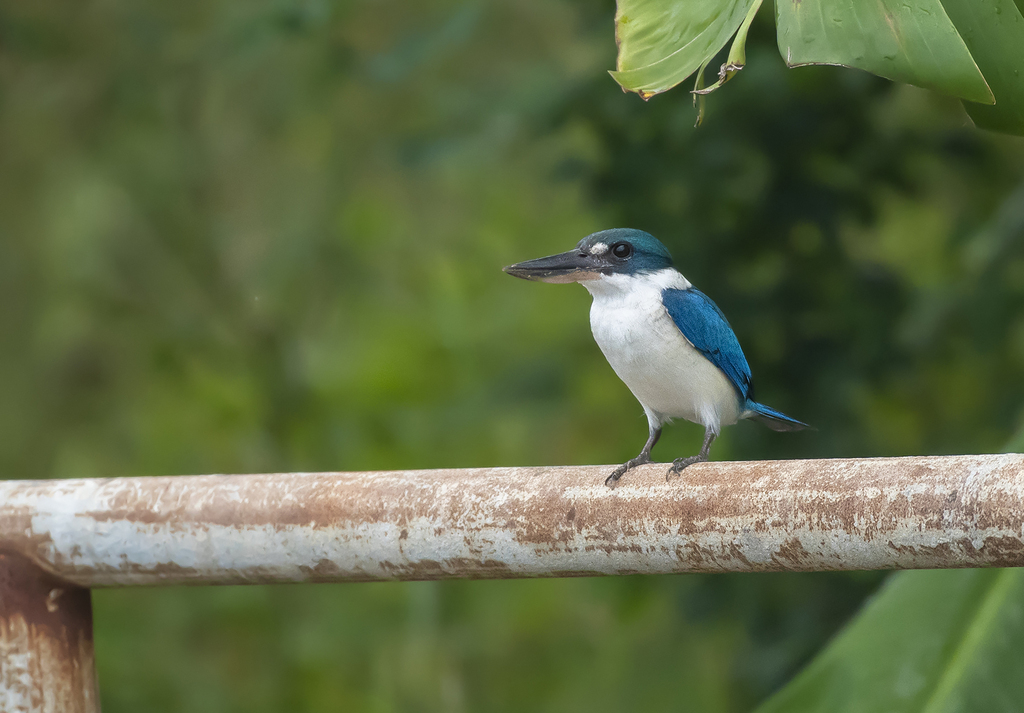
Collared Kingfisher
Photo © Griha Hasanov
Photo © Griha Hasanov — CC BY 4.0 — Source: iNaturalist photo #444790854Identification
The Collared Kingfisher is a medium-sized kingfisher measuring 23 to 25 cm in length. Its most distinctive feature is the white collar around the neck that gives the species its name. The plumage varies from blue to green above, while underparts range from white to buff depending on the subspecies. Some races display a white or buff stripe over the eye or a white spot between the eye and bill, and many have a black stripe through the eye. Females tend to be greener than males. The large black bill has a pale yellow base on the lower mandible. Immature birds are duller than adults, with dark scaly markings on the neck and breast. The bird has a variety of geographically variable calls, with the most typical being a loud, harsh, and metallic "kee-kee-kee" repeated several times.
Range & Habitat
The Collared Kingfisher has an extensive range stretching from the Red Sea across southern Asia to Melanesia, with numerous subspecies distributed across this vast territory. The species is most commonly found in coastal areas, particularly in mangrove swamps, but also inhabits farmland, open woodland, grassland, and gardens. In some parts of its range, especially on islands, it ventures further inland into forests and mountain areas. The bird often perches conspicuously on wires, rocks, or bare branches, making it relatively easy to spot despite its wide distribution.
Behaviour & Diet
The Collared Kingfisher is a patient hunter, perching almost motionless for long periods while scanning for prey. When it spots something, it glides down swiftly to catch it and returns to its perch. Small crabs and shrimps are the favored food in coastal regions, but the species has a remarkably varied diet that includes insects such as beetles, cicadas, stick-insects, grasshoppers, moths, and butterflies, as well as spiders, earthworms, snails, frogs, lizards, small snakes, small fish, and occasionally small birds and mice. Larger prey items are pounded against the branch to subdue them before consumption, and any indigestible remains are regurgitated as pellets.
Best Time & Places to See It
The Collared Kingfisher is widespread and common throughout Southeast Asia, Indonesia, and the Philippines, where it occurs far inland in some regions. It can also be found around the coasts of India, Bangladesh, and the Andaman and Nicobar Islands. In the Arabian Peninsula, the endangered subspecies T. c. kalbaensis is almost entirely restricted to Khor Kalba in the United Arab Emirates, with a population of 55 pairs or fewer. The bird's habit of perching conspicuously makes it a reliable subject for observation, particularly in coastal mangrove areas and along waterways where it hunts from exposed perches.
Photography Tips
The Collared Kingfisher's habit of perching openly on wires, rocks, and bare branches makes it an excellent subject for photographers. Look for birds hunting in mangrove swamps and coastal habitats where they are most common. The distinctive white collar and contrasting blue-green upperparts photograph well in natural light. Since the bird spends long periods motionless while hunting, patient photographers can position themselves near favored perches and wait for the moment when the kingfisher dives after prey, capturing the dynamic hunting behavior that characterizes these skilled predators.
Aketajawe Lolobata National Park
Bako National Park
Berbak National Park
Bogani Nani Wartabone National Park
Bribie Island National Park
Daintree National Park
Endeavour River National Park
Gunung Ciremai National Park
Gunung Merbabu National Park
Nothing matches these filters.
No community photos yet. Log in to add the first one.
No community observations of this species yet.