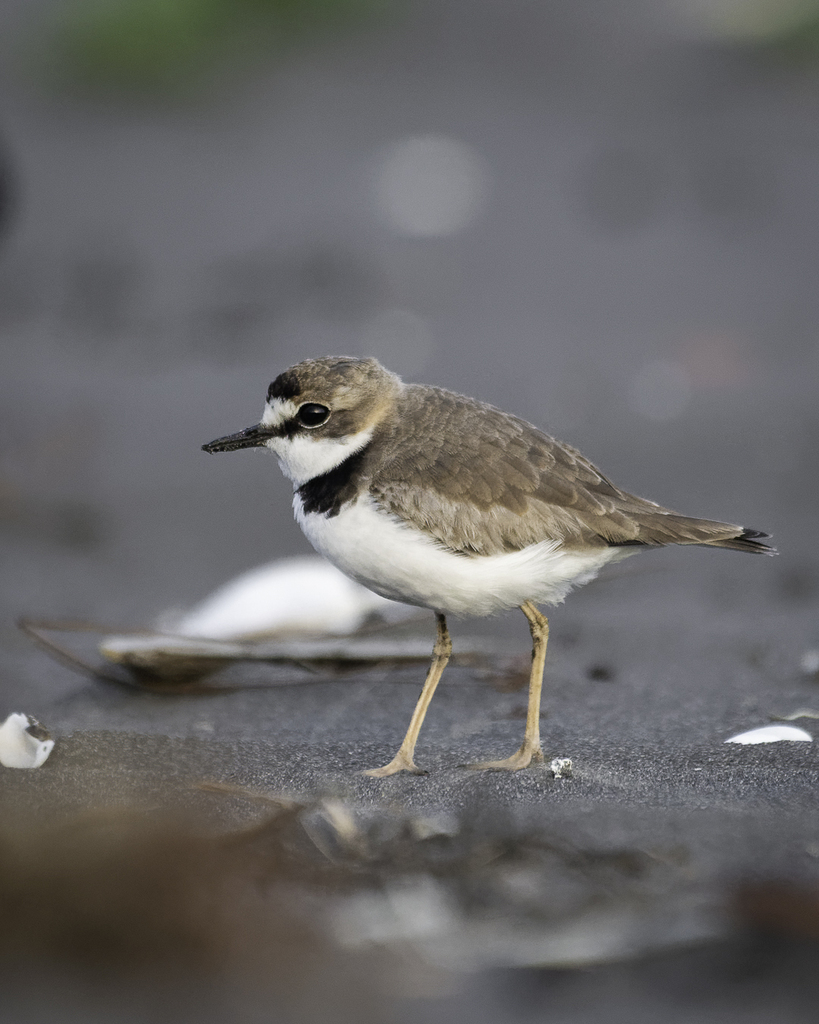
Collared Plover
Photo © felipejarafer
Photo © felipejarafer — CC BY 4.0 — Source: iNaturalist photo #619433740Identification
The collared plover is a diminutive shorebird measuring just 18 centimetres in length and weighing a mere 35 grams. Its most distinctive feature is the bold black breast band that gives the species its English name—ironically, it is actually the absence of a pale collar (present in related species) that inspired both the common and scientific names. Adults display brown upperparts contrasting with white underparts. Males are particularly striking, with a white forehead bordered above by a black frontal bar and below by a black stripe running from the bill to the eye; the mid-crown and nape are warm chestnut, and the legs are bright yellow. Females are usually very similar to males, though some individuals show a brownish tinge to the black markings. Immature birds are notably different, lacking any black on the head and showing brown patches on the chest rather than a complete black band. In flight, the species reveals dark flight feathers with a distinctive white wing bar and white-sided tail. The sharp, metallic pip call is characteristic and helpful for identification.
The collared plover can be confused with two sympatric plovers across its range. The snowy plover is similar in size and structure but appears paler above, has dark legs rather than yellow, and never displays a complete breast band. Semipalmated plovers are larger with thicker bills and possess a pale collar that collared plovers lack.
Range & Habitat
This species is found throughout the tropical and temperate Americas, ranging from central Mexico south through Central America and most of South America to Chile and Argentina. It also occurs on some southern Caribbean islands, including Trinidad and Tobago. The collared plover appears to be mainly sedentary, though limited seasonal movements have been documented.
Collared plovers favour sandy coasts, estuarine mudflats, inland riverbanks, and open sandy savannas. They are adaptable birds that occupy both coastal and inland habitats, making them relatively widespread throughout their range.
Behaviour & Diet
Collared plovers feed primarily on insects and other invertebrates, using the characteristic run-and-pause technique common to many plovers rather than the steady probing methods employed by some other waders. This species is not particularly gregarious and seldom forms flocks, typically occurring singly or in pairs. They are notably wary birds, often taking flight when approached.
Breeding timing varies considerably across their range, occurring from November to December in western Mexico, March to June in Costa Rica, January in Venezuela, and March in Ecuador's lowlands. Males perform a distinctive courtship display involving fluffed breast feathers and pursuit of females; the species lacks any known aerial displays. Nests are simple bare ground scrapes positioned well above tide or flood lines on coasts and islands, or inland near low cover such as grass tufts. Clutches consist of two pale buff eggs spotted with brown. Like many ground-nesting species, collared plovers perform the characteristic broken-wing display to distract potential predators from their vulnerable nests and chicks.
Best Time & Places to See It
Collared plovers can be found year-round throughout most of their range, though breeding activity timing varies by location. Sandy coastal areas, riverbanks, and open savannas are the most productive habitats. Early morning hours often provide the best viewing opportunities, as plovers are most active during cooler parts of the day.
Photography Tips
The collared plover's small size and wariness present challenges for photographers. Use a telephoto lens (at least 400mm) to maintain distance and avoid flushing birds. Early morning light enhances the rich chestnut tones of the crown and nape. Photograph birds in the run-and-pause feeding posture for behavioural interest, and watch for the distinctive courtship display during breeding season. The contrast between the white underparts and black breast band photographs particularly well in soft, directional light.
Santa Rosa National Park
Santa Elena, Costa Rica
+359 birds+30 mammals
Where Pacific-facing slopes descend from volcanic uplands toward the Guanacaste lowlands, Santa Rosa National Park unfolds across a mosaic of tropical dry forest, gallery woodland, and…
VIEW NATIONAL PARKYasuní National Park
Aguarico, Ecuador
+601 birds+43 mammals
Where the western Amazon basin converges with Ecuador's Orellana Province, lowland rainforest reaches toward the horizon in an unbroken canopy of staggering botanical density. Yasuní National…
VIEW NATIONAL PARKPeixe National Park Lagoon
Brazil
+293 birds+4 mammals
Where the coastal plains of Rio Grande do Sul meet the Atlantic, Peixe National Park Lagoon sprawls across nearly 2,200 square kilometres of shallow waters, reed…
VIEW NATIONAL PARKNo community photos yet. Log in to add the first one.
No community observations of this species yet.