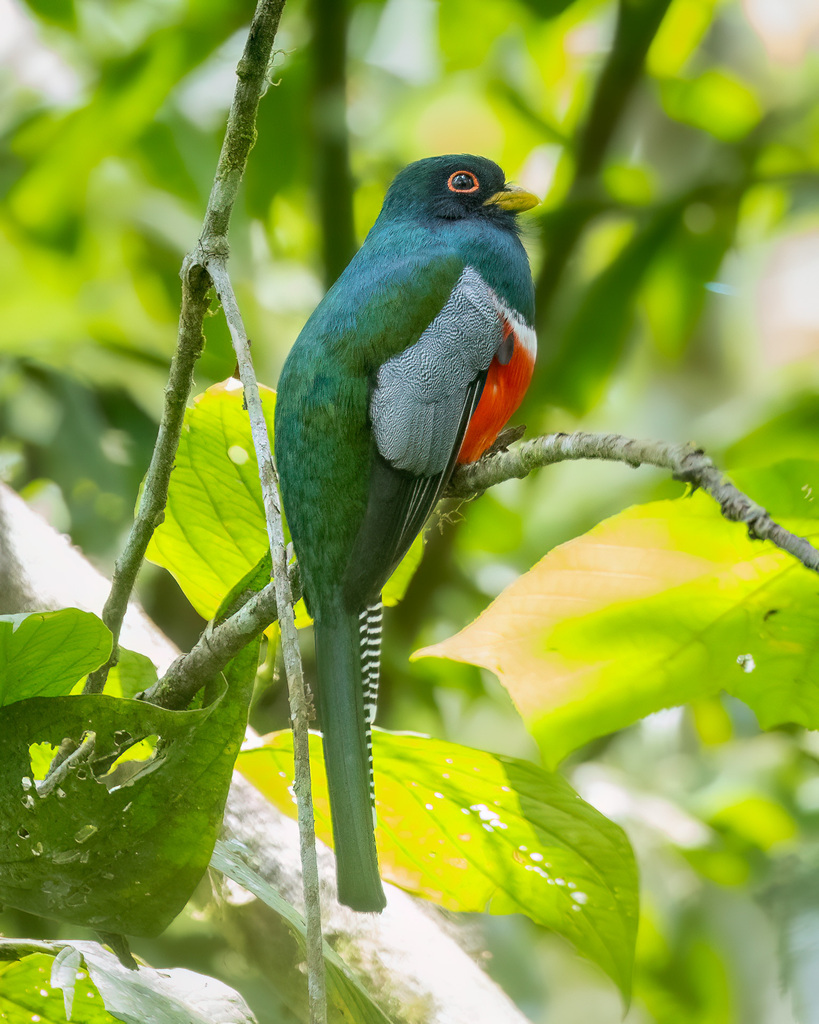
Collared Trogon
Photo © Derek Spencer
Photo © Derek Spencer — CC BY 4.0 — Source: iNaturalist photo #469412916Identification
The Collared Trogon is a compact bird, measuring 25–29 cm in length and weighing 41–64 grams. Both sexes share a distinctive black face and throat, but their plumages diverge dramatically. Males display a striking combination of bright metallic green crown, nape, back, and rump, with a white band across the breast separating the green upper breast from a brilliant red belly and vent. The folded wings show fine black and white vermiculation, while the tail is green with a black tip above and barred black and white below. Females are more subdued, with olive-brown replacing the male's green, duller red underparts, and gray tail feathers marked with black bars and white tips. The family Trogonidae is renowned for soft, colorful plumage, and the Collared Trogon exemplifies this characteristic beauty.
Range & Habitat
This species occurs across Mexico, Central America, and northern South America, with ten recognized subspecies distributed from central Mexico through the Caribbean and Andean regions to Bolivia and Brazil. In Mexico and Central America, it inhabits humid montane, semideciduous, and pine-evergreen forests, as well as humid lowland evergreen forest, reaching elevations up to 2,400 m in Mexico and 2,300 m in Costa Rica. South American populations favor humid lowland evergreen forest, both primary and well-established secondary growth, typically below 1,300 m in Ecuador and 1,200 m in Peru, though Andean populations occasionally venture higher.
Behaviour & Diet
The Collared Trogon typically perches in the higher understory and lower canopy strata, usually observed singly or in pairs, though small flocks may gather outside breeding season. It feeds primarily on small fruits and berries, supplemented by invertebrates including caterpillars, crickets, cicadas, beetles, and phasmids. While these birds often associate with mixed-species foraging flocks at forest edges, they remain somewhat aloof, not actively mixing with other flock members. Nesting occurs in cavities within decaying wood or arboreal termite nests—often so shallow that much of the bird remains visible. Both parents incubate the typical clutch of two eggs and care for the young. Breeding timing varies dramatically across the species' range, beginning as early as November in French Guiana and as late as April in Venezuela.
Best Time & Places to See It
The Collared Trogon's wide distribution and Least Concern status make it a relatively reliable find throughout its range, particularly in humid forest habitats from lowlands to mid-elevations. The highly variable breeding season across different regions means that nesting birds and associated vocalizations can be encountered year-round somewhere within the species' range, though local timing varies considerably. Look for them perching quietly in the mid-story of humid forests, where patience and attention to subtle movements often reward the observer.
Photography Tips
The male Collared Trogon's brilliant metallic green and red plumage presents excellent photographic opportunities, though the bird's preference for mid-canopy perches can challenge composition. The sharp contrast between the white breast band and red belly, combined with the iridescent green crown, creates striking images in natural light. Early morning hours often provide better lighting for capturing the metallic sheen of the male's upperparts. The bird's relatively sedentary perching behavior allows for patient positioning, but approach slowly to avoid flushing. Females, though less vibrant, offer softer, more subtle compositions. Capture the distinctive tail pattern—visible from below—and the characteristic black face and throat shared by both sexes.
Amacayacu National Park
Amazônia National Park
Anavilhanas National Park
Arenal Volcano National Park
Bahuaja Sonene National Park
Barbilla National Park
Baru Volcano National Park
Braulio Carrillo National Park
Campos Amazónicos National Park
Nothing matches these filters.
No community photos yet. Log in to add the first one.
No community observations of this species yet.